

The biblical meaning of the name Daniel is “God is my Judge” — a declaration of faith that has echoed through scripture, history, and the hearts of believers for thousands of years.
There is something deeply personal about searching for the meaning behind a name. Whether you are a parent standing at the threshold of naming a child, a believer curious about your own identity in God, or someone who just encountered the name Daniel in scripture and felt something stir — that search is never just academic. Names in the Bible carry weight. They carry calling. And the name Daniel carries both with extraordinary grace.
The biblical meaning of the name Daniel invites us into a story far larger than one man in a lion’s den. It speaks to a covenant relationship between a soul and its Creator — a relationship where God holds the final verdict and that verdict is always rooted in divine justice and mercy. In this article, you will discover where this name comes from, what it meant to those who bore it in scripture, and why its spiritual significance still speaks directly to lives being lived today.
Lord, meet and bless every reader here and grant them success in every area of their life.
Key Takeaways
- The name Daniel originates from Hebrew and carries the powerful meaning “God is my Judge” or “God is my vindicator”
- Daniel appears in the Old Testament as a prophet of extraordinary faithfulness, wisdom, and prophetic vision
- The spiritual significance of the name Daniel reflects themes of divine justice, steadfast faith, and God’s sovereignty
- Multiple men named Daniel appear in scripture, deepening the biblical and historical richness of this name
Origin and Hebrew Roots of the Name Daniel
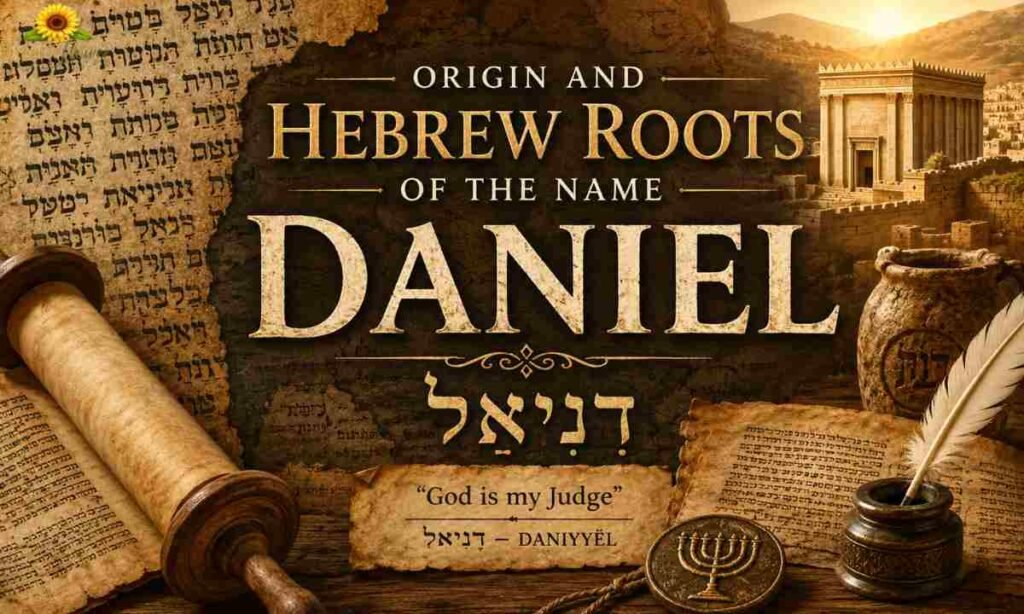
The name Daniel comes from two ancient Hebrew words: Dan, meaning “to judge,” and El, meaning “God.” Together they form Daniyyel — a name that is essentially a complete theological statement. It does not merely describe a person. It declares a posture of the soul. To be named Daniel in ancient Hebrew culture was to wear on your very identity the confession that God alone holds authority over your life and destiny.
This kind of naming was not incidental in biblical times. Hebrew parents named children prophetically and intentionally. A name was a seed planted into a child’s character. The name Daniel, therefore, was not just an identity label — it was a lifelong reminder that no earthly court, no human power, and no unjust ruler held ultimate jurisdiction over the one who bore it. Only God did.
Who Was Daniel in the Bible?
The most prominent Daniel in scripture is the prophet whose life and visions fill the entire Book of Daniel in the Old Testament. Taken as a young man into Babylonian captivity under King Nebuchadnezzar, Daniel was a member of the Jewish nobility — gifted in wisdom, learning, and the discernment of dreams. Yet what set him apart was not his intelligence alone but his unwavering refusal to compromise his faith even in the most hostile of earthly environments.
Daniel served under multiple pagan kings — Nebuchadnezzar, Belshazzar, Darius the Mede, and Cyrus the Persian — and remained faithful through each reign. He interpreted dreams that confounded the wisest scholars of Babylon. He prayed three times a day with his windows open toward Jerusalem even when it meant being thrown into a den of lions. And he walked out of that den unharmed. His life is the lived definition of his name: God was, at every turn, his Judge — and that Judge vindicated him completely.
The Spiritual Meaning of the Name Daniel
When we ask about the spiritual meaning of the name Daniel, we are asking what it means to live under divine judgment rather than human judgment. This is a profoundly countercultural idea in every age. Daniel’s name was a daily act of theological courage. It said: I am not subject to the verdict of Babylon. I answer to someone higher.
Spiritually, the name Daniel speaks to three enduring realities. First, divine justice — the belief that God sees what no human court can see and will act with perfect righteousness. Second, faithful endurance — the capacity to remain spiritually grounded when the entire world around you bends to pressure. Third, prophetic clarity — Daniel was a man who received some of the most sweeping apocalyptic visions in all of scripture, including prophecies that directly foreshadow the New Testament Book of Revelation. His name was both his anchor and his calling.
Daniel in the Old Testament — A Life That Preached Louder Than Words
The Book of Daniel is one of the most cited books in all of prophetic literature. It spans the reigns of several empires and contains visions of four great kingdoms, a mysterious “Ancient of Days,” and a figure called the “Son of Man” — language that Jesus himself would later adopt when speaking of his own identity. For those studying the biblical meaning of the name Daniel, this connection is deeply significant. The prophet who bore the name “God is my Judge” was also the one entrusted with visions of the one who would come to judge all nations.
Daniel’s three companions — Shadrach, Meshach, and Abednego — shared his convictions, but it is Daniel whose name the Holy Spirit placed on the book. He was the interpreter, the intercessor, the dreamer. When King Nebuchadnezzar had a dream he could not remember but demanded his wise men describe and interpret, it was Daniel who prayed through the night and received the answer from God. Not from a textbook. Not from a technique. From God alone.
Keep Feeding Your Faith: Biblical Meaning of the Name Mary
Other Men Named Daniel in the Bible
The name Daniel does not belong to the prophet alone. Scripture records at least two other men who carried this name. The first is Daniel, the second son of King David, born to his wife Abigail the Carmelitess, mentioned in 1 Chronicles 3:1. The second is a priest named Daniel who returned from Babylonian exile with Ezra and signed the covenant of renewed faithfulness to God recorded in Nehemiah 10:6.
These additional appearances reinforce something important: the name Daniel was not uncommon in the Hebrew world, precisely because its meaning resonated so deeply with the faith of the Jewish people. Every parent who named a son Daniel was essentially saying, may this child know that God is the only judge who matters. That is a prayer as relevant today as it was three thousand years ago.
The Name Daniel in Jewish and Early Christian Tradition
In Jewish tradition, Daniel is regarded as one of the four great prophets alongside Isaiah, Jeremiah, and Ezekiel. His book is part of the Ketuvim — the Writings — in the Hebrew Bible, rather than the Nevi’im (Prophets), but his role as a prophetic voice is undisputed. The Dead Sea Scrolls, discovered in the mid-twentieth century, included fragments from the Book of Daniel, confirming its deep roots in ancient Jewish worship and study. You can explore more about Daniel’s historical context through the Jewish Virtual Library’s entry on Daniel.
In early Christianity, Daniel held enormous weight. The early church fathers — including Jerome, who translated the Bible into Latin in the fourth century — wrote extensive commentaries on Daniel’s prophetic visions. Jerome called Daniel “the greatest of all the prophets.” The name Daniel became popular among early Christians precisely because his life embodied what they were being called to live: uncompromising faith in a hostile empire, sustained by the conviction that God alone was their judge and vindicator.
The Name Daniel Across Cultures and Time
The name Daniel has traveled across centuries and continents with remarkable resilience. In Greek it appears as Daniēl. In Latin, Daniel. In Arabic, Danyal. In Swahili, Irish, Spanish, and dozens of other languages, the name retains its essential form — a testimony to how deeply the Hebrew original has embedded itself in global consciousness.
It has been carried by saints, scholars, presidents, artists, and ordinary believers in every generation. Daniel Defoe, the author of Robinson Crusoe, bore the name. Daniel Webster, one of America’s great orators. Daniel O’Connell, the Irish liberator. Yet none of their achievements, remarkable as they are, define the name the way the prophet of Babylon does. When the name Daniel is spoken in a room full of believers, it is his face that rises — standing calm in a lion’s den, trusting the verdict of the only Judge who matters.
What Does the Name Daniel Mean for You Today?
If you carry the name Daniel, or if you are considering it for a child, the biblical meaning of the name Daniel is a remarkable inheritance. It is not a passive name. It is a name that pushes back against every form of fear rooted in human opinion. It says: You are not defined by what the world rules about you. You are defined by what God says about you.
In a culture saturated with external judgment — social media metrics, performance reviews, public opinion — the name Daniel is countercultural in the most ancient and beautiful sense. It roots identity not in approval but in the character of God. And the God who is Daniel’s judge is not a harsh and distant magistrate. He is the same God who shut the mouths of lions, who gave wisdom beyond human learning, and who called a young exile in a foreign land his own beloved servant.
The Name Daniel as a Prophetic Identity
There is one more dimension of the biblical meaning of the name Daniel that deserves to be said plainly: this is a prophetic name. Daniel was not merely reactive to the world around him. He saw ahead of it. His visions in chapters 7 through 12 of his book describe empires, end-time events, and the ultimate triumph of the kingdom of God with a precision that has astonished theologians and historians for centuries.
To bear the name Daniel is to carry, in some small spiritual way, an orientation toward the eternal. It is a name that has always looked past the immediate crisis — past the lions, past the fire, past the decrees of earthly kings — and seen the throne of the Ancient of Days standing unmoved behind all of it. That is a vision worth carrying through a lifetime.
FAQs
What is the biblical meaning of the name Daniel?
The biblical meaning of the name Daniel is “God is my Judge,” derived from the Hebrew words Dan (to judge) and El (God), representing complete trust in divine authority.
What does the name Daniel symbolize spiritually?
Spiritually, the name Daniel symbolizes unwavering faith, divine justice, and the courage to live under God’s authority rather than the approval of the world.
Is Daniel considered a prophet in the Bible?
Yes, Daniel is honored as one of the major prophets in both Jewish and Christian tradition, known for his visions of end-time events and his extraordinary faithfulness in Babylonian captivity.
How many times does the name Daniel appear in the Bible?
The name Daniel appears over 75 times in the Old Testament, most prominently in the Book of Daniel, with additional references in Ezra, Nehemiah, and 1 Chronicles.
What is the significance of the name Daniel for a child today?
Naming a child Daniel carries the beautiful spiritual declaration that God alone is their judge and vindicator, grounding their identity in faith rather than in the world’s opinion.
Conclusion
The biblical meaning of the name Daniel is more than etymology — it is a confession of faith woven into language, a declaration that has outlasted empires and continued to carry meaning in every generation that has inherited it. From a young exile standing faithful in Babylon to the believer reading these words today, the name speaks the same truth: God is your Judge, and His verdict over your life is one of grace and purpose.
If this name belongs to you or to someone you love, carry it with the quiet confidence it was always meant to inspire. In a world that judges by appearance, performance, and power, the name Daniel is a reminder that the only judgment which defines you comes from the One who made you — and that is the most secure place a human soul can stand.
Father, may this truth root itself so deep in us that it flowers into a life of unceasing prayer.

John Carrol is a Christian writer and prayer minister with over a decade of experience in faith-based content, devotional writing, and spiritual encouragement. Rooted in Scripture and a lifelong love of intercessory prayer, John created PrayersFlower to help believers find the right words when their own run out. His writing draws from pastoral study, personal faith practice, and a deep conviction that prayer is the most powerful act available to the human heart. When he is not writing, John is found in quiet study of the Word, mentoring young believers, and serving his local church community.