

The biblical meaning of the name Samuel is “God has heard” or “asked of God,” a name given in scripture to one of the most pivotal prophets in Israel’s history.
There are moments in faith when a name feels like more than letters — it feels like a promise. Parents searching for the meaning of Samuel often carry something deeper than curiosity; they want to know whether the name they love carries the weight of God’s presence. Believers who bear this name wonder if their identity is somehow written into scripture. That longing to feel connected to something holy, something ancient and alive, is exactly why the biblical meaning of the name Samuel continues to draw people across generations and traditions.
This article goes far beyond a dictionary definition. It traces the Hebrew roots of Samuel, walks through the extraordinary life of the prophet himself, explores the spiritual significance this name holds in Christian, Jewish, and theological contexts, and examines why Samuel remains one of the most beloved names in biblical history. If you have ever felt drawn to this name — or if it belongs to you — what follows will ground it in something far greater than tradition.
Lord, meet and bless every reader here and grant them success in every area of their life.
Key Takeaways
- The biblical meaning of the name Samuel traces to the Hebrew roots meaning “God has heard” or “name of God,” rooted in Hannah’s prayer in 1 Samuel 1
- Samuel was a prophet, priest, and judge — one of the only figures in the Old Testament to hold all three offices simultaneously
- The spiritual significance of the name Samuel carries themes of divine response, consecration, and prophetic calling
- Samuel anointed both Saul and David as kings of Israel, making him a cornerstone name in biblical leadership and covenant history
The Hebrew Origin of the Name Samuel
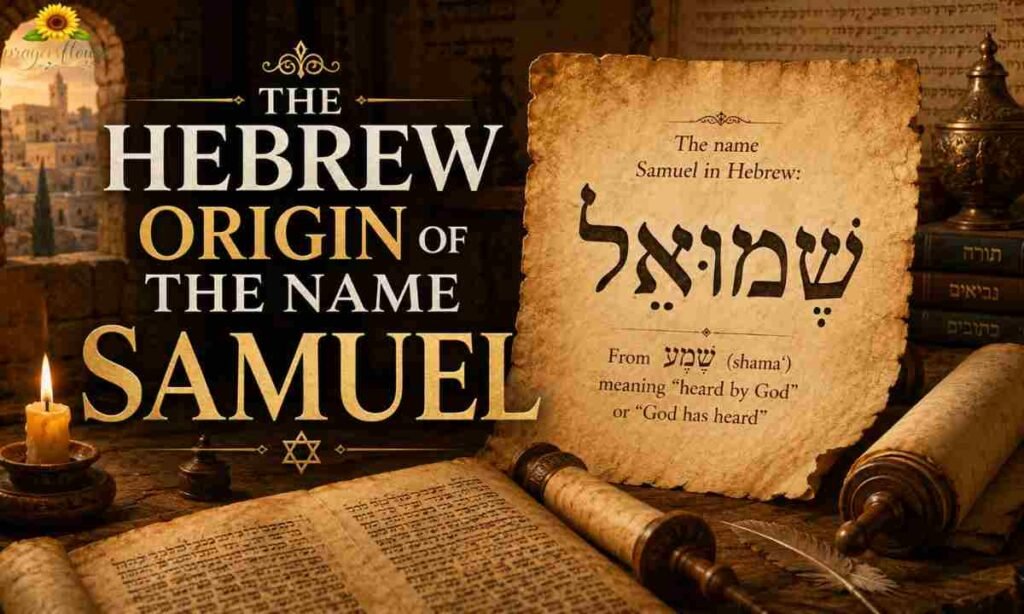
The name Samuel comes from the Hebrew שְׁמוּאֵל (Shemu’el), and its meaning has been a subject of careful study among biblical scholars for centuries. Two primary interpretations exist, and both are deeply rooted in the biblical text itself.
The first reading is “heard of God” or “God has heard,” derived from the Hebrew verb שָׁמַע (shama), meaning to hear, combined with אֵל (El), the Hebrew name for God. This interpretation aligns perfectly with the account in 1 Samuel 1, where Hannah prays desperately for a child and God hears her cry.
The second interpretation reads the name as “asked of God” or “requested from God,” drawing from the Hebrew שָׁאַל (sha’al), meaning to ask or request. This reading emphasizes Hannah’s petition, the act of bringing her deepest need before the Lord and receiving an answer.
Both meanings do not contradict — they complete each other. Samuel’s very name embodies the moment his mother prayed, God listened, and a life was given as a response. This makes the etymology of Samuel one of the most spiritually layered name origins in all of scripture.
The Story Behind the Name — Hannah’s Prayer and God’s Answer
To understand the biblical meaning of the name Samuel, you must first sit with Hannah. She was a woman who carried the ache of barrenness in a culture where fertility was seen as divine favor. Her pain was real, her prayers were desperate, and her faith was tenacious.
In 1 Samuel 1:10–11, Hannah wept and vowed to God: if He would give her a son, she would dedicate that child to the Lord all the days of his life. She prayed so earnestly that the priest Eli mistook her for a woman who had been drinking. When Eli understood the truth, he blessed her, and God remembered Hannah.
She conceived, bore a son, and named him Samuel — “because I have asked for him from the LORD” (1 Samuel 1:20). Every syllable of his name was an act of worship. Hannah was not simply naming her child; she was recording an answered prayer for all of history to witness.
This origin story makes the name Samuel not just a biblical name but a testimony — evidence that God hears, God answers, and God entrusts the asked-for to purposes far beyond what the asking heart imagines.
Samuel the Prophet — Who He Was in Scripture
Samuel occupies a unique space in biblical history. He is the transitional figure who stood at the hinge between the era of the judges and the era of Israel’s monarchy. The books of 1 Samuel and 2 Samuel carry his legacy even after his death.
He was a prophet who spoke the word of God with fearless precision, a priest who offered sacrifices and interceded for Israel, and a judge who led the nation with integrity. In biblical history, very few individuals held all three of these roles. Samuel is one of them.
Among the most defining moments of his ministry was his night call as a young boy at Shiloh. God spoke to Samuel in the night, and Samuel — unfamiliar with divine communication — ran to Eli three times before understanding that the voice belonged to God (1 Samuel 3:1–10). From that night forward, “the LORD was with Samuel and let none of his words fall to the ground” (1 Samuel 3:19).
He anointed Saul as the first king of Israel, and when Saul’s disobedience disqualified him from the throne, it was Samuel who delivered the solemn words, “to obey is better than sacrifice” (1 Samuel 15:22). He then anointed David, a young shepherd, as the man after God’s own heart — a moment that would shape the entire messianic lineage of scripture.
Keep Feeding Your Faith: Biblical Meaning of the Name Sarah
Spiritual Significance of the Name Samuel
The spiritual significance of the name Samuel extends well beyond the man himself. His name is a theological statement: that God is not distant, not silent, and not indifferent to human longing.
When Hannah named her son Samuel, she was making a declaration of faith that God hears prayer. This single truth is woven into every mention of the name in scripture. For believers today, carrying the name Samuel is carrying the message that your existence was preceded by someone’s prayer and followed by God’s answer.
In the New Testament, Samuel is mentioned explicitly in Hebrews 11:32, listed among the heroes of faith. The Apostle Paul, in Acts 13:20, references Samuel as a judge who preceded the era of kings. This places Samuel firmly within the canon of individuals whose faith shaped redemptive history.
Spiritually, the name also carries themes of consecration. Hannah did not simply ask for Samuel — she returned him to God. She brought him to Shiloh, left him in the care of Eli, and worshipped. Samuel was a child who was given back before he could fully understand the gift of being given. This is one of the most profound pictures of surrender and trust found anywhere in the biblical text.
For more on the theology of names in Scripture and their prophetic significance, the Blue Letter Bible’s Hebrew Name Study resource offers an excellent, scholarly foundation rooted in the original languages.
Samuel as a Name in Christian and Jewish Tradition
The name Samuel has been venerated across both Jewish and Christian traditions for thousands of years. In Judaism, Samuel holds a revered position as a prophet whose words carried divine authority and whose intercession was considered especially powerful. The Talmud and rabbinic literature speak of Samuel with great respect, often alongside Moses and Aaron.
In Christian tradition, Samuel is recognized as a type — a foreshadowing — of Christ in several ways. Like Jesus, he was consecrated to God from birth. Like Jesus, he was a mediator between God and the people of Israel. Like Jesus, his ministry bridged an old era and a new one. These parallels are not forced; they emerge naturally from careful reading of the text.
The name Samuel has been carried by theologians, missionaries, pastors, and reformers throughout church history. Samuel Rutherford, the Scottish theologian and covenanter, bore this name. Samuel Zwemer, the great missionary to the Muslim world, carried it into the field. The name has a track record in the history of faith that few biblical names can rival.
What Does the Name Samuel Mean for Someone Who Bears It Today?
If your name is Samuel, you carry one of the most intentional names in human history. You carry the weight of a mother’s prayer, the warmth of divine attentiveness, and the biblical legacy of a man whose words never fell to the ground.
The meaning of the name Samuel in a personal spiritual sense is this: you were heard before you were born. Someone prayed, God answered, and you arrived. Whether or not your parents were consciously invoking this story, the biblical thread is there — woven into your name and available for you to claim.
Many who bear the name Samuel speak of a particular sensitivity to the voice of God in their lives, an awareness that they are called to listen as much as to lead. This is deeply consistent with Samuel’s own story. He was, above all else, a man who heard God — and who then had the courage to say what he heard, even when the message was unwelcome.
To be named Samuel is to be named into attentiveness, into prayer, into the long tradition of those who believed God was listening and found, in the end, that He was.
The Name Samuel in Numerology and Symbolism — A Biblical Perspective
While Christian and Jewish tradition does not place authoritative weight on numerology, it is worth briefly noting that the name Samuel in Hebrew has a numerical value (gematria) that has been studied by scholars interested in the symbolic dimensions of scripture. The more theologically grounded observation, however, lies in the symbolic structure of the name itself.
The name Samuel contains the divine name El, the powerful, covenant-keeping God of Israel. This suffix appears in names like Michael (Who is like God?), Gabriel (God is my strength), and Raphael (God heals). Samuel joins this constellation of theophoric names — names that carry the name of God within them — making it not just a personal identifier but a living theological declaration.
The symbolic weight of Samuel’s name, then, is not in any mystical number but in the character of God it reflects: a God who hears, who acts, who entrusts His purposes to those who have been prayed into existence.
FAQs
What is the biblical meaning of the name Samuel?
The biblical meaning of the name Samuel is “God has heard” or “asked of God,” rooted in Hannah’s prayer in 1 Samuel 1:20, where she named her son as a testimony to God’s answer.
What is the Hebrew origin of the name Samuel?
The Hebrew name Shemu’el (שְׁמוּאֵל) derives from shama (to hear) and El (God), meaning “heard by God,” with a secondary reading from sha’al (to ask), meaning “asked of God.”
Is Samuel considered a prophet in the Bible?
Yes, Samuel is one of the most significant prophets in the Old Testament, also serving as a priest and judge — a rare combination that placed him among the most spiritually authoritative figures in Israel’s history.
Why is the name Samuel significant in Christian theology?
The name Samuel carries deep Christian significance because Samuel prefigures Christ as a consecrated mediator, prophet, and bridge between the old covenant era of the judges and the new era of the Davidic kingship.
What does the name Samuel mean spiritually for someone who bears it?
Spiritually, the name Samuel means that one’s life was preceded by divine attentiveness — a name that declares God hears prayer and entrusts answered prayers with purpose, consecration, and a call to listen.
Conclusion
The biblical meaning of the name Samuel is not merely an entry in a Hebrew lexicon — it is a story of faith preserved in letters. From Hannah’s tears at Shiloh to Samuel’s anointing of a shepherd king, every dimension of this name declares that God is a God who hears and responds.
If you carry this name, or love someone who does, let its meaning be a source of ongoing assurance. You were asked for, and God answered. That is not a small thing — that is the very heart of what it means to walk in faith.
God, let the courage found in this name give us courage to pray boldly and without hesitation.

John Carrol is a Christian writer and prayer minister with over a decade of experience in faith-based content, devotional writing, and spiritual encouragement. Rooted in Scripture and a lifelong love of intercessory prayer, John created PrayersFlower to help believers find the right words when their own run out. His writing draws from pastoral study, personal faith practice, and a deep conviction that prayer is the most powerful act available to the human heart. When he is not writing, John is found in quiet study of the Word, mentoring young believers, and serving his local church community.