

The biblical meaning of the name Michael is “Who is like God?” — a divine question that doubles as a declaration of God’s incomparable greatness.
There is something deeply personal about searching for the meaning behind a name. For parents choosing a name for their child, for believers who carry this name and want to understand its spiritual weight, or for those simply drawn to the figure of Michael in Scripture — this search often comes from a place of faith, wonder, and a desire to feel connected to something eternal. Names in the Bible are never arbitrary; they carry destiny, identity, and divine intention.
The biblical meaning of the name Michael opens a doorway into one of Scripture’s most powerful spiritual realities — the absolute sovereignty and uniqueness of God. Throughout this article, you will discover where this name appears in the Bible, what role the archangel Michael plays in heavenly warfare, and why this name continues to carry profound spiritual significance for believers today. Keep reading, because what this name reveals about God’s character is far greater than most people realize.
Lord, meet and bless every reader here and grant them success in every area of their life.
Key Takeaways
- The name Michael means “Who is like God?” in Hebrew — a rhetorical question affirming that no one and nothing can compare to God
- Michael appears in the Bible as one of the chief angels (archangels), a fierce protector of God’s people and a warrior in spiritual warfare
- The name Michael is found in both the Old and New Testaments, as well as the Book of Revelation, giving it prophetic and eschatological significance
- Carrying the name Michael is considered a spiritual honor in Jewish, Christian, and Islamic traditions — all three Abrahamic faiths revere this heavenly figure
The Hebrew Origin of the Name Michael
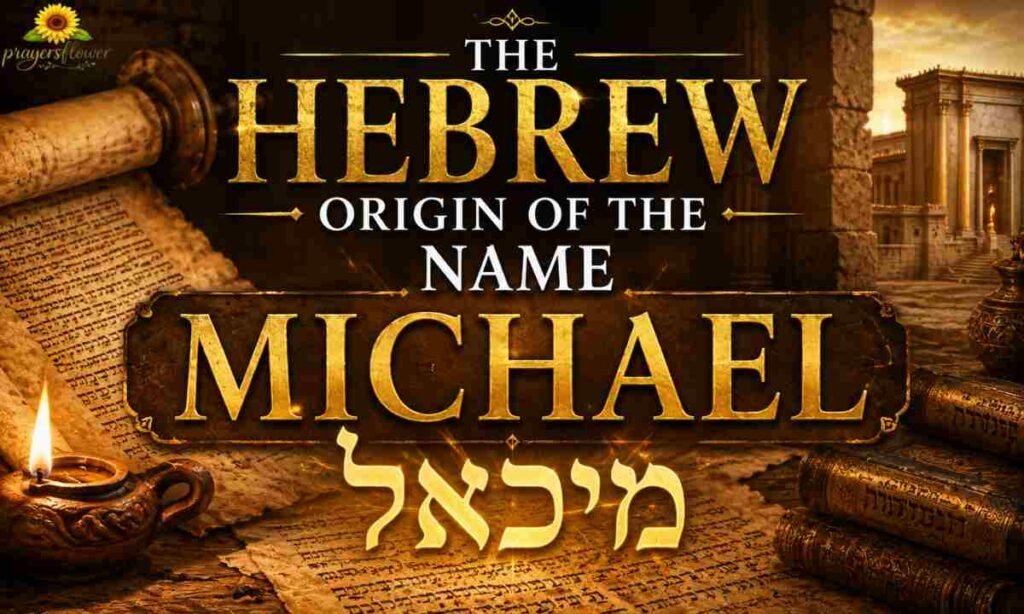
The name Michael comes from the Hebrew מִיכָאֵל (Mikha’el), which is composed of three Hebrew roots: mi (who), kha (like), and El (God). Together they form the rhetorical question: “Who is like God?” In ancient Hebrew culture, names were not just labels — they were living statements. To give a child this name was to embed into their very identity a constant reminder that God stands alone, above all comparison, above all rivals.
This kind of name was common in ancient Israel as a form of devotion. Parents who named their sons Michael were making a declaration of faith. The question the name poses — “Who is like God?” — expects no answer, because the answer is understood: no one is. It is one of the most theologically dense names in all of Scripture, carrying more doctrinal weight in three syllables than most sermons do in an hour.
Michael in the Old Testament — A Name Carried by Many
Before the archangel Michael became the most famous bearer of this name, it was carried by at least nine different men in the Hebrew Scriptures. In the Book of Numbers, a man named Michael is listed as the father of Sethur, one of the spies sent by Moses into Canaan (Numbers 13:13). In 1 Chronicles, several men named Michael appear in tribal genealogies — a son of Izrahiah, a Gadite warrior, a Manassite leader, and others.
This widespread use of the name across different tribes and generations tells us something important: “Who is like God?” was not an elite or rare sentiment. It was a common confession of faith woven into everyday Israelite life. Every time someone called out the name Michael in the marketplace or the temple courts, they were — knowingly or not — proclaiming the incomparability of God.
The Archangel Michael — Heaven’s Warrior Prince
The most significant bearer of the biblical name Michael is undoubtedly the archangel. Michael first appears as a heavenly figure in the Book of Daniel, where he is called “one of the chief princes” (Daniel 10:13) and “the great prince who stands guard over your people” (Daniel 12:1). These are not ceremonial titles. In context, Michael is engaged in intense spiritual warfare — battling demonic princes in the heavenly realms on behalf of God’s people Israel.
What makes Michael extraordinary is not raw power alone, but his absolute alignment with the will of God. He does not act on his own authority; he acts as God’s instrument. The very meaning of his name — “Who is like God?” — is his identity and his mission statement. He exists to point toward God’s supremacy, even in the act of fighting. Michael is Heaven’s chief warrior, but he is Heaven’s chief worshipper first.
Michael in the Book of Daniel — Protector of Israel
Daniel 10 gives us the most detailed angelic encounter in the Old Testament. A heavenly messenger comes to Daniel after a 21-day delay, explaining that “the prince of the Persian kingdom” had been resisting him until Michael came to help (Daniel 10:13). This passage reveals an entire dimension of invisible spiritual conflict operating alongside the visible events of human history.
Then in Daniel 12:1, Michael is described as standing up during “a time of distress such as has not happened from the beginning of nations.” This is an eschatological passage — it points toward the end times. Michael’s role is not limited to the past; he is portrayed as a guardian who will rise at a critical moment in history to defend God’s people. The biblical meaning of the name Michael takes on urgent prophetic weight here: the one whose name means “Who is like God?” will stand when it matters most.
Keep Feeding Your Faith: Biblical Meaning of the Name Sophia
Michael in the New Testament and the Book of Jude
The New Testament references Michael directly in only two places, but both are striking. In Jude 1:9, Michael the archangel is shown in a dispute with the devil over the body of Moses. What is remarkable here is not that Michael fights — it is how he fights. Rather than hurling his own condemnation at Satan, he says simply, “The Lord rebuke you.” Even in direct confrontation with evil, Michael defers to God’s authority. His power is rooted in submission, not independence.
This passage is a masterclass in spiritual warfare for believers. Michael — the most powerful angel in Scripture — does not rely on his own strength. He invokes the name and authority of the Lord. If the one whose name means “Who is like God?” still points away from himself toward God, how much more should human beings do the same?
Michael in the Book of Revelation — The Final Battle
Revelation 12:7–9 presents the most dramatic scene involving Michael in the entire Bible: “Then war broke out in heaven. Michael and his angels fought against the dragon, and the dragon and his angels fought back.” This is the great cosmic confrontation — Michael leading the heavenly army against Satan and his forces, resulting in the dragon being “hurled to the earth.”
For students of biblical prophecy and eschatology, this passage is pivotal. The archangel Michael is not a background figure; he is central to the final conflict between good and evil. The biblical meaning of the name Michael — “Who is like God?” — rings out like a battle cry in this moment. It is precisely because no one is like God that Michael and his angels win.
For a deeper understanding of Michael’s role in end-times prophecy,the Biblical Archaeology Society’s resource on angels in Scripture offers well-researched historical and theological context.
Michael as the Chief Archangel — His Rank and Role
Across both biblical and early Jewish literature, Michael holds the highest rank among the angels. In the deuterocanonical Book of Tobit and in texts like 1 Enoch, Michael is listed as one of the seven archangels who stand before God. In the Dead Sea Scrolls, particularly the War Scroll, Michael leads the forces of light against the forces of darkness in the final eschatological battle.
His titles in various traditions include: Prince of the Presence, Heavenly High Priest, Captain of the Lord’s Hosts, and Guardian of Israel. Each title reflects a different facet of his ministry, but all of them circle back to the same core identity encoded in his name: Michael exists to reflect and defend the supremacy of God.
Spiritual Significance of the Name Michael for Believers Today
For people who carry the name Michael today — or who are considering it for a child — the biblical meaning of the name Michael is an extraordinary gift. You are not just carrying a popular name. You are carrying a theological declaration: God is incomparable. No rival, no darkness, no fear can stand before Him.
In Christian tradition, Michael is the patron saint of soldiers, police officers, doctors, and the sick — those who stand in the gap between life and death, safety and danger. Many believers pray specifically to God through the intercession of Michael when they feel spiritually under attack. Whether or not one engages in that practice, the symbolism is profound: the name itself is a form of spiritual armor.
Michael in Jewish and Islamic Tradition
The reverence for Michael crosses the boundaries of Christianity. In Judaism, Michael is considered the guardian angel of Israel and appears prominently in rabbinic literature and the Talmud. He is described as the angel who pleads the case of Israel before God’s throne.
In Islam, Mika’il (the Arabic form of Michael) is one of the four named archangels and is revered as the angel of mercy and provision — traditionally associated with rain, sustenance, and blessing for humanity. This breadth of reverence across three major world faiths underscores the enduring spiritual power carried in the biblical meaning of the name Michael.
Why the Meaning of Michael Still Matters
In a cultural moment where names are often chosen for how they sound or trend, the name Michael stands apart because of what it means. “Who is like God?” is not a passive question. It is a challenge to every form of pride, idolatry, and self-sufficiency. It is a reminder that every human achievement, every earthly power, every competing claim to ultimate authority collapses before the reality of who God is.
To speak the name Michael is to speak a small theology. Parents who name their children Michael are — whether they know it fully or not — blessing them with a name that points upward. And believers who study the biblical meaning of the name Michael come away not just knowing more about an angel, but knowing more about the God that angel serves.
FAQs
What is the biblical meaning of the name Michael?
The biblical meaning of the name Michael is “Who is like God?” — a Hebrew rhetorical question declaring that God is utterly incomparable and without equal.
What is the role of the archangel Michael in the Bible?
Michael serves as Heaven’s chief warrior and protector of God’s people, engaging in spiritual warfare in Daniel, Jude, and the Book of Revelation.
Is Michael the most powerful angel in Scripture?
Michael is consistently described as the chief archangel and commander of heavenly armies, making him the highest-ranking angel named in the Bible.
What does the name Michael mean spiritually for someone who carries it?
Spiritually, the name Michael is a declaration of God’s supremacy — a constant, living reminder that no power in heaven or earth compares to God.
Where does the name Michael appear in end-times prophecy?
Michael appears in Daniel 12:1 as the great prince who rises during the final time of distress, and in Revelation 12:7–9 as the leader of God’s armies in the war against Satan.
Conclusion
The biblical meaning of the name Michael is far more than a footnote in a name dictionary — it is a declaration etched into heaven itself. From the genealogies of Israel to the final pages of Revelation, this name echoes the singular truth that God stands alone, incomparable and undefeated.
If you carry this name or love someone who does, let it be a source of deep spiritual grounding. The same God who commissioned a warrior angel to bear the question “Who is like God?” is the God who walks with you today — and the answer, now as always, is no one.
Lord, let us carry the meaning of this name into our prayer closets and lay it before Your throne.

John Carrol is a Christian writer and prayer minister with over a decade of experience in faith-based content, devotional writing, and spiritual encouragement. Rooted in Scripture and a lifelong love of intercessory prayer, John created PrayersFlower to help believers find the right words when their own run out. His writing draws from pastoral study, personal faith practice, and a deep conviction that prayer is the most powerful act available to the human heart. When he is not writing, John is found in quiet study of the Word, mentoring young believers, and serving his local church community.