

The biblical meaning of the name Sophia is rooted in the Greek word for wisdom, representing one of the most spiritually significant virtues honored throughout Scripture.
There is something quietly sacred about the moment a parent searches for the meaning behind a name. If you have found yourself here, drawn to understand what Sophia truly carries in its syllables, you are not alone. Across generations, believers have sensed that names are not accidental — they are declarations, whispered intentions, and sometimes prophetic threads woven into a life before it fully begins.
This article walks you through the complete biblical meaning of the name Sophia — from its ancient Greek origins to its presence in sacred texts, its spiritual symbolism, and why this name continues to hold deep resonance for Christian families today. Whether you are naming a daughter, studying the nature of divine wisdom, or simply curious, what you discover here will be worth the read.
Lord, meet and bless every reader here and grant them success in every area of their life.
Key Takeaways
- The name Sophia derives from the Greek word sophia, meaning wisdom, and is directly connected to how the Bible describes God’s divine wisdom throughout both Testaments.
- Though Sophia does not appear as a personal name in the canonical Bible, the concept it represents is central to Proverbs, the Gospels, and Pauline theology.
- In early Christian tradition, Sophia was venerated as a holy martyr, giving the name deep roots in church history.
- Understanding the spiritual meaning of Sophia can deepen how you relate to biblical wisdom literature and the character of God Himself.
What Does the Name Sophia Mean in the Bible?

The name Sophia comes directly from the ancient Greek word sophia (σοφία), which translates simply and powerfully as wisdom. In the world of the New Testament, Greek was the common tongue, and sophia was not a casual word. It carried the weight of divine understanding — the kind that does not merely know facts but perceives the deep order beneath all things. When the biblical writers reached for the highest expression of God’s intelligence and creative power, sophia was the word they chose.
In the Septuagint, the Greek translation of the Hebrew Old Testament, sophia is used to render the Hebrew word chokmah, which also means wisdom. This connection is theologically significant. It means that every time you encounter wisdom personified in the Book of Proverbs — speaking, building her house, calling out in the streets — you are in the presence of the concept that Sophia embodies. The name is not merely decorative. It is doctrinal.
The Name Sophia in Scripture — Is It in the Bible?
This is one of the most searched questions surrounding this name, and it deserves a direct, honest answer. The name Sophia, as a personal name for a woman, does not appear in the canonical Protestant Bible. However, this does not diminish its biblical significance — not even slightly.
The word sophia appears over 50 times in the Greek New Testament alone. Paul writes in 1 Corinthians 1:24 that Christ is “the power of God and the wisdom [sophia] of God.” In Colossians 2:3, all the treasures of wisdom and knowledge are said to be hidden in Christ. The Gospel of Luke references divine wisdom in ways that scholars have long associated with the personified Sophia of Hebrew tradition. The name may not belong to a biblical character, but the reality it names runs like a river through the entire sacred text.
Sophia in the Old Testament — Wisdom Personified
The most vivid biblical portrait of Sophia lives in the Book of Proverbs, particularly in chapters 8 and 9. Here, wisdom is not an abstract quality — she is a person. She stands at the city gates, she calls out to the simple, she declares that she was with God before creation began.
Proverbs 8:22–23 records wisdom speaking: “The Lord brought me forth as the first of his works, before his deeds of old; I was formed long ages ago, at the very beginning, when the world came to be.” This is breathtaking language. Wisdom — Sophia — is portrayed as present at the foundation of the cosmos, working alongside the Creator as His intimate companion. For a name to carry this weight is not a small thing. Parents who name their daughters Sophia are, knowingly or not, invoking one of Scripture’s most majestic images of divine character.
The Book of Proverbs ultimately teaches that true sophia begins with the fear of the Lord (Proverbs 9:10). It is not intellectual superiority. It is moral clarity rooted in reverence for God — a wisdom that shapes how one walks, speaks, loves, and leads.
Sophia in the New Testament — Christ as Divine Wisdom
The New Testament takes the personified wisdom of the Old Testament and brings it to its fullest revelation in the person of Jesus Christ. This is one of the most stunning theological threads in all of Scripture, and it connects directly to the meaning of the name Sophia.
In Matthew 11:19, Jesus refers to wisdom being “proved right by her deeds” — a phrase scholars widely interpret as Jesus identifying Himself with the Sophia figure of Proverbs. The Apostle Paul makes this connection explicit in 1 Corinthians 1:30: “It is because of him that you are in Christ Jesus, who has become for us wisdom from God — that is, our righteousness, holiness and redemption.” The Greek word Paul uses here is sophia. Christ is Sophia made flesh. This is why the name carries such extraordinary spiritual depth for Christian believers — it points, ultimately, to Jesus.
For a deeper exploration of how biblical wisdom literature connects to New Testament Christology, the Bible Gateway commentary on Proverbs 8 offers an accessible and theologically grounded starting point.
Saint Sophia — The Name in Early Christian History
Beyond Scripture, the name Sophia is deeply embedded in early church history. Saint Sophia was a Christian martyr, venerated in both Eastern and Western traditions, who is said to have suffered alongside her three daughters — Faith, Hope, and Love — during the reign of Emperor Hadrian in the second century.
The story carries obvious symbolic power: a mother named Wisdom raising daughters named after the cardinal Christian virtues. Whether the account is historical or hagiographic in nature, its spiritual message is unmistakable. Sophia — wisdom — is the mother of faith, hope, and love. This imagery aligns beautifully with Paul’s words in 1 Corinthians 13, where love is presented as the greatest virtue, born of a life rightly ordered in God. The Hagia Sophia, the breathtaking basilica built in Constantinople in the sixth century, was dedicated to the Holy Wisdom of God — and stands to this day as one of the most awe-inspiring structures in the world.
Keep Feeding Your Faith: Biblical Meaning of the Name Elijah
The Spiritual Significance of Naming a Daughter Sophia
Names in the biblical tradition were never accidental. From Abram to Abraham, from Jacob to Israel, from Simon to Peter — a name change or a name given carried prophetic weight. To name a daughter Sophia is to speak something over her life from her first breath.
It is a declaration that she is called to walk in divine wisdom — not the cold wisdom of mere intellect, but the warm, relational, God-rooted wisdom that Proverbs describes as more precious than rubies (Proverbs 3:15). It is a prayer that she will be a woman who fears the Lord, who builds rather than tears down, who speaks with kindness and wisdom on her tongue (Proverbs 31:26). The spiritual meaning of the name Sophia is not a passive label. It is an inheritance.
Sophia Across Christian Traditions
The name Sophia holds honored space across multiple branches of Christianity. In Eastern Orthodox Christianity, Holy Wisdom — Hagia Sophia — is one of the most revered theological concepts, representing the divine wisdom through which God created and sustains all things. Orthodox churches have long celebrated the feast of Saint Sophia.
In Catholic tradition, the martyred Saint Sophia is commemorated, and the name has carried favor among believers for centuries. In Protestant circles, the name’s connection to biblical wisdom literature — especially Proverbs and the Pauline epistles — gives it strong theological grounding. Across all these traditions, the name Sophia signals a common longing: to raise daughters whose lives reflect the wisdom of God rather than the wisdom of the world.
Hebrew Equivalent of Sophia — Chokmah
Understanding the Hebrew root behind Sophia deepens its meaning considerably. The Hebrew word chokmah (חָכְמָה) is the Old Testament counterpart to the Greek sophia, and it appears 149 times in the Hebrew Bible. It is the word used in Proverbs, in Ecclesiastes, in Job — the great wisdom literature of Israel.
Chokmah is not theoretical knowledge. In the Hebrew conception, wisdom was always practical and moral. A skilled craftsman was called wise. A woman of noble character was called wise. The judges and kings of Israel were called to seek wisdom above all other gifts — as Solomon famously did in 1 Kings 3:9. The name Sophia, then, carries this earthy, practical, God-honoring dimension within it. It is wisdom that works with its hands, wisdom that governs justly, wisdom that loves deeply.
Is Sophia a Christian Name?
Yes — with full confidence and rich supporting history. While the name has roots in Greek philosophy (Plato and the Stoics used sophia extensively), Christianity claimed and sanctified it thoroughly. The biblical meaning of the name Sophia — divine wisdom, the character of God, the virtue by which believers are called to live — makes it one of the most theologically resonant names a Christian family can choose.
It is worth noting that being a name with philosophical pre-Christian origins does not diminish its Christian standing. Names like Stephen (Greek for crown), Philip (lover of horses), and even Mary (from the Hebrew Miriam) all have pre-biblical or cross-cultural histories. What matters is the meaning a community of faith pours into a name — and Christianity has poured centuries of reverence into Sophia.
Sophia as a Symbol of God’s Character
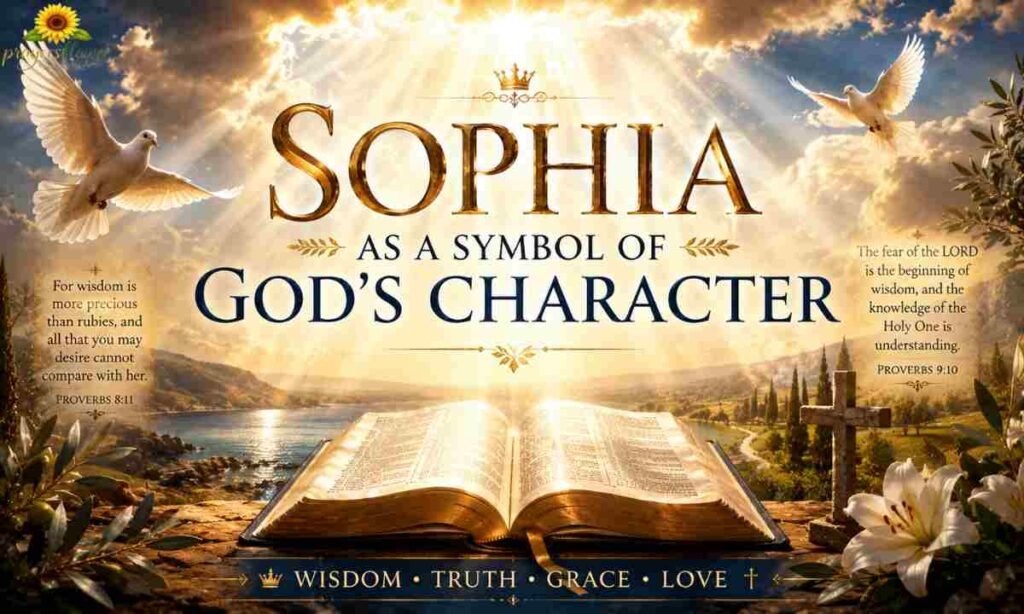
Perhaps the most profound layer of the biblical meaning of the name Sophia is what it reveals about who God is. Wisdom in Scripture is never separated from God’s character — it flows from His nature. Proverbs 3:19 declares, “By wisdom the Lord laid the earth’s foundations; by understanding he set the heavens in place.” James 1:5 promises that God gives wisdom generously and without finding fault to all who ask.
To carry the name Sophia is to carry a reminder — for the one who bears it and for all who speak it — that wisdom is not earned through human effort alone. It is received. It is a gift. It descends, as James 3:17 says, from above, and it is first of all pure, then peace-loving, considerate, submissive, full of mercy and good fruit. The name Sophia is a theology in miniature: a daily invitation to seek God’s wisdom above the world’s, and to trust that He gives it freely.
FAQs
What is the biblical meaning of the name Sophia?
The biblical meaning of the name Sophia is divine wisdom, derived from the Greek word sophia, which appears throughout the New Testament to describe God’s wisdom and the wisdom embodied in Christ.
Does the name Sophia appear in the Bible?
Sophia does not appear as a personal name in the canonical Bible, but the Greek word sophia, meaning wisdom, appears over 50 times in the New Testament and is central to both Old and New Testament theology.
What is the Hebrew equivalent of the name Sophia?
The Hebrew equivalent of Sophia is chokmah, the Old Testament word for wisdom that appears 149 times in Scripture, especially throughout the wisdom literature of Proverbs, Job, and Ecclesiastes.
Is Sophia a good Christian name?
Sophia is a deeply meaningful Christian name rooted in biblical wisdom literature, early church martyrdom, and centuries of theological tradition across Catholic, Orthodox, and Protestant Christianity.
What does Sophia mean spiritually?
Spiritually, Sophia represents divine wisdom — the God-given understanding that begins with reverence for the Lord, shapes a life of virtue and faith, and ultimately points to Christ as the fullness of God’s wisdom revealed.
Conclusion
The biblical meaning of the name Sophia is not a footnote — it is a foundation. From the creation poetry of Proverbs 8 to Paul’s declaration that Christ is the wisdom of God, this name carries one of Scripture’s most enduring and beautiful themes woven into every letter. It is a name that asks something of the one who bears it: to live wisely, to love deeply, and to seek the kind of understanding that only God can give.
If you are giving this name to a daughter, a character, or simply studying it for what it reveals about faith — know that you are touching something ancient and alive. Sophia is a name that has outlasted empires, crossed continents, and continued to carry light. May it do the same in every life it graces.
God, where this name speaks of trust, may our prayers become the evidence of that trust in action.

John Carrol is a Christian writer and prayer minister with over a decade of experience in faith-based content, devotional writing, and spiritual encouragement. Rooted in Scripture and a lifelong love of intercessory prayer, John created PrayersFlower to help believers find the right words when their own run out. His writing draws from pastoral study, personal faith practice, and a deep conviction that prayer is the most powerful act available to the human heart. When he is not writing, John is found in quiet study of the Word, mentoring young believers, and serving his local church community.