

The biblical meaning of the name Sarah is “princess” or “noblewoman,” rooted in ancient Hebrew and carrying a divine promise that reshaped the story of an entire people.
There are moments in a person’s faith walk when a name feels like more than just a label — it feels like a calling. Perhaps you were named Sarah by parents who whispered prayers over you before you were born, or perhaps you’ve met someone who carries this name with a grace that seems otherworldly. Whatever brought you here, you are not the first to look at this name and wonder: what did God mean by it? Names in Scripture are never accidental. They are declarations.
The biblical meaning of the name Sarah runs far deeper than a definition in a concordance. It is a story of transformation, of barrenness turned into abundance, of an ordinary woman elevated by an extraordinary covenant. This article will walk you through the Hebrew roots, the scriptural journey, and the spiritual layers of a name that has echoed through three of the world’s great faiths for four thousand years. Stay close — what follows may change how you think about names entirely.
Lord, meet and bless every reader here and grant them success in every area of their life.
Key Takeaways
- The name Sarah originates from the Hebrew word “śārāh,” meaning princess, noblewoman, or lady of high rank — a title God Himself confirmed.
- Sarah was originally named Sarai before God renamed her in Genesis 17, marking a spiritual upgrade tied to the Abrahamic covenant.
- In the New Testament, Sarah is held up as a model of faith, obedience, and holy hope — referenced by both Paul and Peter.
- The spiritual meaning of the name Sarah encompasses royalty, promise, miraculous faith, and the power of divine timing.
The Hebrew Origin of the Name Sarah
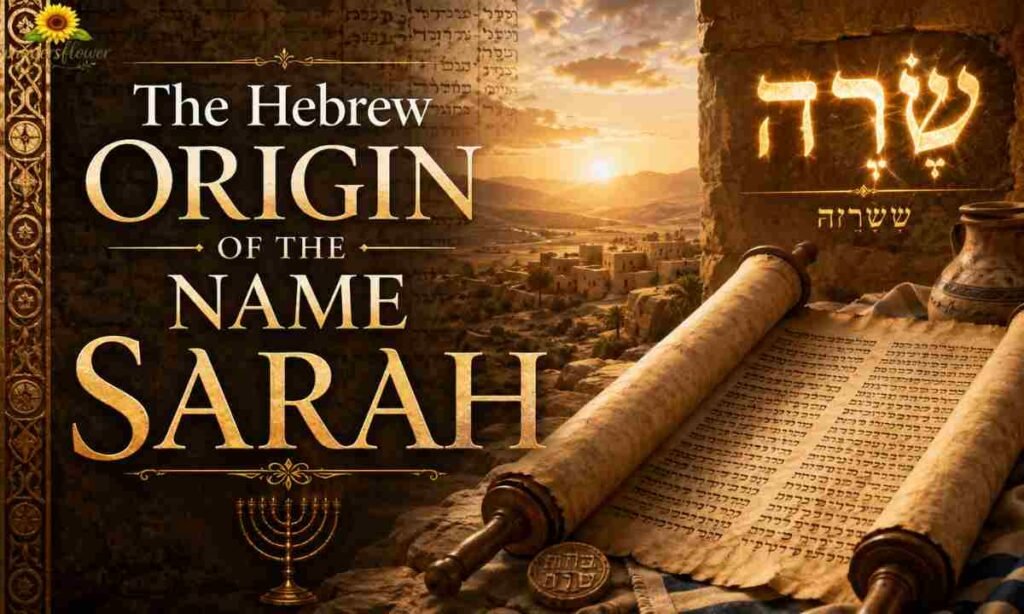
To understand the biblical meaning of the name Sarah, you have to begin at the root. The name Sarah — spelled שָׂרָה in Hebrew — comes from the root word “śar,” meaning ruler, prince, or chief. When applied in the feminine form, it becomes “śārāh,” which translates most naturally as princess or noblewoman.
This is not a soft or decorative title. In the ancient Near Eastern world, a “sar” was a figure of authority, governance, and dignity. When God gave this name to Abraham’s wife, He was not handing her a pretty label. He was making a statement about her rank in the divine economy.
The name carries within it the concept of sovereignty — someone who presides, who leads, who is set apart. In a culture where a woman’s worth was often measured by her fertility or her husband’s status alone, this name was countercultural in the deepest sense. God named her a ruler before she ever held her son.
From Sarai to Sarah — The Divine Renaming in Genesis 17
One of the most profound moments in the entire Hebrew Bible is the renaming of Sarai to Sarah. In Genesis 17:15, God speaks directly to Abraham and says, “As for your wife Sarai, you shall not call her name Sarai, but Sarah shall be her name.” This single verse is a pivot point in salvation history.
The name Sarai (שָׂרַי) is an older, more archaic form and is often understood to mean “my princess” — a name that was personal, perhaps tribal, belonging to one man’s household. But Sarah — the updated form — means princess in a universal, broader sense. The “my” is dropped. She is no longer just Abraham’s princess. She becomes a princess to nations.
God’s very next words confirm this: “I will bless her, and she shall become nations; kings of peoples shall come from her” (Genesis 17:16). The renaming was not cosmetic. It was prophetic. God was announcing her destiny before it had arrived, just as He had done with Abraham’s own name change from Abram. This pattern — God renaming those He is about to greatly use — runs throughout Scripture and is one of the most spiritually significant threads in the entire Bible.
The moment Sarah received her new name, she received a new identity. This is perhaps the most personally applicable truth hidden inside the biblical meaning of the name Sarah: that God has the authority and the desire to redefine who you are.
Sarah in the Book of Genesis — Her Story in Full
Sarah first appears in Genesis 11 as the wife of Abram, a woman described without much fanfare except for one devastating detail: she was barren. In the ancient world, barrenness was not merely a medical condition — it was a social wound, a spiritual weight, and a source of daily grief.
And yet God chose her. He chose the barren woman to be the mother of the promised child. He chose the one who laughed (Genesis 18:12) — not from mockery, but from a pain so deep that hope felt absurd — to be the one through whom His covenant would flow.
Sarah’s story in Genesis is rich and, at times, deeply human. She acted out of fear when Abraham told Pharaoh she was his sister (Genesis 12:10-20). She acted out of impatience when she gave her servant Hagar to Abraham to produce a child (Genesis 16). These are not the acts of a flawless saint. These are the acts of a woman under enormous pressure trying to help God along — something readers across every generation have understood all too well.
But her story does not end in failure. At ninety years old, Sarah conceived and gave birth to Isaac — whose name means laughter — and said, “God has made laughter for me; everyone who hears will laugh over me” (Genesis 21:6). The laughter of despair had become the laughter of joy. That is the arc of her life. That is the biblical meaning of the name Sarah lived out in full.
Keep Feeding Your Faith: Biblical Meaning of the Name Michael
The Spiritual Meaning of the Name Sarah Across Scripture
The significance of Sarah does not remain confined to the book of Genesis. She is referenced across the Old and New Testaments in ways that build a cumulative spiritual portrait of what her name and life represent.
In Isaiah 51:2, God calls His scattered and discouraged people back to their roots: “Look to Abraham your father and to Sarah who bore you; for he was but one when I called him, that I might bless him and multiply him.” Here, Sarah is held up as a source of identity and courage for an entire nation. She is not a footnote — she is a foundation.
In the New Testament, the apostle Paul uses Sarah as a theological figure in Galatians 4, contrasting her with Hagar in an allegory about the covenant of grace versus the covenant of law. Sarah represents freedom, the promise, the Jerusalem that is above. Paul assigns her a cosmic significance that goes far beyond her individual story.
The apostle Peter, in 1 Peter 3:6, calls Sarah a model of holy womanhood: she obeyed Abraham, calling him lord, and in doing so she became a spiritual mother to all women who do good and do not fear. Peter is not commanding blind submission — he is pointing to the quality of quiet, trusting, unshakeable faith that Sarah ultimately embodied.
For a deeper exploration of Sarah’s role in biblical history and the Abrahamic covenant, the Jewish Encyclopedia’s entry on Sarah provides valuable scholarly context from a Hebrew perspective:https://www.jewishencyclopedia.com/articles/13239-sarah
Sarah as a Symbol of Faith and God’s Impossible Promises
The author of Hebrews includes Sarah in the great Hall of Faith in Hebrews 11:11 — a list that reads like the most elite company in all of Scripture. “By faith Sarah herself received power to conceive, even when she was past the age, since she considered him faithful who had promised.” This is remarkable. Despite her laughter, despite her doubt, despite the very human moments where her faith faltered — she is remembered in Hebrews as a woman of faith.
This tells us something essential about how God remembers His people. He does not archive our worst moments as our defining ones. He looks at the arc, the direction, the ultimate trust — and He names us by our finest spiritual posture. Sarah is remembered not for her laughter of disbelief but for the faith that outlasted it.
The spiritual meaning of the name Sarah, understood through this lens, becomes a message of divine patience with human doubt. God does not revoke the promise because you laughed. He fulfills it anyway.
The Name Sarah in Judaism, Christianity, and Islam
The reach of the name Sarah across the world’s three great Abrahamic faiths is extraordinary. In Judaism, Sarah is considered the first of the four matriarchs — Sarah, Rebekah, Leah, and Rachel — and she holds a place of singular honor in Jewish identity, liturgy, and thought. She is buried in the Cave of Machpelah in Hebron, a site that remains sacred to this day.
In Christianity, Sarah is a figure of covenant grace, the mother of the promised lineage through which Jesus Christ would eventually come. Her faith, her waiting, and her miraculous conception are woven into the theological fabric of what it means to trust God against all visible evidence.
In Islam, Sarah — known as Sāra — is honored as the wife of Ibrahim (Abraham) and the mother of Ishaq (Isaac). She is regarded as a righteous and faithful woman, and her story is referenced in Islamic tradition with great reverence.
Across all three traditions, her name carries the same essential weight: she was chosen, she was transformed, she was used by God to carry a promise too large for any single human life to hold alone.
What Does the Name Sarah Mean for You Today?

Names carry memory. They carry meaning. And when a name has been spoken by God Himself into a specific destiny, it carries something more — it carries anointing.
If your name is Sarah, or if you love someone who carries this name, consider what the biblical tradition is depositing into that identity. Not pressure. Not performance. But a heritage that says: you come from a lineage of women who waited in the dark and were not forgotten. You come from a woman who laughed and was still chosen. You come from a story where barrenness became a nation.
The biblical meaning of the name Sarah is ultimately a theology of reversal. It is the God who calls the barren mother of nations. The God who renames before He promotes. The God who waits until the situation is humanly impossible so that when He moves, no one else gets the credit. Sarah’s name holds all of that. And for those who carry it, or who are simply drawn to her story, that is an inheritance worth sitting with.
FAQs
What is the biblical meaning of the name Sarah in Hebrew?
The biblical meaning of the name Sarah in Hebrew is “princess” or “noblewoman,” derived from the root word “śar,” meaning ruler or chief.
Why did God change Sarai’s name to Sarah in the Bible?
God renamed Sarai to Sarah in Genesis 17 to signal her expanded destiny — from a personal, tribal identity to a woman who would mother nations through the Abrahamic covenant.
Is Sarah considered a woman of faith in the New Testament?
Yes, Sarah is explicitly honored in Hebrews 11 as a woman of faith who trusted God’s promise even when conception was physically impossible at her age.
What is the spiritual significance of the name Sarah across religions?
The name Sarah holds deep spiritual significance in Judaism, Christianity, and Islam, where she is universally revered as a righteous, covenant-bearing matriarch of the Abrahamic lineage.
What does the story of Sarah teach us about God’s promises?
Sarah’s story reveals that God’s promises do not expire with time or circumstance — He fulfills them in His own timing, often when the situation appears humanly impossible.
Conclusion
The biblical meaning of the name Sarah is not simply a Hebrew definition — it is a living testimony to what God does with ordinary people who hold on long enough to see His faithfulness. Her name declares royalty; her life demonstrates grace under impossible conditions.
If her story speaks to something in you, let it. You do not need to carry her name to carry her faith — the same God who renamed a barren woman and kept every word of His promise to her is the same God who knows your name today.
Father, may every person who reads this leave with a name in their heart and a prayer on their lips.

John Carrol is a Christian writer and prayer minister with over a decade of experience in faith-based content, devotional writing, and spiritual encouragement. Rooted in Scripture and a lifelong love of intercessory prayer, John created PrayersFlower to help believers find the right words when their own run out. His writing draws from pastoral study, personal faith practice, and a deep conviction that prayer is the most powerful act available to the human heart. When he is not writing, John is found in quiet study of the Word, mentoring young believers, and serving his local church community.