

The biblical meaning of rainbows is not merely poetic — it is God’s living signature across the sky, a covenant of mercy sealed in light after the waters of judgment receded.
There are moments in life when the sky breaks open and a rainbow appears, and something stirs deep inside you — not just wonder, but longing. People search for the biblical meaning of rainbows not out of casual curiosity but out of genuine hunger: they want to know if God is still speaking, still watching, still faithful. That hunger is real, and it is holy.
This article takes you through every layer of the rainbow’s spiritual significance in Scripture — from the covenant after Noah’s flood to the throne room of Heaven in Revelation. The biblical meaning of rainbows carries far more weight than a single verse, and by the time you finish reading, you will understand why this sign has comforted believers across thousands of years.
Lord, meet and bless every reader here, guide them closer to Your heart, and grant them success in every area of their life.
Key Takeaways
- The biblical meaning of rainbows originates in Genesis 9, where God established an everlasting covenant with all living creatures after the flood
- Rainbows in the Bible are symbols of God’s faithfulness, divine mercy, and His promise never to destroy the earth by water again
- The rainbow appears in Revelation 4 and 10, framing God’s heavenly throne and the authority of the mighty angel — connecting the Old Testament covenant to eternal glory
- Understanding the spiritual meaning of rainbows in Scripture can deepen your prayer life and renew your trust in God’s unchanging character
The Origin: Where the Biblical Meaning of Rainbows Begins
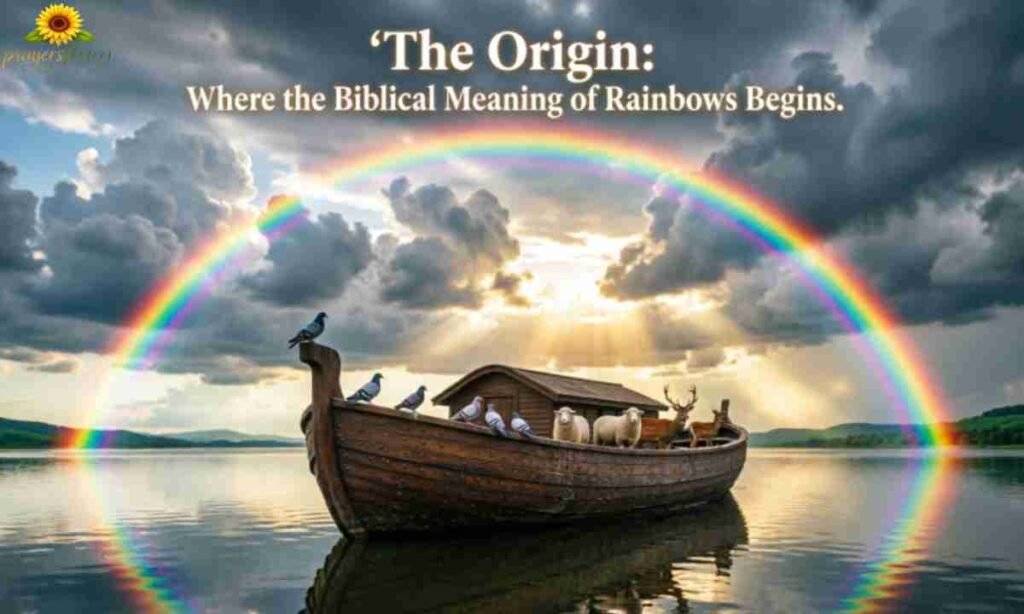
To understand the biblical meaning of rainbows, you have to stand with Noah on the banks of a receding flood. Genesis 8 describes the waters subsiding, the ark coming to rest on the mountains of Ararat, and a world that had been stripped bare waiting to breathe again. Then God speaks.
In Genesis 9:12–16, God declares: “This is the sign of the covenant I am making between me and you and every living creature with you, a covenant for all generations to come: I have set my rainbow in the clouds, and it will be the sign of the covenant between me and the earth.”
This is the first time a rainbow is mentioned in the Bible, and its introduction is staggering in scope. God does not give the rainbow to Noah alone — He gives it to every living creature, to every generation that would follow. The biblical meaning of rainbows is therefore universal and eternal by divine design, not cultural accident.
What makes this origin so profound is that God says the rainbow is also for Himself: “Whenever I bring clouds over the earth and the rainbow appears in the clouds, I will remember my covenant.” God uses the rainbow as a self-reminder of His own mercy. This is not because He is forgetful — it is because He is relational. He binds Himself to His word in a way that human eyes can witness.
Keep Feeding Your Faith: The Exciting Biblical Meaning of the Name ELLIE
God’s Covenant Sign: More Than a Pretty Sky
Covenant theology is at the very heart of the biblical meaning of rainbows. In the ancient Near East, covenants were solemn, binding agreements — often sealed with blood or sacrifice. The Noahic covenant in Genesis 9 is remarkable because it is entirely one-sided. God makes the promise. God keeps the promise. Humanity simply receives it.
The rainbow is the seal of that covenant. Think of it less like a decoration and more like a divine signature on an unbreakable contract. Every time the rainbow appears after rain, God is renewing His pledge to show mercy rather than judgment, to preserve rather than destroy.
This is why so many believers feel an instinctive reverence when they see a rainbow. Somewhere in the spiritual memory of the Church, we recognize it as a sign of God’s faithfulness — not a myth, not a metaphor, but a mark of the living God’s word.
The Bible Gateway resource on Genesis 9 offers the full covenant passage in multiple translations, which is worth reading slowly.
The Rainbow in the Throne Room: Revelation’s Heavenly Vision
The biblical meaning of rainbows does not end in Genesis. It reaches its most glorious expression in the New Testament’s final book.
In Revelation 4:3, the Apostle John describes the throne of God: “And the one who sat there had the appearance of jasper and ruby. A rainbow that shone like an emerald encircled the throne.” The rainbow here is not above the throne — it surrounds it completely. This detail is a deliberate echo of the Noahic covenant, signaling that God’s mercy encircles His judgment at all times.
Then in Revelation 10:1, a mighty angel descends from heaven “robed in a cloud, with a rainbow above his head.” This angel carries a small scroll and plants one foot on the sea and one on the land — an image of total divine authority. The rainbow crowning this messenger links the promised mercy of Genesis to the sovereign power of the end times.
The biblical meaning of rainbows in Revelation tells us that God’s covenant faithfulness is not a relic of ancient history. It is alive, active, and woven into the very fabric of eternity.
Ezekiel’s Vision: The Rainbow as Divine Glory
One of the most overlooked passages in understanding the biblical meaning of rainbows is Ezekiel 1:28. The prophet Ezekiel, in the middle of an overwhelming vision of the living creatures and the wheels of God’s chariot, suddenly says: “Like the appearance of a rainbow in the clouds on a rainy day, so was the radiance around him. This was the appearance of the likeness of the glory of the Lord.”
Ezekiel uses the rainbow as the closest comparison he can find for the glory of God. When human language hits its limit, the prophet reaches for the rainbow. This suggests that the spiritual meaning of rainbows in the Bible is not merely symbolic — it is doxological. It points to the very nature and splendor of God Himself.
This is why the rainbow appears consistently in passages where heaven intersects with earth. It is a bridge not just between storm and calm, but between the human and the divine.
The Rainbow as a Symbol of Hope After Suffering
One of the most personally relevant dimensions of the biblical meaning of rainbows is what it communicates to people walking through suffering. The rainbow did not appear on a bright, carefree day. It appeared after the greatest disaster in human history. It came through water and grief and waiting.
That sequence matters enormously. God did not prevent the flood — He brought His people through it and then placed His sign on the other side. For anyone who has endured a season of grief, loss, illness, or spiritual drought, this pattern is deeply comforting. The rainbow in Scripture is always a post-storm promise.
The spiritual symbolism of rainbows speaks to the heart of Christian hope: that suffering is not the final word, that mercy follows judgment, and that God’s faithfulness outlasts every storm we face.
Rainbow Symbolism Across the Whole Bible: Key Themes
The biblical meaning of rainbows carries several layered themes that appear consistently across Scripture:
Divine mercy over judgment. The rainbow was set precisely in the context of God choosing restraint. His power is infinite, but the rainbow is His chosen reminder to show mercy. This is the God of the Bible — not a God who delights in destruction, but One who delights in redemption.
Eternal covenant faithfulness. The Noahic covenant is described as “everlasting” in Genesis 9:16. That word matters. The biblical meaning of rainbows is tied to a promise that has no expiration date.
The glory and holiness of God. Ezekiel and John both use rainbow imagery to describe God’s presence. The rainbow is a fragment of divine glory made visible in the natural world.
Hope rooted in God’s character, not circumstances. The rainbow does not promise that storms will not come. It promises that God will remain faithful through them and beyond them.
What Does Seeing a Rainbow Mean Spiritually Today?
Many believers ask a deeply personal question: when I see a rainbow, is God speaking to me? The honest biblical answer is that while the rainbow was given as a universal covenant sign rather than a private message, it absolutely functions as a tangible reminder of spiritual truth.
When you see a rainbow, you are seeing the same sign that Noah saw. You are receiving the same promise that God spoke over every living creature. The spiritual meaning of rainbows for believers today is an invitation to remember: God keeps His word. His mercies are new every morning. His covenant does not grow old.
It is not superstition to feel your faith strengthened at the sight of a rainbow — it is the natural response of a soul that recognizes God’s signature in the sky.
The Colors of the Rainbow: Is There Deeper Meaning?
While the Bible does not assign specific theological meaning to each color of the rainbow, the number seven carries deep biblical significance — and the natural spectrum contains seven distinct colors. Seven in Scripture is the number of completeness and divine perfection (Genesis 2:2, Revelation 1:4, 5:1).
The completeness of the rainbow’s arc, its full spectrum light, and its seven colors together suggest wholeness — a covenant that is total, complete, and without any gap. God’s promise is not partial. The biblical meaning of rainbows includes this completeness: His mercy covers every spectrum of human experience.
FAQs
What is the biblical meaning of rainbows in Genesis?
In Genesis 9, the rainbow is God’s covenant sign — His promise to never again destroy the earth by flood, sealed between Him and every living creature forever.
What does the rainbow around God’s throne in Revelation mean?
The rainbow encircling God’s throne in Revelation 4 shows that divine mercy surrounds His judgment, connecting the Noahic covenant to eternal glory.
Is the rainbow a symbol of hope in the Bible?
Yes — the rainbow is one of Scripture’s most powerful symbols of hope, appearing after the flood as proof that God’s faithfulness follows every season of suffering and loss.
What does Ezekiel’s rainbow vision tell us about God’s glory?
Ezekiel 1:28 uses the rainbow as the closest image for God’s radiant glory, revealing that this symbol of divine covenant is also a glimpse of God’s indescribable splendor.
What is the spiritual meaning of rainbows for Christians today?
For Christians today, the spiritual meaning of rainbows is a living reminder that God’s promises endure — a visible sign that His word, spoken in Genesis, remains unbroken across all of history.
Conclusion
The biblical meaning of rainbows stretches from the muddy banks of a receding flood all the way to the emerald light encircling God’s eternal throne. It is one of Scripture’s most consistent and beautiful threads — a sign that mercy is stronger than judgment, and that God’s covenant never expires.
Every rainbow you see is an ancient promise made fresh — a reminder that the God who spoke to Noah is the same God who speaks to you. Anchor your faith there, and let the sight of that arc in the sky be not just wonder, but worship.
Lord, may every reader who found this word find in it a reason to return to Your presence in prayer.

John Carrol is a Christian writer and prayer minister with over a decade of experience in faith-based content, devotional writing, and spiritual encouragement. Rooted in Scripture and a lifelong love of intercessory prayer, John created PrayersFlower to help believers find the right words when their own run out. His writing draws from pastoral study, personal faith practice, and a deep conviction that prayer is the most powerful act available to the human heart. When he is not writing, John is found in quiet study of the Word, mentoring young believers, and serving his local church community.