

By a Bible Study Writer | Last Updated: 2026
Lord, meet and bless every reader here, guide them closer to Your heart, and grant them success in every area of their life.
What Does the Bible Say About the Prayer Life of Jesus?
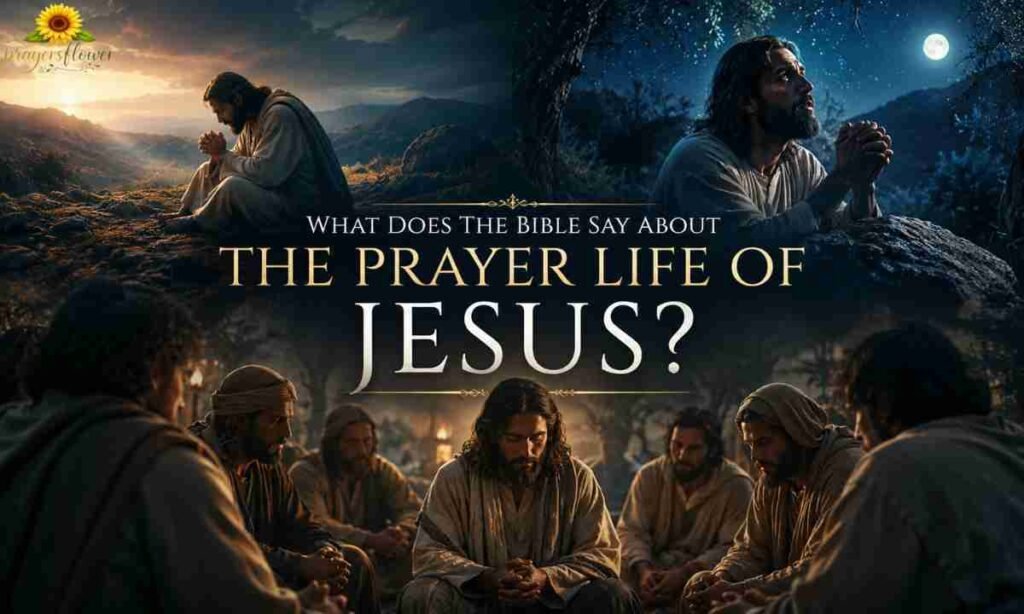
Prayer was not an occasional habit for Jesus — it was the heartbeat of His earthly ministry. Throughout the four Gospels, we see Jesus withdrawing from crowds, kneeling in gardens, lifting His eyes to heaven, and crying out to the Father at the most critical moments of His life. The Bible records Jesus praying before major decisions, during miracles, in the face of suffering, and even on the cross.
Luke 5:16 tells us, “But Jesus often withdrew to lonely places and prayed.”The word “often” is significant. It was a consistent, intentional lifestyle. Whether it was early morning in a desolate place (Mark 1:35), an all-night vigil on a mountain (Luke 6:12), or agonising intercession in Gethsemane (Matthew 26:36–44), Jesus modelled a prayer life of depth, frequency, and complete dependence on the Father.
His prayers were not performances. They were real conversations — honest, reverent, and deeply relational. Hebrews 5:7 says: “In the days of His flesh, He offered up both prayers and supplications with loud crying and tears to the One able to save Him from death, and He was heard because of His piety.”
Studying the prayers of Jesus is one of the most transformative things a Christian can do. They reveal who Jesus is, how He related to the Father, and how we should approach God in our own lives.
The Lord’s Prayer Explained — Matthew 6:9–13
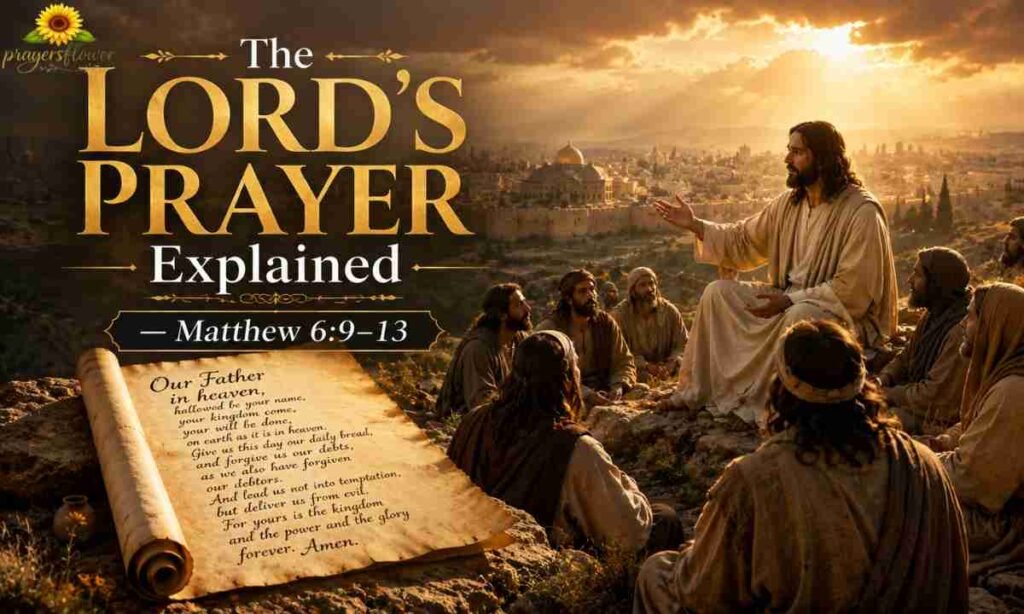
The Lord’s Prayer is arguably the most well-known and most searched prayer in all of human history. Jesus gave it in response to His disciples’ request: “Lord, teach us to pray”(Luke 11:1). It appears in Matthew 6:9–13 as part of the Sermon on the Mount and in a shorter form in Luke 11:2–4.
The full text (Matthew 6:9–13, NIV):
“Our Father in heaven, hallowed be your name, your kingdom come, your will be done, on earth as it is in heaven. Give us today our daily bread. And forgive us our debts, as we also have forgiven our debtors. And lead us not into temptation, but deliver us from the evil one.”
Far from being a rote recitation, this prayer is a master template for all Christian prayer. Let’s break it down:
“Our Father in heaven, hallowed be your name” Jesus begins with worship. Before any request, He acknowledges who God is — a Father who is holy, majestic, and set apart. This sets the posture of the heart.
“Your kingdom come, your will be done, on earth as it is in heaven” Jesus prays for God’s agenda, not His own. This is a radical surrender — asking for heaven’s perfect order to invade earth’s broken reality.
“Give us today our daily bread” A simple acknowledgement of dependence. God is the provider of every physical need. We are to ask daily, not hoard in anxiety.
“Forgive us our debts, as we also have forgiven our debtors” Forgiveness is a two-way road. Jesus ties receiving God’s forgiveness to extending it to others — a sobering connection.
“Lead us not into temptation, but deliver us from the evil one” This is a prayer for spiritual protection. Jesus acknowledges the reality of spiritual warfare and the need for divine guidance.
The Lord’s Prayer is not just a prayer to say — it is a way of life to embody.
You can read the complete text of the Lord’s Prayer in multiple translations at BibleGateway — Matthew 6:9–13 to compare how different versions render each phrase.
Jesus’ High Priestly Prayer in John 17 — Full Breakdown
John 17 records the longest prayer of Jesus in the Bible. Prayed just hours before His arrest, it is sometimes called the High Priestly Prayer because in it Jesus intercedes on behalf of His disciples and all future believers — much like the Old Testament high priest interceded for Israel.
It is divided into three main sections:
Jesus Prays for Himself (John 17:1–5)
“Father, the hour has come. Glorify your Son, that your Son may glorify you.”
Jesus asks the Father to glorify Him so that He, in turn, can glorify the Father. He references the eternal relationship He shared with the Father before creation — a powerful declaration of His divine nature.
Jesus Prays for His Disciples (John 17:6–19)
“I pray for them. I am not praying for the world, but for those you have given me, for they are yours.”
Jesus asks the Father to:
- Protect them from the evil one (v.15)
- Sanctify them through the truth of God’s Word (v.17)
- Keep them unified in mission and love (v.11)
He acknowledges they will remain in the world while He goes to the Father, and He prays for their strength and faithfulness in that mission.
Jesus Prays for All Believers (John 17:20–26)
“My prayer is not for them alone. I pray also for those who will believe in me through their message, that all of them may be one…”
This is one of the most remarkable moments in all of Scripture — Jesus, on the night of His betrayal, prays specifically for you, if you are a believer today. He prays that:
- All believers would be unified, reflecting the unity of the Trinity
- The world would see that unity as proof of God’s love
- Believers would one day behold His glory in heaven
John 17 is the beating heart of Jesus’ earthly ministry — a prayer that echoes across every century to every believer who has ever lived.
For a deeper theological study of John 17, GotQuestions.org offers an excellent verse-by-verse breakdown of what scholars call the most intimate prayer Jesus ever prayed.
The Garden of Gethsemane Prayer — “Not My Will, But Yours”
Of all the prayers Jesus prayed, none is more emotionally raw and spiritually profound than His prayer in the Garden of Gethsemane. Recorded in Matthew 26:36–46, Mark 14:32–42, and Luke 22:39–46, it takes place hours before His crucifixion.
“My Father, if it is possible, may this cup be taken from me. Yet not as I will, but as you will.”— Matthew 26:39
Jesus prayed this prayer three times (Matthew 26:44), each time returning to the same submission: “Your will be done.”
Luke’s Gospel adds a haunting detail: “And being in anguish, he prayed more earnestly, and his sweat was like drops of blood falling to the ground”(Luke 22:44). This medical phenomenon, known as hematidrosis, occurs under extreme psychological stress — giving us a glimpse into the full weight of what Jesus was about to bear.
What this prayer teaches us:
- It is not wrong to express honest emotion to God. Jesus did not suppress His feelings — He brought them to the Father.
- Submission to God’s will is the highest form of prayer. Even when it costs everything, “not my will but yours” is the most powerful prayer a human being can pray.
- God’s will does not always remove suffering — but it always redeems it. The cup was not removed. But through it, the world was saved.
The Gethsemane prayer is the model for every believer facing a moment when God’s will and personal desire seem to pull in opposite directions.
The phenomenon Luke describes — sweat like drops of blood — is a real medical condition.WebMD explains hematidrosis and how extreme psychological stress can cause it, making Luke’s account medically credible.
The Seven Prayers of Jesus on the Cross
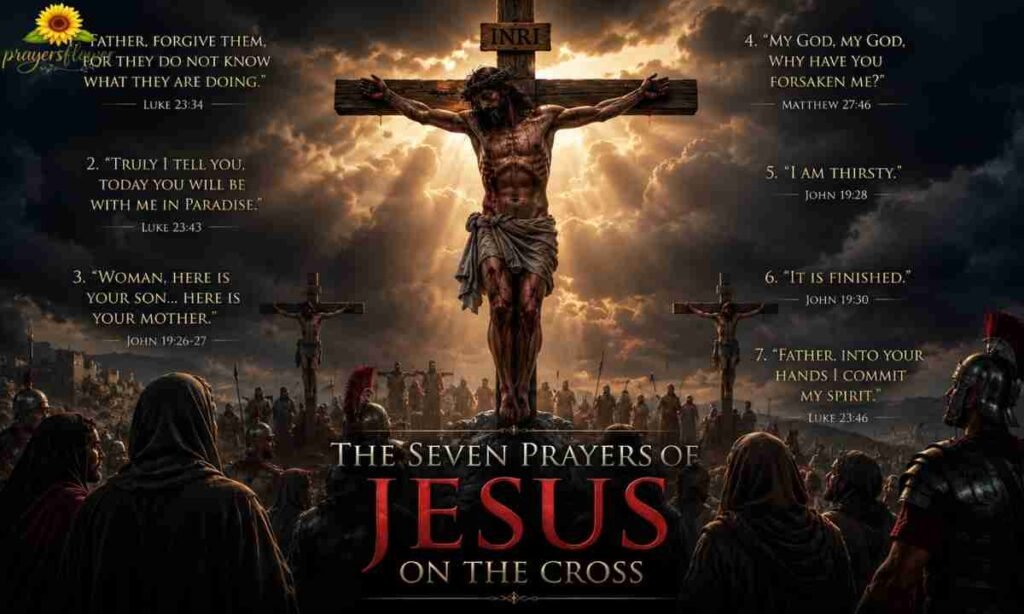
The crucifixion accounts in the four Gospels record seven final statements of Jesus — several of which are direct prayers to the Father. These are among the most studied and most searched words in the entire Bible.
1. “Father, forgive them, for they do not know what they are doing.” (Luke 23:34) Jesus prays for His executioners in the very act of crucifixion. This is the embodiment of His own teaching: “Love your enemies and pray for those who persecute you”(Matthew 5:44). Ultimate forgiveness in the face of ultimate injustice.
2. “My God, my God, why have you forsaken me?” (Matthew 27:46; Mark 15:34) This is a quotation of Psalm 22:1. Jesus, bearing the full weight of the world’s sin, experiences the horrific separation from the Father that sin causes. It is a prayer of desolation — and it is also a declaration that prophecy is being fulfilled.
3. “Father, into your hands I commit my spirit.” (Luke 23:46) Jesus’ final words before death — a quotation from Psalm 31:5. It is a prayer of total trust and surrender. Even in death, He models complete confidence in the Father.
The cross prayers show us that prayer is for every moment — including and especially the darkest ones.
How Jesus Prayed for His Disciples and All Believers
Jesus was fundamentally an intercessor. Throughout His ministry, He regularly prayed specifically for the people around Him — and for those who would come to faith through their witness.
He prayed for Peter:
“Simon, Simon, Satan has asked to sift all of you as wheat. But I have prayed for you, Simon, that your faith may not fail.”— Luke 22:31–32
Even knowing Peter would deny Him three times, Jesus prayed not for Peter’s perfection but for the preservation of his faith. That is the nature of Christ’s intercession — not that we will never fall, but that our faith will survive the fall.
He prayed for His disciples before selecting them: Luke 6:12–13 tells us Jesus spent the entire night in prayer before choosing His twelve apostles. The most important decision of His ministry was preceded by the most sustained act of prayer.
He prayed at the tomb of Lazarus:
“Father, I thank you that you have heard me. I knew that you always hear me, but I said this for the benefit of the people standing here, that they may believe that you sent me.”— John 11:41–42
This prayer is notable for its confidence. Jesus did not beg — He thanked. He prayed publicly so that the watching crowd would understand the source of the miracle they were about to witness.
He prays for us now: Hebrews 7:25 declares: “He is able to save completely those who come to God through him, because he always lives to intercede for them.”The prayers of Jesus did not end at the ascension. Right now, at the right hand of the Father, Jesus intercedes for every believer.
When and Where Did Jesus Pray? His Daily Prayer Habits
One of the most instructive aspects of Jesus’ prayer life is not just what He prayed, but when and where He chose to pray.
Early Morning, in Solitude
“Very early in the morning, while it was still dark, Jesus got up, left the house and went off to a solitary place, where he prayed.”— Mark 1:35
Before the crowds gathered, before the demands of ministry pressed in, Jesus prioritised communion with the Father. The day did not begin with activity — it began with prayer.
All Night on a Mountain
“One of those days Jesus went out to a mountainside to pray, and spent the night praying to God.”— Luke 6:12
Before choosing His twelve disciples — the men who would carry His message to the world — Jesus prayed through the entire night. Great decisions require great prayer.
In Lonely, Deserted Places Luke 5:16 says: “Jesus often withdrew to lonely places and prayed.”The word translated “often” implies a regular lifestyle. Jesus was not reactive in prayer — He was proactive, intentional, and consistent.
At Meals Jesus gave thanks before every recorded meal — feeding the 5,000 (Matthew 14:19), the Last Supper (Matthew 26:26–27), and the resurrection appearance at Emmaus (Luke 24:30). Gratitude before food was a prayer habit.
In the Temple Jesus also prayed in public spaces. He prayed at Lazarus’ tomb (John 11:41), and He drove out those who had turned the temple — meant to be “a house of prayer” — into a marketplace (Matthew 21:13).
Jesus’ Prayers of Thanksgiving and Praise to the Father
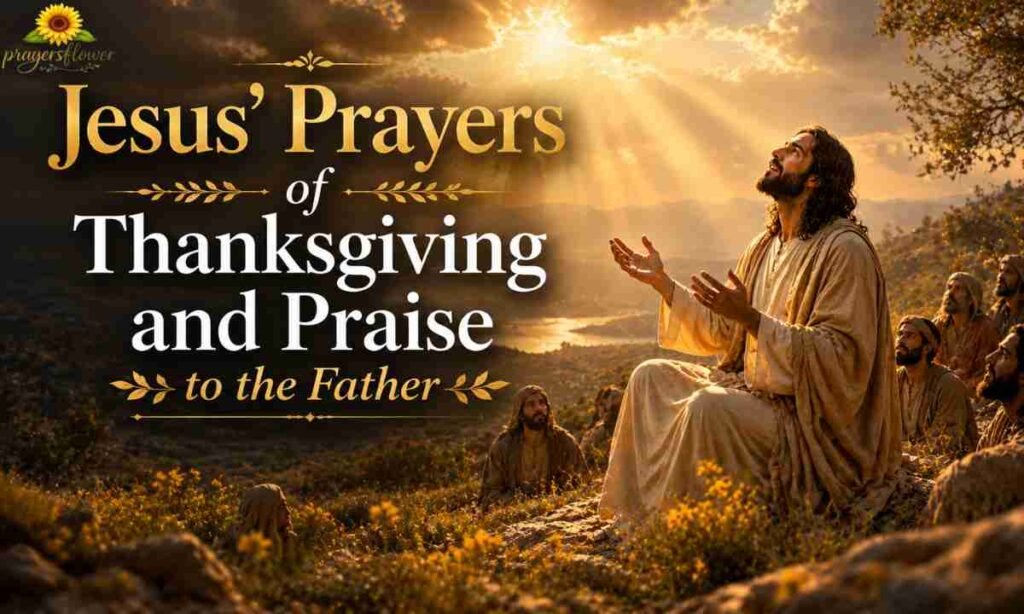
Not all of Jesus’ prayers were petitions or intercessions. Several were pure expressions of joy, gratitude, and praise — giving us a model for the often-neglected dimension of thankful prayer.
Thanking God for Revealing Truth to the Humble
“I praise you, Father, Lord of heaven and earth, because you have hidden these things from the wise and learned, and revealed them to little children.”— Matthew 11:25 / Luke 10:21
This spontaneous outburst of praise came after the seventy-two disciples returned with joy from their ministry. Jesus rejoiced because God’s ways defy human wisdom — the simple and humble receive what the proud miss entirely.
Thanking God Before the Miracle
“Father, I thank you that you have heard me.”— John 11:41
At Lazarus’ tomb, Jesus prayed a prayer of confident thanksgiving before the miracle even happened. This is a profound model of faith — thanking God in advance for what He is about to do.
Thanking God at the Last Supper At the final Passover meal, Jesus took bread, gave thanks, and broke it (Matthew 26:26). He then took the cup and gave thanks again (Matthew 26:27). Even on the night of His betrayal — knowing what lay ahead — His response was gratitude.
Complete List of All Recorded Prayers of Jesus in the Bible
Here is a comprehensive reference of every recorded prayer of Jesus in the New Testament:
| # | Prayer | Scripture Reference |
| 1 | At His baptism | Luke 3:21 |
| 2 | In the desert / lonely places | Mark 1:35; Luke 5:16 |
| 3 | All-night prayer before choosing disciples | Luke 6:12–13 |
| 4 | Thanksgiving for revelation to the humble | Matthew 11:25–26; Luke 10:21 |
| 5 | Before feeding the 5,000 | Matthew 14:19 |
| 6 | Alone on a mountain | Matthew 14:23; Mark 6:46 |
| 7 | Before feeding the 4,000 | Matthew 15:36 |
| 8 | At the Transfiguration | Luke 9:28–29 |
| 9 | Prayer for children | Matthew 19:13–14 |
| 10 | Prayer for Peter | Luke 22:31–32 |
| 11 | At the tomb of Lazarus | John 11:41–42 |
| 12 | Before the Triumphal Entry | John 12:27–28 |
| 13 | The Lord’s Prayer (model prayer) | Matthew 6:9–13; Luke 11:2–4 |
| 14 | At the Last Supper | Matthew 26:26–27 |
| 15 | The High Priestly Prayer | John 17:1–26 |
| 16 | Gethsemane (three times) | Matthew 26:36–44 |
| 17 | “Father, forgive them” (on the cross) | Luke 23:34 |
| 18 | “My God, why have you forsaken me?” | Matthew 27:46; Mark 15:34 |
| 19 | “Father, into your hands I commit my spirit” | Luke 23:46 |
| 20 | Blessing disciples at the Ascension | Luke 24:50–51 |
What Can We Learn From the Prayers Jesus Prayed?
The prayers of Jesus are not just historical records — they are living blueprints for the Christian prayer life. Here are the most important lessons:
1. Prioritise Prayer Above Everything Else Jesus was the Son of God — yet He prayed constantly. If the sinless Son of God needed to spend extended time in prayer with the Father, how much more do we?
2. Begin With Worship, Not Requests Every significant prayer of Jesus starts by acknowledging the Father — His holiness, His sovereignty, His name. We rush to our wish list; Jesus began with reverence.
3. Pray in Complete Honesty Gethsemane shows us that Jesus did not sanitise His prayers. He expressed real anguish, real reluctance, real pain — and then surrendered. God can handle your honesty.
4. Submit Your Will to God’s The defining phrase of Jesus’ prayer life is: “Not my will, but yours be done.”Every prayer, ultimately, is an act of surrender to a Father who knows better.
5. Pray for Others Constantly Jesus was an intercessor by nature. He prayed for His disciples, for Peter by name, for future believers, for His enemies, and for those who crucified Him. Our prayers should extend far beyond our own needs.
6. Pray in Solitude Jesus repeatedly left crowds and sought lonely places to pray. A rich prayer life requires deliberate, uninterrupted time with God — not just prayers squeezed into a busy schedule.
7. Bring Thanksgiving into Every Prayer Jesus gave thanks at meals, before miracles, and even on the night of His betrayal. Gratitude is not contingent on circumstances — it is a posture of trust in a good God.
Does Jesus Still Pray for Us Today? His Intercessory Role
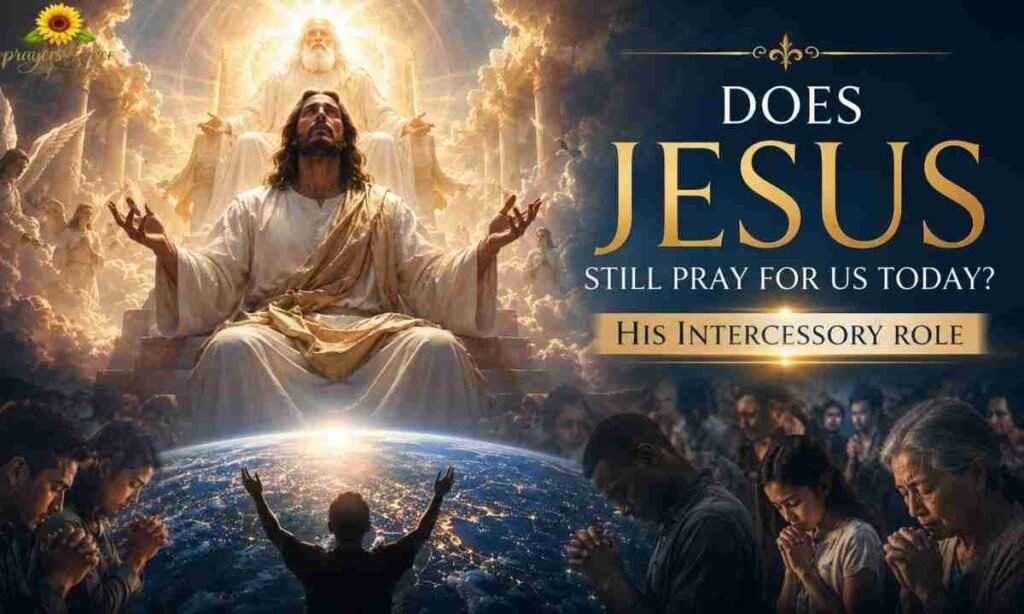
One of the most comforting and least understood truths in the New Testament is this: Jesus is still praying for you right now.
Hebrews 7:25 says:
“Therefore he is able to save completely those who come to God through him, because he always lives to intercede for them.”
The word “always” is absolute. Jesus’ intercessory work did not end at the cross, the resurrection, or the ascension. At the right hand of the Father, in His glorified, risen state, Jesus continues to act as our great High Priest — bringing our names before the Father.
Romans 8:34 confirms: “Christ Jesus who died — more than that, who was raised to life — is at the right hand of God and is also interceding for us.”
1 John 2:1 adds: “But if anybody does sin, we have an advocate with the Father — Jesus Christ, the Righteous One.”
The same Jesus who prayed for Peter that his faith would not fail is praying for you today. The same Jesus who wept at Lazarus’ tomb and prayed for future believers in John 17 is interceding right now on your behalf. His prayers are not distant history — they are present-tense reality.
This truth transforms how we approach prayer. We do not pray alone. We pray in the company of the one who taught us to pray, who modelled prayer for us, and who is even now standing before the Father on our behalf.
Keep Feeding Your Faith: Praying the Psalms: A Complete Guide to Letting Scripture Become Your Prayer
Frequently Asked Questions About the Prayers of Jesus
How many times did Jesus pray in the Bible?
The Gospels record at least 20 distinct instances of Jesus praying. However, many additional references note He “often” or “regularly” prayed (Luke 5:16), suggesting the recorded prayers are only a representative sample of a constant prayer life.
What was the longest prayer Jesus prayed?
The High Priestly Prayer in John 17 is the longest recorded prayer of Jesus, spanning 26 verses. It is a deeply theological and deeply personal prayer covering His own glorification, His disciples’ protection, and the unity of all future believers.
What was the shortest prayer Jesus prayed?
One of the shortest is His prayer at Lazarus’ tomb in John 11:41–42: “Father, I thank you that you have heard me.”It is brief, confident, and rooted entirely in trust.
Did Jesus pray to Himself since He is God?
This is a common theological question. Jesus is the second Person of the Trinity — fully God, yet distinct from God the Father. His prayers to the Father demonstrate the relational nature within the Trinity and His full humanity. As the God-man, He chose to live in dependence on the Father as a model for human beings.
What language did Jesus pray in?
Most scholars believe Jesus primarily spoke and prayed in Aramaic, the common language of first-century Judea. The Gospels preserve Aramaic phrases in His prayers, most notably “Eloi, Eloi, lama sabachthani”(Mark 15:34) — His cry from the cross.
Can we pray the prayers of Jesus today?
Absolutely. The Lord’s Prayer was given explicitly as a model for Christian prayer. The High Priestly Prayer and Gethsemane prayer are rich texts for meditation, personalisation, and reflection. Praying through the prayers of Jesus is one of the deepest forms of Scripture-saturated prayer available to believers.
“In the same way, the Spirit helps us in our weakness. We do not know what we ought to pray for, but the Spirit himself intercedes for us through wordless groans.” — Romans 8:26
The prayers of Jesus are not relics of ancient devotion. They are a living school of prayer — available to every believer, in every generation, at every moment of need.
Final Thoughts
The prayers of Jesus are not just ancient words recorded in old books — they are a window into the heart of God. Every time Jesus knelt, looked up to heaven, or cried out to the Father, He was showing us that prayer is not a religious duty but a living relationship. If the Son of God made time to pray through the night, in deserted places, and even on the cross, then prayer is clearly the most important thing any of us can do.
Start small if you have to. Pick one prayer of Jesus — even just the Lord’s Prayer — and sit with it for a week. Let it shape how you talk to God, what you ask for, and how you surrender what you cannot control. The same Father that Jesus prayed to is listening to you right now, and the same Jesus who interceded for His disciples is interceding for you today.

John Carrol is a Christian writer and prayer minister with over a decade of experience in faith-based content, devotional writing, and spiritual encouragement. Rooted in Scripture and a lifelong love of intercessory prayer, John created PrayersFlower to help believers find the right words when their own run out. His writing draws from pastoral study, personal faith practice, and a deep conviction that prayer is the most powerful act available to the human heart. When he is not writing, John is found in quiet study of the Word, mentoring young believers, and serving his local church community.