

The biblical meaning of the name Mary is rooted in ancient Hebrew and carries a depth of spiritual significance that has shaped the faith of millions across centuries.
There is something quietly powerful about the moment a person pauses and asks, why does this name feel sacred? Whether you carry the name yourself, love someone who does, or are drawn to the women in Scripture who bore it, that question is not a small one. Names in the Bible were never decorative — they were declarations. And Mary is no exception. Seekers of faith turn to this name because they sense, even before they can articulate it, that it holds something real.
The biblical meaning of the name Mary opens a window into one of the most layered and beloved names in all of Christian and Jewish heritage. From the banks of the Nile where its roots were first planted to the hills of Galilee where it became forever intertwined with the story of Jesus Christ, this name carries grief, strength, divine favor, and resurrection hope all at once. What you are about to discover may change how you hear this name forever.
Lord, meet and bless every reader here and grant them success in every area of their life.
Key Takeaways
- The name Mary derives from the Hebrew Miriam, meaning “bitter,” “beloved,” or “wished-for child,” with scholars debating its precise origin across Hebrew and Egyptian linguistic roots.
- Multiple women named Mary appear in the New Testament, each carrying distinct spiritual significance — from the Virgin Mary, mother of Jesus, to Mary Magdalene, the first witness of the resurrection.
- The name Mary reflects themes of sorrow, strength, and divine grace — qualities deeply woven into the biblical narrative of redemption.
- Understanding the spiritual meaning of the name Mary enriches Bible study, personal faith, and even the significance of a name given to a daughter or loved one.
The Hebrew and Egyptian Roots of the Name Mary
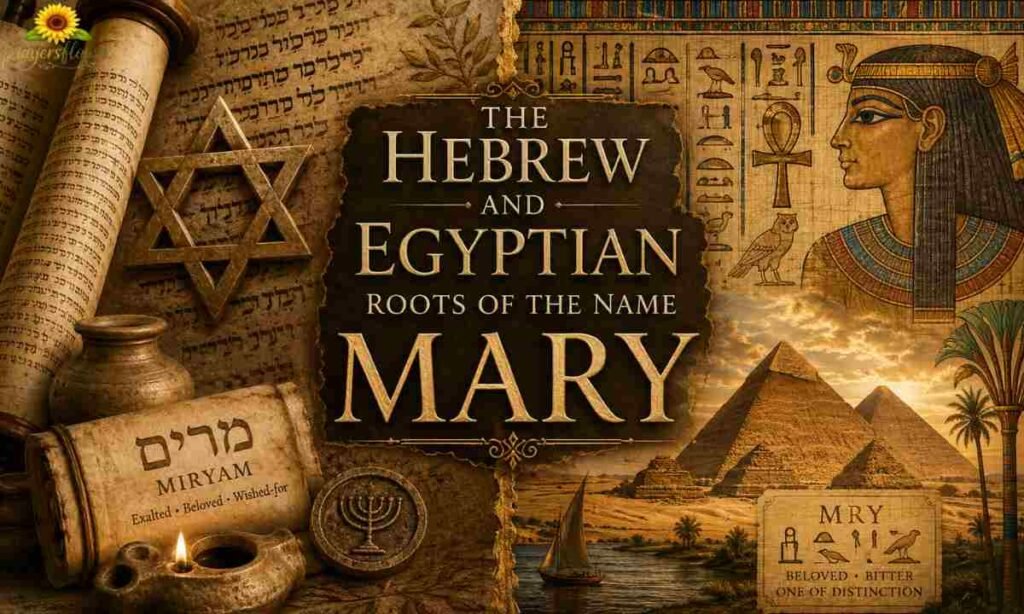
To understand the biblical meaning of the name Mary, you must travel back well before the New Testament — all the way to the Old Testament, to a woman named Miriam. Mary is the Greek and Latin form of the Hebrew name Miriam, the sister of Moses and Aaron, a prophetess and leader of the Israelite women. The two names share the same ancient root, and that root tells a story.
Linguists and biblical scholars trace Miriam — and by extension Mary — to the Hebrew root mara, meaning bitter or bitterness. This is the same word Naomi used in the book of Ruth when she said, “Call me Mara, because the Almighty has made my life very bitter” (Ruth 1:20). It speaks to suffering borne with dignity, to a woman who has walked through fire and come out still standing.
But bitterness is not the only thread. Many scholars also propose the meaning beloved or wished-for child, drawing from alternative Hebrew and Aramaic roots. Some connect the name to the Hebrew marah (to be strong or rebellious) suggesting a woman of fierce inner resolve — not defiant against God, but unyielding in spirit. There is also a compelling case for an Egyptian origin, since Miriam lived in Egypt: the root mr in ancient Egyptian meant love or beloved, and mry was a common element in Egyptian names meaning beloved of God.
What this means is that the name Mary is not one-dimensional. It holds within it the paradox that defines so much of the biblical narrative itself — sorrow and belovedness, bitterness and divine love, existing not in contradiction but in sacred tension.
Miriam: The First Mary of Scripture
Long before the angel Gabriel appeared to a young woman in Nazareth, the name that would become Mary belonged to Miriam, the eldest sibling of Moses. She is one of the most remarkable women of the Old Testament, and understanding her story is essential to grasping the full spiritual meaning of the name Mary.
Miriam first appears in Exodus 2, as a young girl watching over her infant brother Moses in a basket on the Nile — an act of courage and devotion that would shape the destiny of an entire people. Later, in Exodus 15, after the parting of the Red Sea, it is Miriam who leads the women of Israel in song and dance, tambourine in hand, crying out: “Sing to the Lord, for he is highly exalted. Both horse and driver he has hurled into the sea” (Exodus 15:21). She is called a prophetess — the first woman in Scripture given that title.
Miriam’s life was not without shadow. Numbers 12 records her speaking against Moses, and she is struck with leprosy before being restored. This arc — prophetic calling, human failing, divine restoration — mirrors the deep spiritual texture that the name Mary carries forward into the New Testament. She was not a figure of flawless perfection. She was a figure of profound, tested faith.
Keep Feeding Your Faith: Biblical Meaning of the Name David
The Biblical Meaning of the Name Mary in the New Testament
The New Testament is extraordinary in how many women it names Mary. In a world that rarely preserved women’s names in historical records, the Gospel writers mention at least six women who carry this name. That frequency is itself significant — it reflects both the name’s cultural popularity in first-century Jewish society and, to many theologians, a kind of spiritual marking.
The most prominent is, of course, Mary of Nazareth, the mother of Jesus. Luke 1:28 records the angel Gabriel greeting her: “Greetings, you who are highly favored! The Lord is with you.” The Greek word translated “highly favored” is kecharitomene — a unique, perfect passive participle that implies a state of grace already bestowed, not merely anticipated. She did not earn divine favor; she was given it. And yet she responded with complete surrender: “I am the Lord’s servant. May your word to me be fulfilled” (Luke 1:38).
The name Mary, in the life of this woman, becomes a vessel for the entire theology of grace — unearned, transforming, and world-altering.
Mary Magdalene: The Apostle to the Apostles
No discussion of the biblical meaning of the name Mary is complete without Mary Magdalene, one of the most misunderstood and spiritually significant figures in the New Testament. She was not, as centuries of tradition incorrectly assumed, a reformed prostitute. Scripture says only that Jesus drove seven demons from her (Luke 8:2) — a deliverance that forged an unbreakable bond of devotion.
Mary Magdalene followed Jesus throughout his ministry, stood at the cross when most of the disciples had fled, and was the first human being to see the risen Christ (John 20:14-16). When Jesus said her name — “Mary” — she recognized him immediately. That moment is among the most intimate in all of Scripture. The risen Lord’s first spoken word to another person after his resurrection was a woman’s name. This name.
For this reason, the early church fathers called her Apostola Apostolorum — the Apostle to the Apostles. The spiritual meaning of the name Mary is embedded in that title: one who encounters the living God and cannot stay silent about it.
Other Women Named Mary in the Bible
The New Testament does not stop with two. Other women bearing the name Mary include:
Mary of Bethany — the sister of Lazarus and Martha, who sat at Jesus’ feet to learn (Luke 10:39) and anointed him with expensive perfume before his death (John 12:3). Jesus defended her act as preparation for his burial and declared it would be remembered wherever the gospel is preached.
Mary, mother of James and Joseph — mentioned among the women at the crucifixion and at the empty tomb (Matthew 27:56, 28:1). She stood in witness at both the darkest and most glorious moments of the Christian story.
Mary, wife of Clopas — present at the cross (John 19:25), her quiet faithfulness preserved in a single verse.
Mary, mother of John Mark — whose home in Jerusalem served as a gathering place for early Christians (Acts 12:12), making her house a cradle of the early church.
Each of these women named Mary carried the name’s meaning in her own way — through service, witness, sacrifice, or hospitality. Together, they form a constellation of faith.
Spiritual Significance of the Name Mary Across Christian Tradition
Across centuries of Christian thought, the name Mary has accumulated layers of spiritual meaning that go beyond etymology. In Catholic and Orthodox traditions, Mary the mother of Jesus holds a place of singular honor — Theotokos, meaning “God-bearer,” a title affirmed at the Council of Ephesus in 431 AD. Protestant traditions, while more reserved in their Mariology, nonetheless affirm her as among the most blessed of all human beings.
What unites all traditions is the recognition that the name Mary is inseparable from the story of the Incarnation — God becoming human. To carry this name is, in a sense, to carry that story.
For those exploring the biblical meaning of the name Mary for personal spiritual reasons — whether for a child’s name, a confirmation name, or simply for understanding — the name speaks of someone who is called, favored, faithful, and strong. It speaks of a person who can hold both grief and glory without letting either one swallow the other.
For a deeper exploration of Mary’s role in the New Testament and early church history, the Bible Gateway resource on Mary offers access to every scriptural passage in which she appears — an invaluable tool for anyone studying her life in depth.
The Name Mary in Modern Faith and Naming Tradition
The name Mary has been one of the most given names in the Western world for over a thousand years. At its peak in the United States in the 1950s, roughly one in four women was named Mary. Even as naming trends have shifted, it remains a name chosen with intention — by parents who want their daughters to carry something ancient and true.
To name a child Mary is to hand her a lineage: Miriam at the Nile, Mary at the manger, Mary at the cross, Mary at the empty tomb. It is a name that has seen darkness and refused to leave. A name that has spoken truth when it was costly. A name that has been the first to carry resurrection news.
In the spiritual meaning of the name Mary, there is a blueprint for faithful womanhood that is neither passive nor performative — it is present. Wholly, courageously, tenderly present.
FAQs
What is the biblical meaning of the name Mary?
The biblical meaning of the name Mary derives from the Hebrew Miriam, carrying meanings that include “bitter,” “beloved,” and possibly “wished-for child,” all of which are reflected in the lives of the biblical women who bore the name.
What does the name Mary mean spiritually?
Spiritually, the name Mary represents grace, faithful endurance, and divine favor — qualities embodied most fully in Mary the mother of Jesus, who was called “highly favored” by the angel Gabriel.
How many women named Mary are in the Bible?
At least six women named Mary appear in the New Testament, including the Virgin Mary, Mary Magdalene, Mary of Bethany, Mary mother of James, Mary wife of Clopas, and Mary mother of John Mark.
Is the name Mary connected to the Old Testament name Miriam?
Yes — Mary is the Greek and Latin form of the Hebrew name Miriam, the prophetess and sister of Moses, making the name’s roots deeply embedded in the Old Testament long before the New Testament era.
Why is Mary Magdalene significant in the Bible?
Mary Magdalene holds unique biblical significance as the first person to witness the risen Jesus Christ, earning her the early church title Apostola Apostolorum — the Apostle to the Apostles.
Conclusion
The biblical meaning of the name Mary is not a single, fixed definition — it is a living thread woven through the entire story of Scripture, from Miriam’s song at the Red Sea to Mary Magdalene’s trembling joy at an empty tomb. To trace this name is to trace a lineage of women who bore both sorrow and grace with extraordinary faithfulness. It is a name that has stood at every defining moment of redemptive history.
If you carry this name, love someone who does, or are simply drawn to understand it more deeply, let it remind you of something true: the women Scripture chose to name were never incidental. They were essential. And the name Mary, in all its layered, ancient, grace-soaked meaning, remains one of the most beautiful gifts a name can carry.

John Carrol is a Christian writer and prayer minister with over a decade of experience in faith-based content, devotional writing, and spiritual encouragement. Rooted in Scripture and a lifelong love of intercessory prayer, John created PrayersFlower to help believers find the right words when their own run out. His writing draws from pastoral study, personal faith practice, and a deep conviction that prayer is the most powerful act available to the human heart. When he is not writing, John is found in quiet study of the Word, mentoring young believers, and serving his local church community.