

The biblically accurate Lucifer is one of the most misunderstood figures in all of religious history. Centuries of artistic interpretation, theological tradition, and popular culture have painted a picture so distorted from the original scriptural text that most people would be genuinely shocked to discover what the Bible actually says. If you have grown up in a church, watched a Hollywood film, or read any popular fiction involving the devil, you have almost certainly absorbed a version of this figure that owes far more to medieval imagination than to ancient scripture.
To understand the biblically accurate Lucifer is to embark on a journey through Hebrew linguistics, early Christian theology, and the slow drift of religious tradition across millennia. What emerges from that journey is a portrait both more nuanced and more profound than the horned red figure most people picture. The truth challenges assumptions held by believers and skeptics alike, and it carries serious theological implications for how we understand pride, free will, and the origin of evil.
Lord, meet and bless every reader here and grant them success in every area of their life.
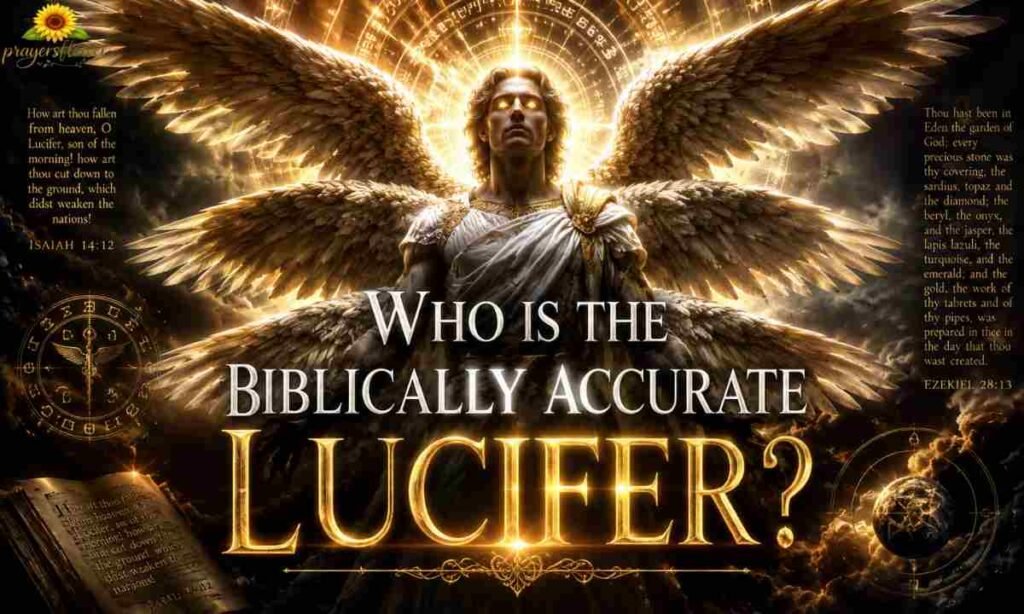
Who Is the Biblically Accurate Lucifer?
Common Misconceptions About Lucifer in Modern Culture
Most people today picture Lucifer as a red-skinned, horned ruler of hell who eternally tortures the damned, a cunning villain draped in darkness and theatrical menace. This image has been so thoroughly embedded in Western culture that even many devoted Christians accept it without question. Novels, films, television series, and heavy metal album covers have all contributed to a version of this figure that is more theatrical construct than biblical truth. The name itself is often used interchangeably with Satan, Beelzebub, and the devil, as though they are all simply different titles for a single cosmic villain.
None of this, however, reflects what the Bible actually teaches. The word Lucifer appears only once in the entire Protestant Bible, in a single passage in the book of Isaiah. It describes not an eternal supernatural villain but a specific king whose pride led to his downfall. Understanding this requires stepping back from centuries of accumulated tradition and returning directly to the text.
What Scripture Actually Reveals About Lucifer
Scripture is far more restrained about the figure commonly called Lucifer than popular culture suggests. There are only two Old Testament passages that theologians have traditionally associated with the pre-fall identity of this being: Isaiah 14 and Ezekiel 28. Both passages are addressed to earthly rulers, the king of Babylon and the king of Tyre, yet both contain imagery that many scholars believe points beyond those mortal figures to a heavenly being whose rebellion preceded human history. These passages, read carefully and in their original languages, tell a story quite different from the one most people have heard.
The Hebrew Original: Helel and Its True Meaning
The word translated as Lucifer in many older Bible versions comes from the Hebrew word Helel, specifically the phrase Helel ben Shachar, which means shining one, son of the dawn. This is a title of radiance and brilliance, evoking the planet Venus as it appears before sunrise, outshining every other star in the pre-dawn sky. There is no darkness, malice, or sinister connotation in the original Hebrew term. It is a name of luminous beauty, which makes the subsequent fall all the more dramatic. The original word carries no meaning of devil, tempter, or ruler of hell. It simply describes something extraordinarily bright.
Jerome’s Latin Vulgate and the Birth of ‘Lucifer’
When the scholar Jerome translated the Hebrew scriptures into Latin in the late fourth century, producing the text known as the Vulgate, he rendered Helel ben Shachar as Lucifer, a Latin word meaning light-bearer or light-bringer. This was a reasonable translation choice. In Latin, Lucifer was not a sinister name at all. It was used in classical Latin poetry to describe the morning star, and even early Christian writers used the word Lucifer to refer to Christ himself as the bringer of spiritual light. The name only became permanently associated with the devil through centuries of theological tradition layering new meaning onto Jerome’s translation. You can explore the original manuscript traditions through the scholarly resources available at the Biblia Sacra Vulgata online archive (https://www.thelatinlibrary.com/bible.html) to see how this translation developed.
Biblically Accurate Description of Lucifer’s Appearance
Lucifer’s Pre-Fall Glory According to Ezekiel
The most detailed physical description associated with the being scholars identify as the pre-fall Lucifer comes from Ezekiel 28, in the lament over the king of Tyre. The passage describes a being of extraordinary beauty who was adorned with every kind of precious stone: sardius, topaz, and diamond, beryl, onyx, and jasper, sapphire, turquoise, and emerald. This being is described as the seal of perfection, full of wisdom and perfect in beauty. He is placed in Eden, the garden of God, and described as an anointed guardian cherub who walked on the holy mountain of God among the fiery stones. This is not the image of a red-horned devil. This is the image of a being of breathtaking luminosity and elevated heavenly rank.
The Morning Star Imagery in Isaiah’s Prophecy
Isaiah 14 adds another layer to the portrait. The prophetic taunt song addressed to the king of Babylon asks how the shining one, son of the dawn, has fallen from heaven. The passage describes a being who once shone brighter than all others in the heavenly assembly but was cast down to the depths of the earth because of overreaching pride. The Morning Star imagery in this passage was potent and evocative to an ancient audience who watched Venus blazing brilliantly in the eastern sky before the sun rose, only to disappear when the greater light arrived. The fallen morning star had been the brightest of all, and yet it could not endure.
Does Lucifer Possess a Physical Form After His Fall?
The Bible says remarkably little about the physical nature of Lucifer or Satan after any presumed fall. Scripture speaks of spiritual beings in ways that defy simple physical categorization. There is no biblical passage that describes the post-fall biblically accurate Lucifer as possessing a body with wings, horns, a tail, or any other physical attribute. The New Testament describes the adversary as a roaring lion and as an angel of light, both of which are clearly figurative. The physical form familiar from medieval iconography has no scriptural basis whatsoever.
What Biblical Silence Tells Us Lucifer Is Not
Biblical silence is itself instructive. The Bible never describes the biblically accurate Lucifer as the ruler of hell, since Revelation indicates that even Satan has not yet been cast into the lake of fire as a permanent resident. The Bible does not portray him as the opposite or equal of God, a kind of dark deity balanced against divine light. Scripture consistently presents the adversary as a created being operating under divine permission, not as an autonomous cosmic power. The dramatic dualism of popular imagination, the eternal war between equal forces of good and evil, is far more Zoroastrian than it is biblical.
The Critical Distinction Between Lucifer and Satan in Scripture
Biblical Evidence Supporting Their Distinction
One of the most significant discoveries that emerges from careful biblical scholarship is that the term Lucifer, appearing only in Isaiah 14, is nowhere in that passage directly identified as Satan. The Hebrew text identifies the subject as the king of Babylon. The leap from that figure, whether understood as purely human or as pointing to a heavenly archetype, to the New Testament figure called Satan requires interpretive steps that are not made explicit in the text itself. The word satan in the Old Testament is not always a proper name. In Hebrew, the word means adversary or accuser and is used to describe both human and divine opponents in various contexts.
How Christian Tradition Merged These Figures
The identification of Lucifer with Satan was not an invention of any single theologian. It developed gradually across the early and medieval church as various passages from Isaiah, Ezekiel, Luke 10, Revelation 12, and other texts were woven together into a single coherent narrative. The early church fathers, including Origen and Tertullian, contributed to this synthesis, interpreting the Old Testament cosmic imagery through a New Testament lens shaped by belief in Jesus Christ’s victory over spiritual powers. By the medieval period this merged figure had become so entrenched in Christian imagination that few questioned whether it reflected the actual structure of the biblical text.
Protestant Reformers’ Rejection of the Equation
Interestingly, several Protestant reformers were skeptical of the identification of Isaiah 14 with a fallen angelic being. John Calvin himself argued that the passage referred strictly to the king of Babylon and not to a supernatural adversary at all. He was concerned that reading cosmic drama into a historical taunt song distorted the plain meaning of the text. This Reformed caution about over-allegorizing Old Testament passages represents a serious scholarly tradition that is often forgotten in modern popular discussions of the biblically accurate Lucifer.
Why This Theological Distinction Matters Today
This distinction matters because it shapes how Christians and others understand the origin and nature of evil. If Lucifer and Satan are not straightforwardly identical, then the traditional cosmic narrative of a once-glorious angel turning evil and becoming the eternal adversary requires more careful scriptural grounding than is often acknowledged. It also matters for pastoral reasons, since an inflated theology of demonic power can lead believers into either excessive fear of spiritual forces or into a dualistic worldview that Scripture itself does not support.
Keep Feeding Your Faith: The Biblical Meaning of the Cross: God’s Greatest Act of Love Explained
The Fall of Lucifer: Biblical Account and Significance
The Narrative of the Fallen Angel in Scripture
The narrative most commonly associated with the fall of the biblically accurate Lucifer draws primarily on two texts: Isaiah 14:12–15 and Ezekiel 28:12–19, supplemented by the New Testament statement in Luke 10:18 where Jesus says he saw Satan fall like lightning from heaven, and Revelation 12 which describes a war in heaven. Together these passages have been used to construct a narrative in which a supremely beautiful and powerful angelic being, created perfect and placed in the highest position of the heavenly host, chose through pride to rebel against God and was cast down from his exalted position.
Lucifer’s Five ‘I Will’ Declarations of Pride
Isaiah 14 contains five declarations of intent, each beginning with the words I will, that have been interpreted as the expression of the rebellious pride that caused the fall. The fallen morning star declares he will ascend to the heavens, that he will raise his throne above the stars of God, that he will sit enthroned on the mount of assembly on the utmost heights, that he will ascend above the tops of the clouds, and that he will make himself like the Most High. These five I will statements represent in theological tradition the distilled essence of creaturely pride: the desire of a created being to displace its Creator and claim divine status for itself.
The Nature of Sin: Pride Within Created Perfection
What makes the fall of the biblically accurate Lucifer theologically remarkable is that it took place within a being that Ezekiel describes as perfect. This was not a flawed creature driven to sin by deprivation or weakness. This was a being who possessed wisdom and beauty in full measure, who occupied the highest place in the divine order, and who still chose pride. The sin was not born of poverty but of abundance. The very gifts and position this being possessed became the occasion for the temptation. This observation carries profound implications for human experience, suggesting that privilege and gifting create their own particular spiritual dangers.
The Catastrophic Consequences of Angelic Rebellion
The consequences described in scripture for this rebellion are depicted in the most dramatic terms available in prophetic literature. The being once described as walking among the fiery stones on the holy mountain of God is cast down to earth and eventually to the pit. The Morning Star that outshone all others becomes an object of contempt. Those who see this being in its reduced state are said to stare and ponder whether this is truly the one who shook the earth and made kingdoms tremble. The catastrophic reversal from supreme glory to utter ruin is presented as both a historical event and a theological demonstration: pride destroys even the most gifted of created beings.
The Scope of Rebellion: One-Third of the Angels
Revelation 12 describes a war in heaven in which a great dragon swept a third of the stars of heaven with his tail and flung them to the earth. This passage has been widely interpreted in Christian tradition as a description of the rebellion in which the fallen morning star drew a vast number of angelic beings into his rebellion, with that number being understood symbolically as one third of the heavenly host. If this interpretation is correct, the rebellion of the biblically accurate Lucifer was not a solitary act of pride but the beginning of a cosmic catastrophe that corrupted a substantial portion of the angelic order and introduced demonic beings into the spiritual architecture of the created order.
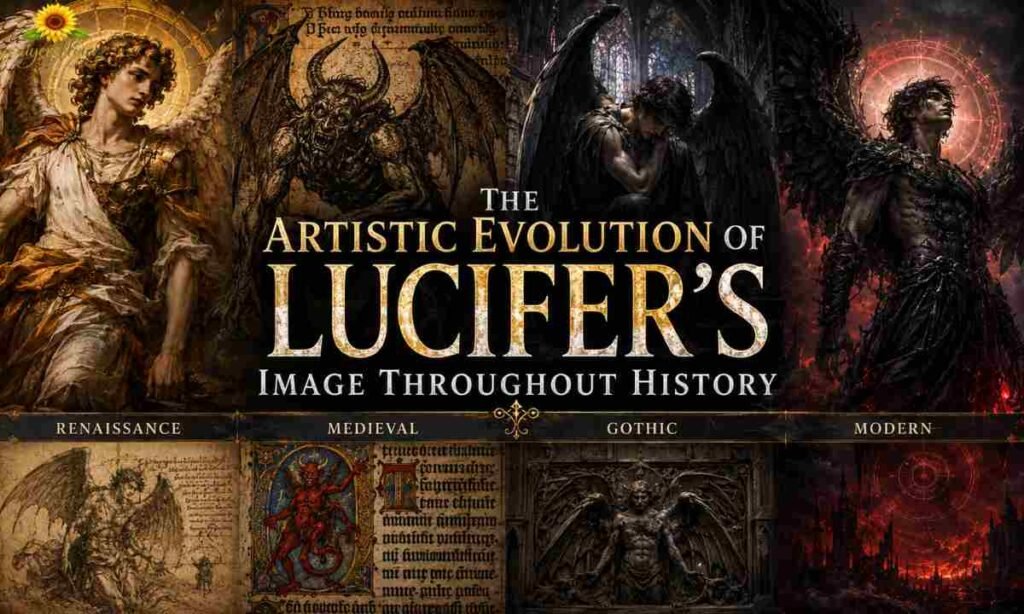
The Artistic Evolution of Lucifer’s Image Throughout History
Early Medieval Period: The Ethereal Blue Angel
In early medieval Christian art, depictions of Lucifer before his fall often portrayed him as a luminous blue angel of extraordinary beauty. Manuscripts from the Carolingian period show a being of ethereal grace, marked by light rather than darkness. This reflected the theological emphasis on the perfection of the pre-fall state and understood the tragedy of the fall as the corruption of something genuinely magnificent. The blue tones were associated with heaven and celestial beings, and the beauty of the figure was understood as theologically necessary: the fall only makes sense as a fall from something worth having.
High Medieval Period: The Transformation to Grotesque Forms
By the high medieval period, theological concerns about the danger of making evil attractive led artists to transform the image dramatically. The beautiful angel gave way to grotesque forms with multiple faces, bat wings, and animalistic features. Dante’s Inferno, composed in the early fourteenth century, depicts Satan as a three-headed giant frozen in ice at the lowest point of hell, as far as possible from the warmth and light of God. This was a theological statement in visual and literary form: the ultimate end of pride is not glamorous power but frozen, mindless degradation.
The Renaissance: Milton’s Tragic Rebel
The Renaissance and particularly the seventeenth century saw a dramatic rehabilitation of the figure’s literary potential. John Milton’s Paradise Lost, published in 1667, created the most influential literary portrait of the biblically accurate Lucifer in the English language, presenting him as a tragic rebel of magnificent rhetoric and heroic bearing whose pride leads him to prefer ruling in hell over serving in heaven. Milton’s Satan is given the most memorable speeches in the poem and has been interpreted by readers from William Blake onward as the poem’s true hero. This romanticization of the fallen angel has had an enormous and largely unacknowledged influence on how Western culture thinks about rebellion, individualism, and the appeal of transgression.
Victorian Era Through Modern Times: The Theatrical Red Devil
The theatrical red devil with horns, pitchfork, and pointed tail that dominates Halloween imagery and cartoon shorthand is largely a product of the Victorian era’s popularization of folk images. This figure draws on classical imagery of Pan and other pagan deities, combined with medieval grotesque traditions and theatrical conventions. By the twentieth century this image had become so dominant in popular culture that it effectively displaced all other representations. Modern film and television have produced further iterations, from the suave sophisticated tempter of countless thrillers to the conflicted romantic lead of recent urban fantasy series. None of these representations bear more than a superficial relationship to the scriptural portrait.
The Stark Contrast Between Artistic and Biblical Portrayals
The contrast between the artistic tradition and the biblically accurate Lucifer could hardly be more stark. Scripture presents a being of perfection who chose pride, a morning star whose radiance was genuine before it fell, a guardian cherub of the highest order whose gifts made his rebellion all the more inexplicable and all the more terrible. Art has given us alternately a monster, a romantic rebel, a comic figure, and a suave villain. The biblical portrait is in many ways more unsettling than any of these, precisely because it demands that we take seriously the possibility that genuine beauty and perfection can become the occasion for catastrophic pride.
Theological Insights from a Biblically Accurate Lucifer
The Paradox of Created Perfection and Free Will
The account of the biblically accurate Lucifer forces a serious engagement with one of the most difficult questions in theology: how can a perfect being sin? If this angelic figure was created perfect, as Ezekiel states, then the capacity for sin cannot simply be explained by created weakness or ignorance. The most compelling theological answer involves free will. A being that is compelled to choose good is not genuinely choosing good. Genuine moral goodness requires the genuine capacity for moral failure. The fall of this radiant being demonstrates that even the most glorious created existence remains genuinely free and genuinely capable of turning away from its source.
The Origin of Evil Within a Perfect Creation
The fall of the biblically accurate Lucifer addresses one of philosophy’s hardest problems: the origin of evil. If God created everything good, where did evil come from? The answer that emerges from this narrative is that evil is not a substance or a created thing but a privation, a turning away, a choosing of self over source. Evil entered the cosmos not through God’s creation but through the free choice of a created being who possessed everything and chose to grasp for more. Evil is therefore parasitic on the good rather than an independent power. This has profound implications for how spiritual warfare is understood: the adversary is not a creator or a sovereign but a rebel operating on borrowed time within a universe that is not ultimately his.
Pride’s Specific Danger: The Temptation of Giftedness
The theological portrait of the biblically accurate Lucifer offers a sobering insight about the particular dangers of gifting and position. This being was not tempted through envy of what others possessed. He was tempted through the very excellence he himself embodied. His wisdom, his beauty, his elevated position among the heavenly host all became the soil in which pride took root. The five I will declarations were not the desperate grasping of a being with nothing. They were the overreach of a being who had almost everything and could not bear the remaining distance between himself and the divine. This is a warning that Scripture appears to direct with particular force toward those in positions of spiritual leadership and exceptional ability.
Cosmic Implications: Corrupting Others and Spiritual Warfare
The fall of the biblically accurate Lucifer did not remain a private catastrophe. His rebellion drew other angelic beings with him, and his subsequent work in the narrative of Scripture involves the ongoing corruption of human beings, beginning in Eden and continuing through the arc of biblical history. This gives his fall cosmic rather than merely personal significance. It introduces into the created order a force of deception and accusation that Scripture consistently portrays as hostile to human flourishing and to the purposes of God. Understanding spiritual warfare biblically requires neither an inflated mythology that elevates the adversary to near-divine status nor a dismissive skepticism that denies any real spiritual dimension to human struggle.
Lessons for Humanity: Humility and Dependence on God
Perhaps the most direct application that emerges from the account of the biblically accurate Lucifer is the imperative of humility. The being who possessed the most of any created being was destroyed by the refusal to acknowledge dependence on the Creator who gave him everything. The five I will statements are ultimately a declaration of independence from God, an assertion that creaturely glory can sustain itself. The theological tradition that has reflected on this narrative consistently draws the same lesson: human beings, like angels, are derivative beings whose gifts are not their own achievement, whose position is not their own accomplishment, and whose very existence depends on a continuous relationship with the God who made them. Pride, understood in this biblical sense, is not merely a character flaw but a form of ontological confusion about the nature of creaturely existence.
Summary: The Biblically Accurate Lucifer
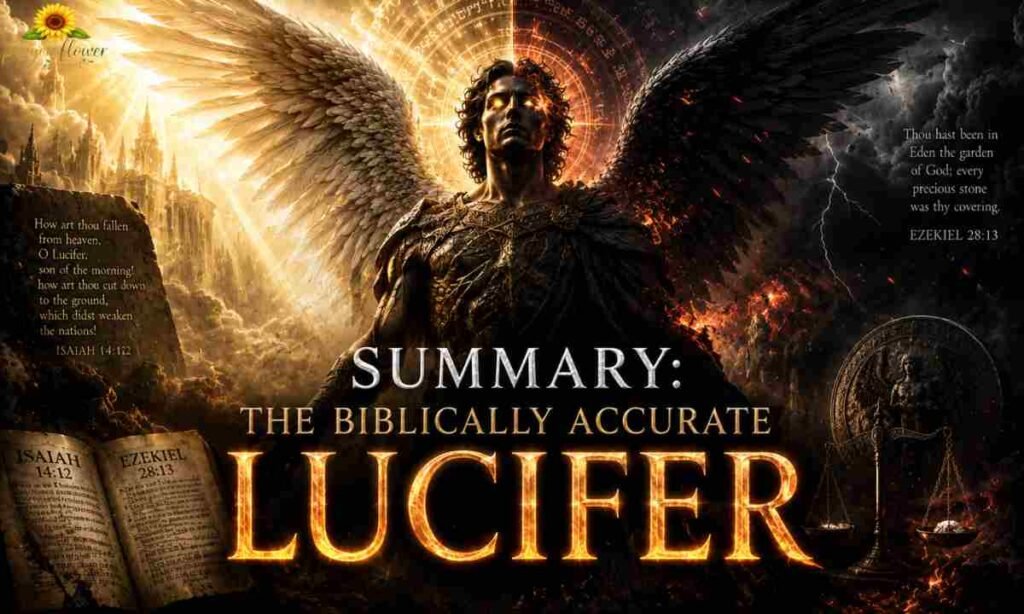
The biblically accurate Lucifer is a figure far more complex, far more sobering, and far more theologically rich than popular culture has ever allowed. He is not the red-horned cartoon villain, the romantic rebel of Milton’s imagination, or the equal and opposite of God. He is, according to the scriptural texts that address him most directly, a being of created perfection who possessed wisdom, beauty, and the highest position in the angelic order, and who chose pride over praise, independence over dependence, and self-exaltation over service. The name itself, rooted in the Hebrew Helel and the Latin Lucifer, means light-bearer, and that original luminosity makes the fall all the more profound. The biblically accurate Lucifer stands as scripture’s most dramatic illustration of the truth that pride, especially the pride of the gifted and the exalted, leads not to the ascent it promises but to the most catastrophic descent imaginable. His story is not primarily about a supernatural villain. It is a mirror held up to human pride, and what it reflects is something we would do well to take seriously.
Frequently Asked Questions
What does the biblically accurate Lucifer actually look like?
According to Ezekiel 28, the biblically accurate Lucifer was a being of breathtaking beauty, adorned with precious stones and described as the seal of perfection — nothing like the red-horned devil of popular culture.
How many times is the biblically accurate Lucifer mentioned by name in the Bible?
The name Lucifer appears only once in the entire Protestant Bible, in Isaiah 14:12, where it is a Latin translation of the Hebrew word Helel, meaning “shining one, son of the dawn.”
Is Lucifer the same as Satan, or are they different fallen angels?
They are not explicitly identified as the same being in scripture; the merging of Lucifer with Satan happened gradually through early church tradition, not through a direct biblical statement.
What is the meaning of the morning star in relation to Lucifer’s fall?
The morning star imagery in Isaiah 14 describes a being of supreme brilliance — like Venus before sunrise — whose pride caused him to be cast down, making the fall all the more dramatic by contrast.
Where does the popular image of the horned devil come from if not the Bible?
The horned, red-skinned devil has no scriptural basis; it evolved from medieval grotesque art, Victorian folk imagery, and classical depictions of the pagan god Pan, not from any biblical description.
Our Thoughts
The biblically accurate Lucifer reminds us that real danger often comes not from obvious evil but from the subtle corruption of pride within gifted people. Understanding this figure accurately through scripture rather than through cultural myths is one of the most important steps a serious student of the Bible can take.
When we strip away centuries of artistic distortion and return to what the Bible actually says, the biblically accurate Lucifer becomes a far more instructive and convicting figure than the theatrical villain of popular imagination. His story is ultimately our story, and the humility it calls for is the foundation of genuine spiritual health.

John Carrol is a Christian writer and prayer minister with over a decade of experience in faith-based content, devotional writing, and spiritual encouragement. Rooted in Scripture and a lifelong love of intercessory prayer, John created PrayersFlower to help believers find the right words when their own run out. His writing draws from pastoral study, personal faith practice, and a deep conviction that prayer is the most powerful act available to the human heart. When he is not writing, John is found in quiet study of the Word, mentoring young believers, and serving his local church community.