

**The Lord’s Prayer is not simply a memorized recitation — it is the most complete framework for human communion with God ever spoken aloud.**
For centuries, believers in grief, in joy, in confusion, and in desperate need have turned to these words. There is something about the Lord’s Prayer that holds you even when you cannot find your own language for what you are feeling. It was given to ordinary people by Jesus himself, and it still carries that same weight today.
This article walks through every dimension of the Lord’s Prayer — its full text in multiple trusted versions, its line-by-line meaning, its Jewish roots, its global reach, and the most sacred way to pray it with genuine intention. Whether you are returning to this prayer after years away or meeting it for the very first time, what follows will change the way you speak to God.
Lord, meet and bless every reader here and grant them success in every area of their life.
Key Takeaways
– The full text of the Lord’s Prayer appears in two distinct biblical versions: Matthew 6:9-13 and Luke 11:2-4, each with important theological differences.
– Every line of the Lord’s Prayer carries layered meaning — this guide unpacks each petition with depth and clarity.
– Catholics and Protestants pray slightly different versions, and this article explains exactly why.
– You will find a complete step-by-step guide for praying the Lord’s Prayer with intention, not just repetition.
The Complete Lord’s Prayer Full Text — 3 Most Trusted Versions: KJV, Catholic and Modern
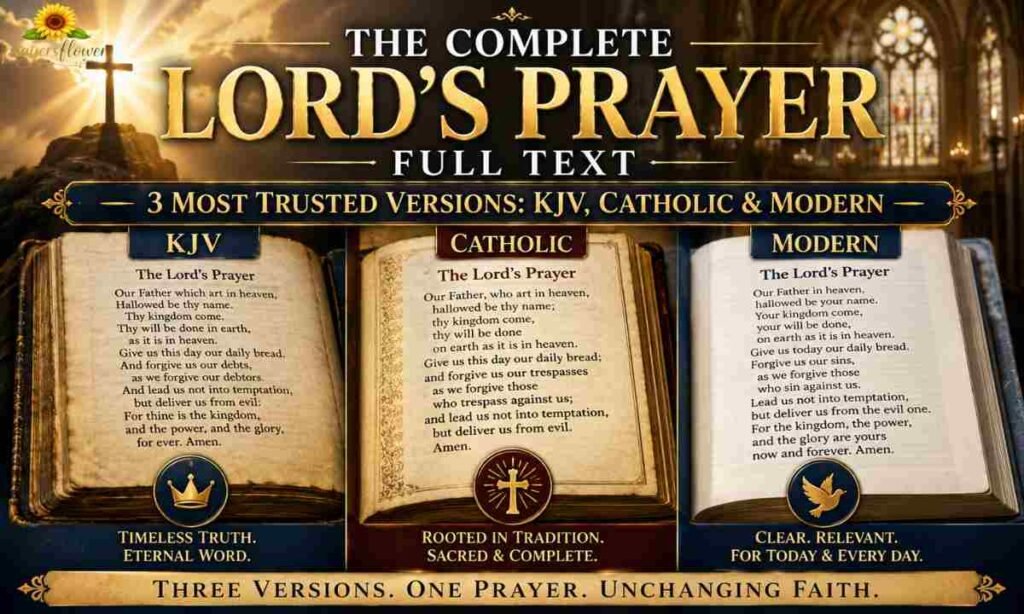
These are the three versions most widely prayed across the world today.
– “Our Father, who art in heaven, hallowed be thy name; thy kingdom come; thy will be done on earth as it is in heaven. Give us this day our daily bread; and forgive us our trespasses as we forgive those who trespass against us; and lead us not into temptation, but deliver us from evil. Amen.” (Catholic version)
– “Our Father which art in heaven, Hallowed be thy name. Thy kingdom come, Thy will be done in earth, as it is in heaven. Give us this day our daily bread. And forgive us our debts, as we forgive our debtors. And lead us not into temptation, but deliver us from evil: For thine is the kingdom, and the power, and the glory, for ever. Amen.” (KJV)
– “Our Father in heaven, hallowed be your name, your kingdom come, your will be done, on earth as in heaven. Give us today our daily bread. Forgive us our sins as we forgive those who sin against us. Save us from the time of trial and deliver us from evil. For the kingdom, the power, and the glory are yours now and for ever. Amen.” (Modern ecumenical version)
The Lord’s Prayer Word for Word: The Critical Differences Between Matthew 6:9-13 and Luke 11:2-4
Matthew’s version is longer and more doxological; Luke’s is stripped down and intimate.
– Matthew’s Lord’s Prayer includes the doxology (“For thine is the kingdom”) while Luke’s account ends simply at “deliver us from evil.”
– Luke’s version opens with “Father” while Matthew uses the fuller address “Our Father in heaven,” suggesting a different liturgical setting.
– Matthew presents the Lord’s Prayer in the context of teaching against hypocrisy; Luke records it as a direct response to a disciple’s request.
– The word translated “debts” in Matthew becomes “sins” in Luke, reflecting two early Christian communities with different theological emphases.
What Does the Lord’s Prayer Really Mean? The Most Thorough Line-by-Line Breakdown You’ll Find
Every phrase of the Lord’s Prayer carries weight that a single reading rarely captures.
– “Our Father” — the word “our” immediately removes isolation; you are never praying alone when you pray the Lord’s Prayer.
– “Hallowed be thy name” — this is a declaration, not a request; it affirms that God’s name is already holy before anything is asked.
– “Thy kingdom come” — a prayer for God’s reign to become as visible on earth as it already is in heaven.
– “Thy will be done” — this line is submission and trust wrapped into a single breath.
– “Give us this day our daily bread” — a request for enough, not excess; a posture of daily dependence.
– “Forgive us our trespasses” — the Lord’s Prayer ties our receiving of forgiveness directly to our giving of it.
– “Lead us not into temptation” — an acknowledgment that without God’s guidance, our own choices can destroy us.
– “Deliver us from evil” — a cry for protection from forces larger than ourselves.
– “For thine is the kingdom” — an ending that returns all glory to God, completing the circle the prayer began.
“Our Father Who Art in Heaven” — The Powerful Opening Address That Changes Everything About How You Pray
The first four words of the Lord’s Prayer restructure your entire relationship with God.
– Calling God “Father” in the Lord’s Prayer was culturally radical — Jesus offered intimacy where religion had previously offered only distance.
– “Who art in heaven” does not mean God is far away; it means God exists above every earthly limitation that confines us.
– The Lord’s Prayer begins with relationship, not request — this sequence is not accidental; it is instructional.
– Praying “Our Father” rather than “My Father” places every believer in community from the very first syllable.
The 7 Sacred Petitions of the Lord’s Prayer — Each One Explained With Depth and Clarity
The Lord’s Prayer contains seven distinct requests, perfectly balanced between God’s concerns and ours.
– Petition one: “Hallowed be thy name” — orient your heart toward God’s glory before your own needs.
– Petition two: “Thy kingdom come” — align your deepest hope with God’s ultimate purpose for creation.
– Petition three: “Thy will be done” — surrender your timeline and your plan to the one who sees all things.
– Petition four: “Give us our daily bread” — ask God for exactly what you need today, not a stockpile for tomorrow.
– Petition five: “Forgive us our trespasses” — bring your honest failures to God without editing them.
– Petition six: “Lead us not into temptation” — ask God to be your guide through the places where you are weakest.
– Petition seven: “Deliver us from evil” — trust God as your protector against what you cannot fight alone.
What Does “Hallowed Be Thy Name” Mean Today? The Most Searched Line Finally Explained
“Hallowed” is a word almost no one uses in daily conversation, yet it carries the theological heart of the entire Lord’s Prayer.
– “Hallowed” comes from the Old English word for holy; to hallow something is to treat it as set apart, sacred, and worthy of reverence.
– When we pray “hallowed be thy name” we are not informing God that his name is holy — we are aligning our own hearts with that reality.
– In Hebrew tradition, the name of God represents his entire character; to hallow the name is to honor who God actually is.
– This line of the Lord’s Prayer invites the one praying to stop and consider God’s nature before asking for anything at all.
“Give Us This Day Our Daily Bread” — The Profound Spiritual and Practical Truth Behind These 9 Words
These nine words in the Lord’s Prayer are among the most quietly powerful in all of Scripture.
– The word “daily” in the original Greek (epiousios) appears almost nowhere else in ancient literature — it likely means “bread for the coming day” or “bread that is sufficient.”
– This line of the Lord’s Prayer teaches contentment by design; the prayer does not ask for abundance, only enough.
– “Us” and “our” appear again here — the Lord’s Prayer does not allow for private hoarding even in its requests for provision.
– Praying for daily bread is an act of trust repeated every single morning, which is exactly what Jesus intended.
“Lead Us Not Into Temptation” — What Jesus Truly Meant and Why the Pope Made a Historic Change
This line of the Lord’s Prayer has generated more theological debate than almost any other.
– The concern is grammatical and theological: does God lead people into temptation? James 1:13 says directly that God tempts no one.
– In 2017, Pope Francis publicly suggested that the traditional Italian translation of this petition was misleading, sparking global conversation.
– The French Catholic Church revised its translation in 2017 to read “do not let us fall into temptation,” which better reflects the underlying Greek.
– Jesus most likely meant: “do not bring us to the place of testing” — a prayer for divine protection from the circumstances that break us.
– This petition of the Lord’s Prayer is less about God’s nature and more about our own fragility — a humble admission that we need guidance.
Keep Feeding Your Faith: 150+ Powerful Warfare Prayer Points Against Enemies That Will Destroy Every Attack and Give You Total Victory
“For Thine Is the Kingdom” — The Powerful Reason Catholics and Protestants End This Prayer Differently
The doxology at the end of the Lord’s Prayer has divided liturgical traditions for over a thousand years.
– The closing doxology, “for thine is the kingdom, and the power, and the glory,” is absent from the oldest Greek manuscripts of Matthew’s Gospel.
– Most scholars believe it was added by early Christian communities for liturgical use, not by Jesus himself.
– Protestant churches retained the doxology during the Reformation; Catholic liturgy removed it in alignment with the oldest manuscript tradition.
– Both traditions are praying faithfully — the difference reflects manuscript choices, not theological disagreement about God’s glory.
Where Did the Lord’s Prayer Come From? The Fascinating Biblical and Historical Origins Revealed
The Lord’s Prayer did not emerge from a vacuum — it grew from centuries of Jewish prayer practice.
– Jesus taught the Lord’s Prayer in response to a disciple’s simple request: “Lord, teach us to pray” (Luke 11:1).
– The prayer reflects the structure of the Jewish Kaddish, an ancient Aramaic prayer that also opens with praise of God’s name and a longing for his kingdom.
– The Lord’s Prayer is found in the Didache, a first-century Christian document, suggesting it was used in worship gatherings within decades of Jesus’ lifetime.
– Research published by theological scholars at institutions like Yale Divinity School confirms that the Lord’s Prayer belongs to a rich tradition of Second Temple Jewish liturgy.
The Lord’s Prayer in the Sermon on the Mount — The Essential Context in Matthew 6 Every Believer Must Know
Matthew 6 places the Lord’s Prayer in a remarkably specific teaching moment.
– Jesus introduces the Lord’s Prayer by criticizing two forms of false prayer: public performance (Matthew 6:5) and empty repetition (Matthew 6:7).
– The Lord’s Prayer is presented as an antidote to both — it is private, sincere, and purposefully brief.
– Jesus says “pray then like this,” suggesting the Lord’s Prayer is a model to learn from, not a script to repeat mechanically.
– The Sermon on the Mount context makes clear that the spirit behind the words matters more than the words themselves.
How the Lord’s Prayer Powerfully Draws From 3,000 Years of Jewish Prayer Tradition
The Lord’s Prayer is deeply Jewish in structure, vocabulary, and theological priority.
– The opening address “Our Father in heaven” mirrors the Hebrew “Avinu Malkeinu,” meaning “Our Father, our King” — a phrase still prayed in Jewish High Holiday liturgy.
– The petition for forgiveness of debts echoes the Year of Jubilee concept in Leviticus 25, where all debts were cancelled before God.
– Jewish daily prayer (the Amidah) also petitions for provision, forgiveness, and protection from evil — the same sequence the Lord’s Prayer follows.
– Understanding this Jewish context deepens the Lord’s Prayer rather than complicating it; it roots the prayer in millennia of human longing toward God.
Catholic vs. Protestant Lord’s Prayer — 5 Key Differences Every Christian Should Understand
The Lord’s Prayer is shared, but the traditions praying it are not identical.
– Catholics end the Lord’s Prayer with “deliver us from evil. Amen” during Mass, reserving the doxology for a separate embolism prayer by the priest.
– Protestants include “for thine is the kingdom, and the power, and the glory, for ever and ever. Amen” as part of the congregational prayer.
– Catholics use “trespasses” in the wording; some Protestant denominations use “debts” or “sins” depending on their translation tradition.
– The Catholic Lord’s Prayer follows the liturgy of the Roman Rite; Protestant versions often follow the 1662 Book of Common Prayer wording.
– Both communities consider the Lord’s Prayer sacred and central; the differences are liturgical, not doctrinal.
Keep Feeding Your Faith: 7 Swords of St Michael Prayer
The Lord’s Prayer in Latin (Pater Noster) — Full Sacred Text, Word-for-Word Translation and Meaning
The Latin Lord’s Prayer carried the faith of the Western Church for more than a thousand years.
– “Pater noster, qui es in caelis” means “Our Father, who art in heaven” — the Latin preserves the intimate address of the original.
– “Sanctificetur nomen tuum” translates as “hallowed be thy name” — the word “sanctificetur” shares its root with “sanctify” and “saint.”
– “Fiat voluntas tua” means “thy will be done” — the same word “fiat” used at creation in Genesis: “let it be.”
– “Panem nostrum quotidianum da nobis hodie” is “give us this day our daily bread” — the word “quotidianum” gives us the English word “quotidian,” meaning daily or ordinary.
– The Latin Lord’s Prayer shaped the architecture of Western prayer for centuries and still carries enormous spiritual weight in liturgical settings.
Traditional vs. Modern Lord’s Prayer — Which Version Is More Faithful, Powerful and Right for You?
The choice between traditional and modern language in the Lord’s Prayer is ultimately a matter of heart, not hierarchy.
– The traditional Lord’s Prayer uses thee, thy, and art — language that creates distance from casual speech and signals sacred space.
– Modern versions of the Lord’s Prayer use “you” and “your,” which can feel more conversational and immediate.
– Neither version is more faithful in terms of theology; both translate the same Greek source text with integrity.
– Studies on prayer and emotional connection, including research covered by outlets like Psychology Today on how personal language shapes spiritual experience, suggest that the version you connect with most deeply is often the most effective for your prayer life.
– The Lord’s Prayer works in any honest translation because the Spirit prays through the intention, not the vocabulary.
How to Pray the Lord’s Prayer the Right Way — A Complete Step-by-Step Guide for Every Believer
There is no single right posture for the Lord’s Prayer, but there is a right spirit.
– Step one: Be still. Before speaking the first word of the Lord’s Prayer, pause long enough to mean what you are about to say.
– Step two: Begin with “Our Father” and let those words actually land — you are speaking to someone, not reciting a text.
– Step three: Move through the petitions slowly, pausing at each line to consider what it means for your life today.
– Step four: When you reach “forgive us,” stop and be honest — name what you actually need forgiven before continuing.
– Step five: Pray “lead us not into temptation” with a specific situation in mind; make the petition personal.
– Step six: End with the doxology as a returning of all things to God, completing the circle from relationship to surrender to praise.
Is the Lord’s Prayer a Script or a Divine Template? What Jesus Actually Intended Will Surprise You
Jesus said “pray like this” — not “pray these exact words every time.”
– The Lord’s Prayer functions as a skeleton, not a script; it shows the shape of faithful prayer without locking it into fixed syllables.
– When Jesus criticised “vain repetition” just verses before teaching the Lord’s Prayer, he was warning against using this very prayer without meaning.
– The Lord’s Prayer covers every dimension of the human relationship with God: worship, surrender, need, forgiveness, protection, and praise.
– Using the Lord’s Prayer as a template means expanding each petition into your own words rather than rushing through the whole text in thirty seconds.
How to Use the Lord’s Prayer as a Powerful Daily Prayer Framework That Transforms Your Spiritual Life
Many believers find that the Lord’s Prayer restructures not just their prayer time but their entire orientation toward each day.
– Begin each morning with the Lord’s Prayer spoken slowly, one petition at a time, and journal what surfaces in your heart under each line.
– Use “thy will be done” as an anchor phrase throughout the day — when anxiety rises, return to that one petition.
– At midday, pause at “give us our daily bread” and name three specific things you are trusting God to provide.
– Before sleep, pray through “forgive us our trespasses” honestly, naming what happened in the day that needs release.
– Over time, the structure of the Lord’s Prayer becomes internal — it reshapes how you think about need, forgiveness, and purpose.
Keep Feeding Your Faith: 7 Powerful Daily Prayers for Every Day of the Week
The Best and Most Effective Ways to Teach the Lord’s Prayer to Children at Every Age
Children can learn the Lord’s Prayer long before they fully understand it — and that is not a problem but a gift.
– For children under six, teach the Lord’s Prayer as a rhythm: sing it, clap it, whisper it at bedtime, make it a belonging rather than a lesson.
– For children aged six to ten, take one line of the Lord’s Prayer each week and ask: “What do you think this means?” Let them wonder aloud.
– For teenagers, introduce the Matthew 6 context and invite them to rewrite each petition of the Lord’s Prayer in their own words.
– The Lord’s Prayer plants seeds in children that grow for a lifetime — the goal is not comprehension but formation.
How 2 Billion People Pray the Lord’s Prayer — Its Extraordinary Global Reach Across All Denominations
No prayer in human history has been spoken by more mouths than the Lord’s Prayer.
– The Lord’s Prayer is prayed by Roman Catholics, Eastern Orthodox Christians, Anglicans, Lutherans, Baptists, Pentecostals, and virtually every other Christian tradition on earth.
– An estimated 2 billion Christians worldwide know at least some version of the Lord’s Prayer — making it the most widely shared text in human history.
– The Lord’s Prayer crosses every divide: it is prayed in mud-brick chapels in rural Africa and Gothic cathedrals in Europe, in underground house churches in China and storefront congregations in Chicago.
– This global reach is not incidental — the prayer begins with “our,” building community across every language, culture, and denomination.
The Lord’s Prayer in 10+ Languages — What Gets Powerfully Lost and Gained in Translation
Every language adds something irreplaceable and loses something aching when it carries the Lord’s Prayer.
– In Swahili, “Baba yetu” (Our Father) carries a warmth and earthiness that reflects African communal family culture.
– In Mandarin, the Lord’s Prayer uses a term for Father that simultaneously conveys both authority and tenderness — a balance that English struggles to achieve in a single word.
– In Arabic, the language closest to the Aramaic Jesus likely spoke, certain phrases of the Lord’s Prayer carry resonances that send scholars quiet with recognition.
– In Spanish, “hágase tu voluntad” (thy will be done) uses the subjunctive mood — a grammatical form of longing and hope that English has nearly lost.
– Every translation of the Lord’s Prayer is both a loss and a gift; the prayer is alive enough to survive and illuminate every tongue.
5 Common Misconceptions About the Lord’s Prayer — And What the Bible Actually Says
The Lord’s Prayer is the most prayed text in Christianity, yet several widespread misunderstandings surround it.
– Misconception one: The Lord’s Prayer was meant to be recited word for word, every time. What the Bible says: Jesus gave it as a model, not a mandatory script (Matthew 6:9: “pray then like this”).
– Misconception two: The longer version with the doxology is more authentic. What the Bible says: the oldest manuscripts do not include it; it was a liturgical addition.
– Misconception three: The Lord’s Prayer is only for communal worship. What the Bible says: Jesus taught it in the context of private prayer (Matthew 6:6).
– Misconception four: Praying the Lord’s Prayer many times a day is vain repetition. What the Bible says: the warning in Matthew 6:7 is about empty words, not sincere repetition.
– Misconception five: The Catholic and Protestant versions of the Lord’s Prayer represent a theological split. What the Bible says: the difference is textual and liturgical, not doctrinal.
Frequently Asked Questions About the Lord’s Prayer
What is the full text of the Lord’s Prayer in the Bible?
The Lord’s Prayer appears in Matthew 6:9-13 and Luke 11:2-4, with Matthew’s version being longer and including the doxology found in most Protestant traditions.
Why do Catholics and Protestants pray the Lord’s Prayer differently?
Catholics omit the closing doxology during Mass because it is absent from the oldest manuscripts, while Protestants retained it through the influence of the 1662 Book of Common Prayer.
What does “hallowed be thy name” mean in the Lord’s Prayer?
“Hallowed” means holy and set apart; this line of the Lord’s Prayer is a declaration that God’s name is sacred, offered before any personal request is made.
How many petitions are in the Lord’s Prayer?
The Lord’s Prayer contains seven petitions, divided between those focused on God’s glory and those focused on human need.
Is the Lord’s Prayer meant to be prayed word for word every time?
Jesus presented the Lord’s Prayer as a template for prayer, saying “pray like this” rather than “pray these exact words” — it is a model for shape and intention, not a required script.
Closing Thoughts
The Lord’s Prayer has survived two thousand years because it is true in every direction — true to God’s nature, true to human need, and true to the relationship between them. Praying it slowly, with intention, remains one of the most transforming spiritual practices available to any believer at any stage of faith.
If you return to the Lord’s Prayer today, return to it as a living conversation rather than a familiar obligation. Let each line ask something of you before it asks anything of God.
*”Prayer is not asking. It is a longing of the soul. It is daily admission of one’s weakness. It is better in prayer to have a heart without words than words without a heart.”* — Mahatma Gandhi, as cited widely in Christian devotional literature, reflecting a truth that crosses every tradition.

John Carrol is a Christian writer and prayer minister with over a decade of experience in faith-based content, devotional writing, and spiritual encouragement. Rooted in Scripture and a lifelong love of intercessory prayer, John created PrayersFlower to help believers find the right words when their own run out. His writing draws from pastoral study, personal faith practice, and a deep conviction that prayer is the most powerful act available to the human heart. When he is not writing, John is found in quiet study of the Word, mentoring young believers, and serving his local church community.