

The biblical meaning of stars is not merely poetic — it is one of God’s most profound and consistent languages throughout all of Scripture, from Genesis to Revelation.
There is something deeply human about lifting your eyes to a night sky and feeling, instinctively, that it means something. For people of faith, that instinct is not coincidence. Across generations, believers have looked upward during seasons of grief, wonder, prayer, and awe — sensing that the stars are not random fires scattered in the dark, but rather a message written by a God who never stops speaking. If you have ever stood under an open sky and wondered whether God placed those lights there for a reason, you are asking one of the oldest and most spiritually rich questions in the human story.
This article is a complete, Scripture-rooted guide to the biblical meaning of stars — covering creation, prophecy, the Star of Bethlehem, fallen angels, end-times signs, the dreams of the patriarchs, and the calling of every believer to shine. Whether you are studying the Bible for the first time or going deeper into a lifelong faith, what follows will show you just how intentionally God wove the stars into the fabric of His eternal story.
Key Takeaways
- Stars in the Bible carry layered meanings — they represent God’s glory, divine guidance, covenantal promises, angels, and prophetic signs depending on context.
- The biblical meaning of stars spans both Testaments, from God’s promise to Abraham in Genesis to Christ identifying Himself as the Bright Morning Star in Revelation.
- Falling stars in prophecy symbolize divine judgment, spiritual warfare, and the collapse of earthly powers — not random astronomical events.
- Every believer is called in Scripture to reflect the light of stars — to shine with righteousness in a dark world, according to Daniel 12:3 and Philippians 2:15.
What Do Stars Symbolize in the Bible? A Complete Scripture-Based Overview
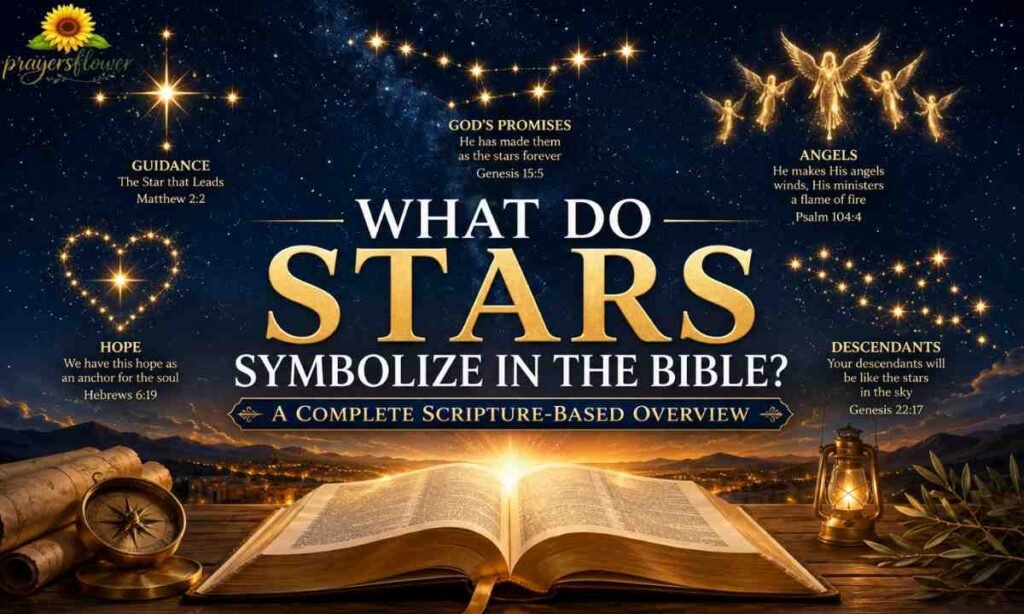
Stars in the Bible are never mere decoration. From the very first chapter of Genesis, where God sets lights in the firmament “for signs and seasons, and for days and years” (Genesis 1:14), the stars carry intentional divine meaning. The biblical meaning of stars touches on guidance, covenant, divine order, prophecy, angelic beings, and the glory of God — and each of these threads runs consistently from the Old Testament into the New.
At the most foundational level, stars symbolize the sovereignty and creative power of God. Psalm 19:1 declares that the heavens declare His glory — not as a metaphor for something vague and spiritual, but as a literal, ongoing proclamation that the created order points toward its Creator. Stars are God’s handiwork placed in plain sight, visible to every person regardless of language or culture, communicating truth without words.
Beyond that, stars symbolize number, promise, and abundance. They represent the righteous — those who shine like lights in the world. They represent angels, both faithful and fallen. They carry prophetic weight in the end times. And in the person of Jesus Christ, the ultimate star — the Bright Morning Star — the entire celestial symbolism of Scripture finds its fulfillment. Understanding the full biblical meaning of stars means following all of these threads carefully and letting Scripture interpret Scripture.
The Hebrew Word for Star in the Bible (Kokab) and What It Really Means
The primary Hebrew word translated as “star” throughout the Old Testament is kokab (כּוֹכָב). It appears 37 times across Genesis, Exodus, Numbers, Deuteronomy, Judges, Job, Psalms, and beyond, and it refers broadly to any luminous heavenly body apart from the sun and moon. It is important to understand that the ancient Hebrew mind did not draw sharp scientific lines between stars, planets, and constellations — all were encompassed under the cosmic category of God’s celestial creation.
In the Greek New Testament, the equivalent words are aster and astron, carrying similar meaning. What is striking is how consistently both Testaments use stars not as neutral astronomical objects but as active symbols charged with spiritual and prophetic significance. The biblical meaning of stars, even at the linguistic level, is always tied to something greater than astronomy — it is theology written in light.
The great biblical expositor Matthew Henry noted that when Scripture names the stars, it is always to direct the reader’s attention upward — not to the stars themselves, but to the One who made them, numbered them, and named every single one (Psalm 147:4).
Stars as God’s Creation: What Genesis 1:14–16 Reveals About Their Divine Purpose
Genesis 1:14–16 is the foundational passage for understanding God’s intentional design behind the stars. God did not create stars as an afterthought or backdrop. He created them for four explicit purposes: to separate day from night, to serve as signs, to mark seasons, and to give light upon the earth. Each of these purposes carries deep theological weight.
The word translated “signs” in Genesis 1:14 is the Hebrew ot, the same word used for covenantal markers throughout the Old Testament. This tells us that from the very beginning, God intended the stars to serve a communicative function — they are signposts in His divine narrative. The biblical meaning of stars as signs is therefore not superstition — it is embedded in the very fabric of creation by God Himself.
This is why the Star of Bethlehem was not an anomaly. It was entirely consistent with the purpose God built into the stars at the dawn of creation — to mark the most significant moment in redemptive history, the arrival of the Savior of the world.
The Star of Bethlehem: Biblical Meaning, Identity, and Theological Significance
Few stars in history have captured human imagination as powerfully as the Star of Bethlehem. Matthew 2:1–12 records how Magi from the East followed a star that led them to the exact location where the child Jesus lay. This was not coincidence, astrology, or folklore — it was the most precise celestial sign in human history, fulfilling a prophecy spoken centuries earlier.
In Numbers 24:17, the prophet Balaam declared: “A star will come out of Jacob; a scepter will rise out of Israel.” This Messianic prophecy was well known in the ancient Near East, and it is entirely plausible that the Magi — scholars of ancient texts and celestial observation — were watching precisely for this sign. The Star of Bethlehem, in the biblical meaning of stars framework, represents divine revelation breaking into the physical world to announce the arrival of the King.
Theologically, the star that guided the Magi represents God’s commitment to being found by those who seek Him sincerely — regardless of their background or origin. The fact that Gentile scholars followed the star while many in Jerusalem ignored it carries its own prophetic message about who would ultimately receive the Messiah.
Falling Stars in the Bible: Prophetic Meaning in Isaiah, Matthew, and Revelation
The image of falling stars appears repeatedly in biblical prophecy, and it consistently carries weighty theological significance. In Isaiah 34:4, stars falling from heaven accompany God’s judgment against the nations. In Matthew 24:29, Jesus Himself describes stars falling from the sky as one of the cosmic signs preceding His return. In Revelation 6:13 and 8:10–11, falling stars signal divine judgment and the unfolding of end-time events.
The biblical meaning of stars that fall is not primarily astronomical — it is the language of prophetic disruption. When the established order of the heavens appears to collapse, Scripture is communicating that God is dismantling structures of earthly power and bringing His sovereign purposes to completion. These are not passages meant to generate fear; they are declarations of God’s ultimate authority over every order — celestial and earthly alike.
Importantly, falling stars in Revelation also carry a second meaning: the fall of spiritual beings. Revelation 12:4 describes the dragon sweeping a third of the stars from the sky — widely understood by biblical scholars as a reference to the fall of angels who joined Satan’s rebellion. For more on the astronomy-theology connection in these passages, the work of scholars at the BioLogos Foundation offers careful, faith-rooted engagement with biblical cosmology.
The Seven Stars in Revelation 1:20 — Angels, Churches, and End-Time Symbolism
Revelation 1:20 is one of the most precise and explicit star interpretations in all of Scripture. Jesus Himself explains the mystery: “The seven stars are the angels of the seven churches.” This is a rare moment where the Bible defines its own symbolic language with unmistakable clarity. Stars here represent messengers — the spiritual overseers of God’s covenant communities.
The seven stars held in Christ’s right hand communicate His complete authority over His church. He holds the messengers. He holds the lampstands. The biblical meaning of stars in this passage is inseparably tied to the lordship of Christ over His people — a deeply comforting image for any believer who has wondered whether God truly holds His church secure.
What Does the Bible Say About Astrology and Reading the Stars? A Balanced Biblical Answer
This is one of the most searched questions connected to the biblical meaning of stars, and it deserves a careful, honest answer. Scripture is consistent and clear: the stars were made by God to declare His glory and mark His seasons — they were not placed in the sky to determine human personality, predict individual futures, or dictate relationships. Isaiah 47:13–14 directly addresses those who “make predictions by the stars,” describing it as a futile pursuit that cannot save.
At the same time, Scripture does not deny that the stars carry meaning — it explicitly affirms it. The distinction the Bible draws is between reading the stars as a window into God’s story versus using them as a substitute for trusting God Himself. Astrology inverts the order: it treats the creation as the authority rather than the Creator.
The biblical meaning of stars as signs was always meant to point beyond the stars to God. The moment the stars become an end in themselves — a system for self-knowledge or fortune — they are being misused in exactly the way Scripture warns against.
Stars as Angels in the Bible: The Connection Between Celestial Bodies and Heavenly Beings
One of the most fascinating and consistent threads in biblical star symbolism is the connection between stars and angels. In Job 38:7, the “morning stars” sang together when God laid the foundations of the earth — and the parallel line identifies them as “sons of God,” a term used throughout the Old Testament for angelic beings. This passage places angels at the cosmic birth of creation itself, rejoicing before a single human being existed.
Revelation 1:20, as discussed, explicitly identifies stars as angels. Isaiah 14 uses star language to describe Lucifer’s pride and fall. Revelation 12:4 uses stars to represent the angels swept away in Satan’s rebellion. The biblical meaning of stars as angelic symbols is not a minor or isolated theme — it runs through both Testaments as a consistent theological thread, helping readers understand the invisible spiritual world through the visible language of the night sky.
Lucifer and the Fallen Stars: What the Bible Says About Satan’s Fall and Fallen Angels
Isaiah 14:12 contains one of the most dramatic star references in Scripture: “How you have fallen from heaven, morning star, son of the dawn!” The Hebrew here is Helel ben Shachar — “shining one, son of the morning” — and it describes the pride-driven catastrophic fall of the being who became Satan. The imagery of a brilliant star falling captures both the splendour of what was lost and the finality of the judgment.
This passage, combined with Luke 10:18 where Jesus says He saw Satan fall like lightning from heaven, and Revelation 12:4 where a third of the stars are cast to the earth, forms a coherent biblical picture of the fall of angels as a celestial event described in the language of falling stars. The biblical meaning of stars in this prophetic context is one of warning: brilliance without submission to God is not glory — it is ruin.
“I Am the Bright Morning Star” — Jesus as the Star in Revelation 22:16 and Numbers 24:17
In Revelation 22:16, Jesus makes one of His final declarations of identity in all of Scripture: “I am the Root and the Offspring of David, and the bright Morning Star.” This is the culmination of all biblical star symbolism. Every star in Scripture — as a sign of God’s glory, as a mark of covenant promise, as a symbol of guidance and light — finds its ultimate fulfilment in the person of Jesus Christ.
The Morning Star is the star that appears just before dawn — announcing the end of darkness and the coming of full light. For Jesus to take this title is a declaration that He is the turning point of all history, the One in whom night gives way to the eternal day of God’s kingdom. The biblical meaning of stars, followed from Genesis to Revelation, always arrives here: at the One who is Himself the light the stars were always pointing toward.
Keep Feeding Your Faith: Biblical Meaning of Flowers: Roses, Lilies, and Sunflowers — Spiritual Symbolism Explained
Stars and Abraham’s Covenant: The Meaning of “Descendants as Numerous as the Stars” (Genesis 15:5)
Genesis 15:5 records one of the most tender and awe-inspiring moments in all of Scripture. God takes Abraham outside under the open sky at night and says simply: “Look up at the sky and count the stars — if indeed you can count them. So shall your offspring be.” In this moment, the stars become the visual language of an eternal covenant. Their number — incomprehensible, vast, beyond human arithmetic — becomes the measure of God’s promise.
The biblical meaning of stars in this covenant context speaks directly to God’s faithfulness across time. Every star Abraham could not count represents a life brought into God’s family through the covenant sealed that night. Paul confirms in Galatians 3:29 that all who belong to Christ are Abraham’s offspring and heirs of that promise. The stars Abraham counted in faith are still speaking.
Job 38 and the Stars: What God’s Questions to Job Reveal About Cosmic Authority
Job 38 is perhaps the most humbling chapter in Scripture on the subject of cosmic authority. God speaks from the whirlwind and asks Job a series of unanswerable questions — among them: “Can you bind the chains of the Pleiades? Can you loosen Orion’s belt? Can you bring forth the constellations in their seasons?” (Job 38:31–32). These are not cruel questions — they are liberating ones. They reorient Job’s perspective from his own suffering to the magnitude of the God who holds everything in order.
The biblical meaning of stars in Job 38 is fundamentally about the sufficiency and sovereignty of God. The One who arranges the Pleiades and guides Orion across the winter sky is the same One walking with Job through his pain. The stars here are not a display of God’s distance — they are evidence of His incomprehensible nearness in power and care.
“He Calls Them Each by Name” — What Psalm 147:4 Teaches About God’s Sovereignty Over Stars
Psalm 147:4 states it with magnificent simplicity: “He determines the number of the stars and calls them each by name.” In a universe containing an estimated two trillion galaxies, each holding billions of stars, this verse is either the most audacious claim in Scripture or the most staggering revelation of God’s nature. For the believer, it is the latter.
The point of Psalm 147:4 is not primarily astronomical — it is pastoral. The same God who knows every star by name also “heals the brokenhearted and binds up their wounds” (Psalm 147:3). The juxtaposition is intentional: the God of cosmic immensity is also the God of intimate personal care. The biblical meaning of stars as named objects points to a God who does not manage the universe from a distance but governs it with personal, detailed attention.
“Morning Stars Sang Together” — The Spiritual Meaning of Stars at Creation (Job 38:7)
When God laid the foundations of the earth, before any human eye existed to witness it, “the morning stars sang together and all the angels shouted for joy” (Job 38:7). This is one of the most beautiful verses in all of Scripture — and one of the most profound for understanding the relationship between the stars and the angelic world.
The spiritual meaning of this passage is that creation was never a silent mechanical event. It was a joyful, worshipful occasion. The celestial beings who would later be symbolised as stars were the first audience of God’s creative act, and their response was song. This gives the entire cosmos a worshipful quality — the stars carry the echo of that original rejoicing in their very existence.
Shooting Stars in Dreams: Biblical and Spiritual Interpretation
Dreams involving shooting stars carry layered meaning in the biblical framework. Since angels are consistently represented as stars in Scripture, a shooting star in a dream often symbolises an angelic movement — either a messenger dispatched or a spiritual battle being won. In some biblical contexts, a falling or shooting star can represent the decline or death of a person of great influence and public standing.
The biblical meaning of stars in dreams is closely tied to the dreamer’s spiritual discernment. Joseph’s dream in Genesis 37:9 — where the sun, moon, and eleven stars bowed down to him — carried a direct prophetic meaning about authority and destiny. When stars appear in dreams today, Scripture encourages the believer not to interpret them through superstition but through prayer, discernment, and the full counsel of God’s Word.
What Does It Mean When You Dream of a Bright Star? Biblical Insights and Prophetic Significance
A bright star appearing in a dream has historically been associated in Scripture with divine guidance, the presence of God, and significant destiny. The Star of Bethlehem was a bright celestial sign that guided specific people to a specific person — Jesus. Similarly, dreams of bright stars can symbolise clarity of divine direction being given in a season of seeking.
The biblical meaning of stars in this dream context should always be tested against Scripture. Any sense of spiritual direction drawn from a dream must align with God’s written Word and be submitted to prayer and wise counsel. The stars in dreams are prompts toward God — not substitutes for Him.
Biblical Meaning of Stars in Dreams — What Scripture Says About Celestial Dream Visions
Scripture’s most detailed example of stars in a dream is Genesis 37:9, where Joseph dreams of eleven stars bowing to him alongside the sun and moon. His father Jacob immediately understood the symbolic language — stars represented his sons, people of authority and covenant significance. This tells us that in the biblical framework, stars in dreams commonly represent people of influence, divine authority, and destined purpose.
The biblical meaning of stars in dreams also connects to the prophetic tradition in which God communicated through vision and symbol. Daniel, Ezekiel, and John all received star-laden visions that required spiritual interpretation. Believers who encounter stars in their dreams are encouraged by Scripture to bring those experiences before God in prayer and to seek interpretation through the lens of Scripture and mature spiritual community.
The Gospel in the Stars: Is the Mazzaroth a Biblical Map of Redemption History?
Job 38:32 references the Mazzaroth — the complete cycle of constellations moving through the sky across the year. This enigmatic term has led many scholars and theologians to explore whether God embedded a redemptive narrative in the original naming of the star groupings before that knowledge was corrupted into pagan astrology.
The idea, popularised by 19th-century writers and more recently by biblical astronomers, suggests that the twelve major constellations originally told the story of redemption — from Virgo (the promised virgin birth) through Leo (the Lion of Judah’s final victory). Whether one accepts this interpretation fully or holds it loosely, the biblical meaning of stars as a redemptive narrative pointing to Christ has deep Scriptural grounding — the stars were made for signs, and the greatest sign in all of history is the salvation God accomplished through His Son.
Pleiades and Orion in the Bible: What These Named Constellations Reveal Spiritually
The Pleiades and Orion are the only constellations named directly in multiple books of Scripture — appearing in Job 9:9, Job 38:31, and Amos 5:8. Their repeated mention is not coincidental. In Job 38:31, God asks whether Job can bind the Pleiades or loose Orion’s belt — framing these constellations as under His direct governance. In Amos 5:8, the prophet praises the God who made the Pleiades and Orion and calls Israel back to covenant faithfulness.
The spiritual significance of these named constellations in Scripture is that they anchor cosmic order to God’s authority. The Pleiades, associated in the ancient world with spring and renewal, and Orion, associated with winter and the harvest, together represent the full cycle of God’s sovereign governance over time and season. The biblical meaning of stars here is ecological, covenantal, and deeply pastoral.
Stars as Signs of the End Times: What Biblical Prophecy Says About Celestial Disturbances
Matthew 24:29, Joel 2:10, Revelation 6:12–13, and Luke 21:25 all describe cosmic disturbances — stars falling, the sun darkened, the moon turning blood-red — as signs accompanying the end of the age and the return of Christ. These passages form one of the most consistent prophetic patterns in all of Scripture: before the final day, the created order will visibly testify to the magnitude of what is coming.
The biblical meaning of stars in eschatological prophecy is not meant to generate panic — it is meant to generate watchfulness and hope. Jesus gave these signs to His disciples not to frighten them but to assure them that when these things happen, their “redemption is drawing near” (Luke 21:28). The stars in end-times prophecy are ultimately a signal of God’s faithfulness — He promised these signs, and He will fulfil every word.
What the Star of Bethlehem Symbolizes About Jesus Christ and Messianic Prophecy
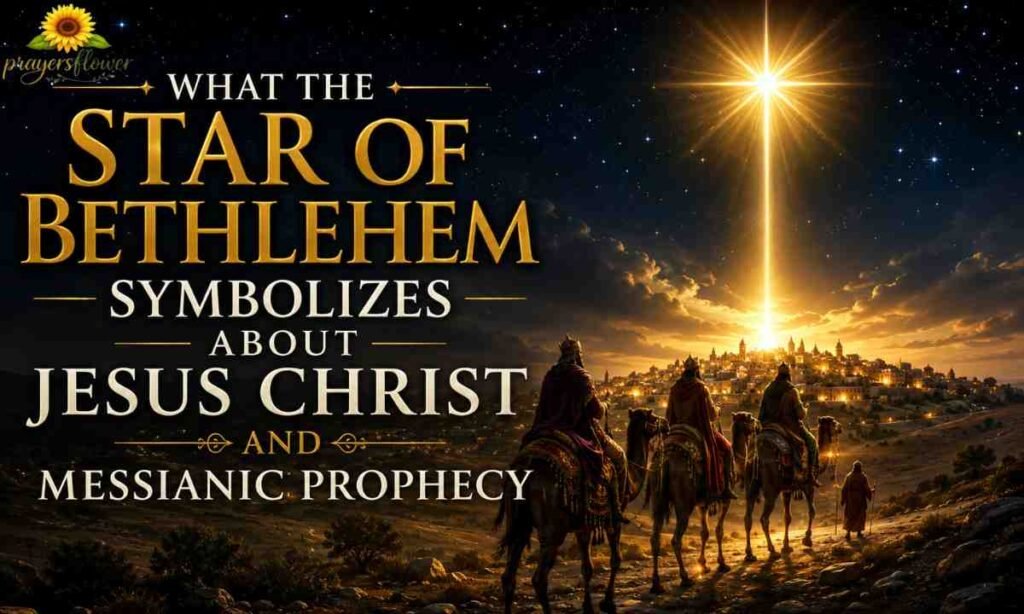
The Star of Bethlehem is the bridge between Old Testament Messianic expectation and New Testament fulfilment. Numbers 24:17 had promised a star out of Jacob and a sceptre from Israel — language that combined celestial imagery with royal authority in a way that pointed unmistakably to a coming King. When the Magi followed the star to Bethlehem, they were walking in the footsteps of that ancient prophecy.
The biblical meaning of stars as Messianic signs finds its fullest expression here: the star did not merely announce Jesus — it led people to Jesus. It was active, directional, purposeful. Every attribute assigned to stars throughout Scripture — guidance, glory, covenant, divine presence — is embodied in the One to whom the star pointed.
“Shine Like Stars” — What Philippians 2:15 and Daniel 12:3 Mean for Christian Living
The biblical meaning of stars is not only about what God placed in the sky — it is about who God calls His people to be. Daniel 12:3 declares: “Those who are wise will shine like the brightness of the heavens, and those who lead many to righteousness, like the stars forever and ever.” Philippians 2:15 echoes this calling: “You shine among them like stars in the sky as you hold firmly to the word of life.”
These are among the most personally applicable star passages in all of Scripture. The believer is not merely an observer of celestial signs — the believer is one. Called to shine with righteousness, wisdom, and the light of Christ in a world of darkness, every follower of Jesus is invited into the same symbolic identity that Scripture assigns to the stars — reflecting God’s glory in the darkness, pointing others toward the light of the Morning Star.
The Star as a Symbol of Hope and Divine Promise in the Old and New Testament
Throughout both Testaments, the star functions as one of Scripture’s most enduring symbols of hope. For Abraham, the stars were God’s visual promise that his legacy would outlast the night. For the Magi, a single star was enough to set them on a journey across continents toward the King. For John on the island of Patmos, the stars in the hand of Christ were a sign that the church, however persecuted, was held securely by the One with all authority.
The biblical meaning of stars as hope is not wishful thinking — it is covenant confidence. Every time a believer looks up at the night sky, they are looking at a canvas God painted with intention. The same God who hung those stars keeps His promises. The darkness that makes them visible does not diminish them — it is the very condition in which they shine most clearly.
How Many Times Are Stars Mentioned in the Bible — and Why It Matters
Stars are mentioned approximately 75 times across the Old and New Testaments, appearing in books as diverse as Genesis, Job, Psalms, Isaiah, Daniel, Amos, Matthew, Luke, Jude, and Revelation. The frequency and range of this usage is itself significant for understanding the biblical meaning of stars. This is not an occasional metaphor — it is a sustained symbolic language that God employs consistently across vastly different literary genres: poetry, prophecy, narrative, apocalypse, and epistle.
The fact that stars appear in every major section of Scripture signals that their symbolic significance is not incidental. From creation to consummation, from the covenant with Abraham to the final self-revelation of Christ, stars serve as one of God’s chosen vehicles of communication. A theology that ignores the stars misses part of the language God chose to speak.
Do Stars Have Symbolic Meaning in the Old Testament vs. New Testament?
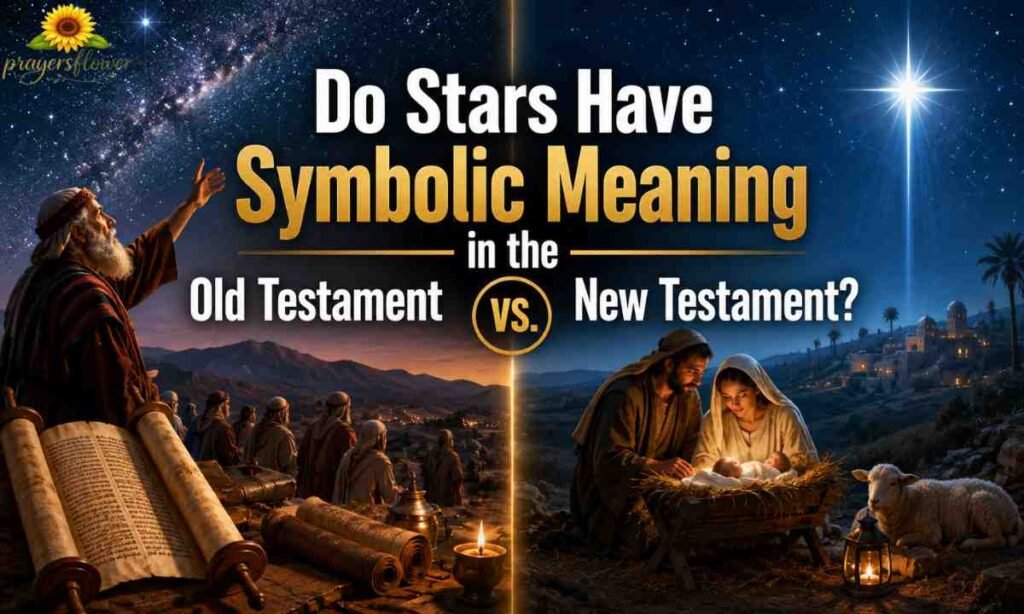
The short answer is yes — and the two Testaments build upon each other in a remarkably coherent way. In the Old Testament, stars primarily function as signs of God’s power (creation), symbols of covenantal multiplication (Abraham), representations of angelic beings (Job), and markers of divine sovereignty over time and season (Psalms, Amos). They carry prophetic weight in Isaiah and Daniel, foreshadowing judgment and glory to come.
In the New Testament, all of this symbolism converges on Jesus Christ. The Star of Bethlehem fulfils the Messianic star prophecy of Numbers 24:17. The morning star identity of Satan in Isaiah 14 is replaced and overwhelmed by Christ’s superior claim to the title in Revelation 22:16. Believers are called to shine like stars in Philippians 2:15, completing the circle from Abraham’s descendants to God’s redeemed family. The biblical meaning of stars in the New Testament is the Old Testament meaning fully realised.
What Do Stars Represent Spiritually in the Bible?
Spiritually, stars in the Bible represent the following consistent themes across both Testaments: the glory and creative power of God, His covenantal faithfulness, divine guidance, angelic beings both faithful and fallen, prophetic signs of coming judgment and restoration, and the calling of the righteous to shine as lights in a dark world. The biblical meaning of stars is never singular — it is a constellation of meanings, all orbiting the central truth that God made the stars and speaks through them.
Are Stars Mentioned in the Book of Revelation?
Yes, and extensively. The Book of Revelation uses star imagery more densely than almost any other New Testament book. Stars appear as angels held in Christ’s hand (1:20), as the fallen Satan described as a morning star stripped of glory (Isaiah 14, echoed in Revelation 12), as cosmic signs of judgment (6:13, 8:10–11), and ultimately as the identity of Christ Himself — the bright Morning Star (22:16). The biblical meaning of stars in Revelation forms the culmination and climax of everything the rest of Scripture has been building toward.
What Is the Significance of the North Star in the Bible?
The North Star, known as Polaris, is not named explicitly in Scripture, but the concept of a fixed, guiding star has deep resonance with biblical themes. The ancient world used fixed stars for navigation — and Scripture uses the language of celestial constancy as a metaphor for God’s unchanging faithfulness. Psalm 89:37 speaks of a covenant “established forever like the moon, the faithful witness in the sky.” The significance attributed to the North Star across cultures — constancy, direction, reliability — mirrors the character of the God whom Scripture reveals as the same yesterday, today, and forever.
What Is the Difference Between Stars and Angels in Biblical Symbolism?
The relationship between stars and angels in Scripture is one of intentional overlap rather than confusion. Stars are physical creations; angels are spiritual beings. However, Scripture frequently uses star imagery to represent angels because both share qualities of brilliance, celestial origin, and divine purpose. Job 38:7 equates morning stars with the sons of God. Revelation 1:20 explicitly identifies stars as angels. Revelation 12:4 uses stars to represent fallen angels.
The key distinction is this: in Scripture, when stars represent angels, they are always functioning as symbols — the star is the visible, comprehensible image given to communicate something about the invisible spiritual being. The biblical meaning of stars as angelic symbols is a literary and theological device that reveals the dignity, brilliance, and accountability of angelic beings, both faithful and fallen.
Frequently Asked Questions
What is the biblical meaning of stars according to Scripture?
Stars in the Bible carry multiple meanings including God’s glory, covenantal promises, divine guidance, angelic beings, and prophetic signs — all consistently pointing to the Creator.
What does the Star of Bethlehem represent in biblical prophecy?
The Star of Bethlehem fulfils Numbers 24:17’s Messianic prophecy and represents God’s active, directional guidance leading all who seek Him to the person of Jesus Christ.
What do falling stars symbolize in biblical end-times prophecy?
Falling stars in passages like Matthew 24:29 and Revelation 6:13 symbolize divine judgment, the collapse of earthly powers, and cosmic signs heralding Christ’s return.
Are stars connected to angels in the Bible?
Yes — Job 38:7, Revelation 1:20, and Revelation 12:4 all use stars as direct symbols for angels, representing their celestial brilliance, divine origin, and spiritual authority.
What does it mean spiritually to shine like stars according to Daniel 12:3?
Daniel 12:3 calls the wise and righteous to shine like stars forever — meaning every believer is called to reflect God’s light and lead others toward righteousness in this world.
Conclusion
The biblical meaning of stars is one of God’s most consistent, layered, and breathtaking languages — stretching from the first act of creation in Genesis to the final self-revelation of Christ in Revelation. Every star in the night sky is a deliberate word in a story that has been unfolding since before time began, and that story ends in the light of the One who called Himself the Bright Morning Star.
You are not a passive observer of that story. Scripture calls you to be a star in it — to shine with wisdom, righteousness, and the reflected light of Christ in whatever darkness you find yourself standing in. The same God who hung every star by name knows your name too, and He placed you here, in this moment, to shine.

John Carrol is a Christian writer and prayer minister with over a decade of experience in faith-based content, devotional writing, and spiritual encouragement. Rooted in Scripture and a lifelong love of intercessory prayer, John created PrayersFlower to help believers find the right words when their own run out. His writing draws from pastoral study, personal faith practice, and a deep conviction that prayer is the most powerful act available to the human heart. When he is not writing, John is found in quiet study of the Word, mentoring young believers, and serving his local church community.