

The biblical meaning of the name Elijah is “My God is Yahweh,” a declaration of unwavering faith that has echoed through Scripture and shaped the spiritual identity of believers for thousands of years.
There is something deeply personal about searching for the meaning behind a name rooted in Scripture. When a parent whispers the name Elijah over a newborn, or when a believer encounters this name in their Bible reading, something stirs — a sense that names carry weight, that God speaks through them, and that identity is never accidental in His kingdom. People seek the biblical meaning of the name Elijah not out of mere curiosity, but out of a longing to connect with something eternal.
This article goes beyond a simple translation. It traces the Hebrew roots, the prophetic legacy, and the spiritual significance that make the biblical meaning of the name Elijah one of the most profound name studies in all of Scripture. If you have ever felt drawn to this name — for your child, your faith, or your own study — what follows will ground you deeply in its truth.
Lord, meet and bless every reader here and grant them success in every area of their life.
Key Takeaways
- The name Elijah comes from the Hebrew אֵלִיָּהוּ (Eliyahu), meaning “My God is Yahweh” — a personal covenant declaration, not merely a title
- The prophet Elijah in the Bible stands as one of Scripture’s most powerful figures, known for calling fire from heaven and confronting false prophets on Mount Carmel
- The name Elijah carries strong prophetic and messianic significance, appearing in both the Old and New Testaments as a symbol of spiritual revival
- In modern faith communities, naming a child Elijah is considered an act of spiritual intention, rooted in the Hebrew name meaning and its legacy of bold, fearless devotion
The Hebrew Root of the Name Elijah
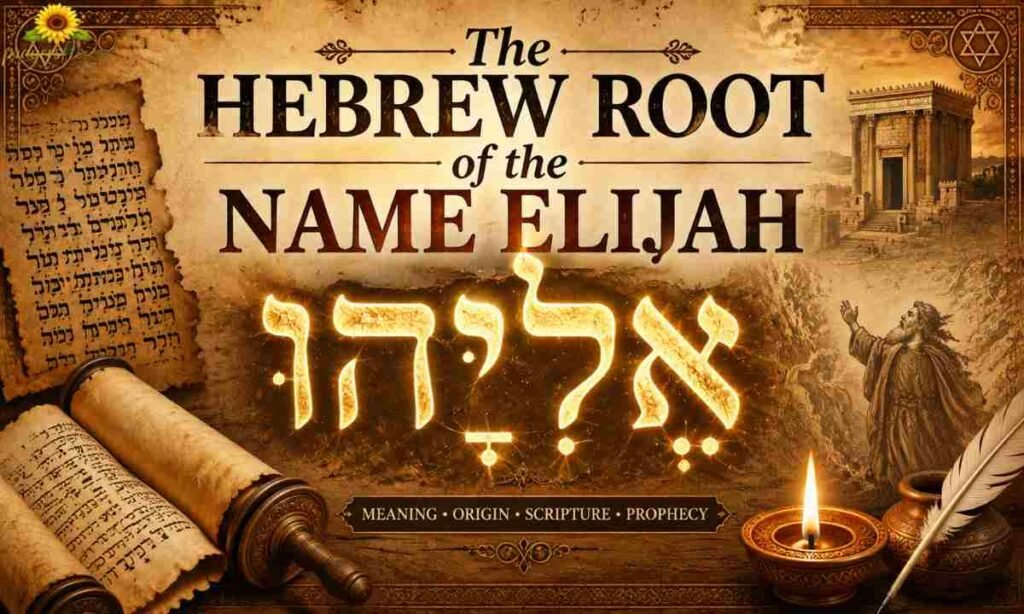
To understand the biblical meaning of the name Elijah, you must begin where all meaning begins — in the original language. The name Elijah is the English rendering of the Hebrew name אֵלִיָּהוּ, transliterated as Eliyahu. In some older biblical manuscripts and traditions, a shortened form Elijah (אֵלִיָּה, Eliyyah) also appears, but both carry the same foundational meaning.
The name is composed of two powerful Hebrew elements. The first is El (אֵל), the ancient Hebrew word for God — majestic, sovereign, and all-powerful. The second is Yah (יָהּ), a contracted form of YHWH or Yahweh, the personal, covenant name of God revealed to Moses at the burning bush in Exodus 3:14. Together, they form a sentence-name: “My God is Yahweh.” This is not merely biographical — it is theological. It is a confession of faith sealed into a name.
In ancient Hebrew culture, names were not decorative. They were prophetic assignments. A child named Eliyahu carried a declaration with them every time someone called their name: “My God is Yahweh” — a direct repudiation of every false god, every Baal, every idol that competed for Israel’s devotion.
Who Was Elijah in the Bible?
The prophet Elijah stands as one of the most electrifying figures in all of biblical history. His story begins abruptly in 1 Kings 17:1, with no genealogy, no backstory — just a man stepping out of Tishbe in Gilead with a word from God on his lips and fire in his eyes. From that moment, the narrative never slows down.
Elijah was a prophet during the reign of King Ahab of Israel, arguably the most corrupt king in the northern kingdom’s history. Ahab, under the influence of his wife Jezebel, had turned Israel toward the worship of Baal, the storm deity of Canaan. Into this spiritual darkness, God sent Elijah — whose very name was the answer to Baal worship. “My God is Yahweh,” not Baal.
The defining moment of Elijah’s ministry came on Mount Carmel, where he stood alone against 450 prophets of Baal and 400 prophets of Asherah (1 Kings 18). He called down fire from heaven, the altar was consumed, and Israel fell to their faces crying, “The LORD — He is God!” It is one of the most dramatic demonstrations of divine power in all of Scripture, and it is inseparable from the biblical meaning of the name Elijah.
Spiritual Significance of the Name Elijah
The spiritual significance of Elijah’s name goes far beyond a historical biography. It functions as a living theology. In a world saturated with competing loyalties, the name Elijah declares a primary allegiance: Yahweh alone is God. This is why the name carries such weight in Jewish, Christian, and even Islamic traditions.
For believers today, the name Elijah represents a posture of the soul — the willingness to stand alone for truth when the crowd has chosen comfort. It speaks to intercessory power, to prophetic courage, and to the kind of faith that moves heaven. When James 5:17 reminds us that “Elijah was a human being, even as we are,” and that his prayers shut and opened the heavens, it democratizes his legacy — reminding us that the God who answered Elijah is the same God who hears us.
The spiritual significance of the name Elijah is also deeply tied to the concept of teshuvah — repentance and return. Elijah’s ministry was always aimed at turning hearts back to God. That is not simply a historical mission; it is the enduring spiritual calling embedded in this name.
Elijah’s Name in the New Testament
The biblical meaning of the name Elijah reaches its fullest prophetic resonance in the New Testament. Elijah does not simply fade into the Old Testament — he reappears, literally and figuratively, in the life and ministry of Jesus Christ.
Malachi 4:5 contains one of the most significant messianic prophecies in Scripture: “See, I will send the prophet Elijah to you before that great and dreadful day of the LORD comes.” This prophecy held enormous weight in Jewish expectation. When John the Baptist appeared — preaching repentance in the wilderness, clothed like Elijah, calling people back to God — Jesus identified him as the fulfillment of this prophecy (Matthew 11:14, Luke 1:17).
Then, at the Transfiguration on the mountain, Elijah appeared physically alongside Moses in the presence of Jesus (Matthew 17:1–8). This moment confirms that the name and legacy of Elijah are woven into the fabric of redemptive history. He represents the prophetic voice that always points toward the Messiah.
For more on the prophetic significance of Elijah in messianic prophecy, the Blue Letter Bible’s entry on Elijah offers a thorough and well-sourced scholarly reference rooted in the original Hebrew and Greek texts.
Elijah as a Symbol of Prophetic Boldness
Few figures in Scripture embody prophetic boldness the way Elijah does. He confronted a king to his face. He challenged an entire nation’s spiritual compromise. He prayed with such focused intensity that the rain stopped for three and a half years — and then fell again at his word. This was not arrogance; it was a man so aligned with the heart and name of God that heaven responded to his voice.
The name Elijah in Christian tradition has long been associated with the prophetic office — with men and women called to speak truth in hostile environments, to intercede for revival, and to refuse the comfortable silence of compromise. The Carmel confrontation is not just a story from 900 BC; it is a template for every generation that must choose whom it will serve.
This is part of why parents in faith communities choose the name Elijah for their sons — not simply because it sounds strong, though it does — but because naming a child Elijah is an act of prophetic declaration. It is a prayer embedded in identity.
Keep Feeding Your Faith: Biblical Meaning of the Name Hannah
The Name Elijah Across Cultures and Traditions
The reach of the name Elijah crosses cultural and religious boundaries in remarkable ways. In Jewish tradition, Elijah holds a place of extraordinary reverence. At every Passover Seder, an empty chair is set and a cup of wine — the Cup of Elijah — is poured in anticipation of his return as the herald of the Messiah. This tradition, rooted in Malachi’s prophecy, has been practiced for centuries and speaks to the enduring hope embedded in this name.
In Islam, Elijah appears as the prophet Ilyās (إِلْيَاس), mentioned in the Quran in Surah 6:85 and Surah 37:123–132. He is honored as a righteous messenger who called his people away from idol worship — consistent with the biblical narrative and the declaration built into his name.
In Christianity, Elijah is celebrated as a model of intercessory prayer, prophetic courage, and dependence on God — particularly in evangelical, charismatic, and Catholic traditions. His name has remained consistently popular in Christian communities across centuries and continents.
The Name Elijah in Modern Times — Popularity and Meaning
In contemporary culture, the name Elijah has seen a remarkable resurgence. In the United States, Elijah has ranked among the top 10 baby names for boys for several consecutive years, reflecting a broader cultural and spiritual reconnection with biblical names that carry weight and legacy.
This popularity is not accidental. Parents drawn to the name Elijah often speak of the same things: strength, faith, purpose. The biblical meaning of the name Elijah resonates deeply in a generation that craves authenticity and depth. A name that means “My God is Yahweh” carries an identity that no cultural trend can erase.
In faith communities specifically, choosing the name Elijah is a theological act. It roots a child’s identity in covenant, in prophecy, and in the story of a God who answers by fire when His people dare to ask.
What the Name Elijah Teaches Us About God

Perhaps the most overlooked dimension of the biblical meaning of the name Elijah is what it reveals — not about the man, but about God. The name is not simply a description of Elijah’s devotion. It is a proclamation about Yahweh’s character.
“My God is Yahweh” declares that God is personal — not a distant cosmic force, but a God who enters covenant, who speaks through prophets, who answers prayer, who shows up on mountaintops and in still small voices. Elijah’s name insisted that the God of Abraham, Isaac, and Jacob was not one deity among many — He was the God, worthy of every loyalty and every prayer.
This is the theology embedded in a name. When you read the name Elijah in Scripture, you are not just reading a proper noun — you are reading a sermon. And that sermon has never gone out of date.
FAQs
What is the biblical meaning of the name Elijah?
The biblical meaning of the name Elijah is “My God is Yahweh,” drawn from the Hebrew Eliyahu and expressing a personal declaration of covenant faith in the one true God.
What does the name Elijah mean spiritually?
Spiritually, the name Elijah represents prophetic boldness, intercessory prayer, and an uncompromising devotion to Yahweh above every competing god or idol.
Is Elijah mentioned in the New Testament?
Yes — Elijah appears at the Transfiguration alongside Moses, and Jesus identifies John the Baptist as the one who came in the spirit and power of Elijah, fulfilling Malachi’s prophecy.
Why is the Hebrew name Eliyahu significant in Jewish tradition?
The Hebrew name Eliyahu is deeply honored in Jewish tradition because Elijah is expected to return as the forerunner of the Messiah, which is why a Cup of Elijah is poured at every Passover Seder.
What character traits are associated with the name Elijah in the Bible?
The prophet Elijah in the Bible is consistently associated with courage, fierce intercession, prophetic authority, and a faith that moved heaven — traits embedded in his name and legacy.
Conclusion
The biblical meaning of the name Elijah is not a footnote in Scripture — it is a declaration that has echoed through history, prophecy, and covenant. From the fire on Mount Carmel to the voice in the wilderness, Elijah’s name has always pointed to one truth: Yahweh alone is God.
Whether you carry this name, love someone who does, or simply study it in your walk with God, let it remind you that names in Scripture are never accidental. To speak the name Elijah is to speak a prayer — and that prayer still rises before the same God who answered by fire.
Father, let the faith behind this name be the same faith that fuels every prayer we bring to You.

John Carrol is a Christian writer and prayer minister with over a decade of experience in faith-based content, devotional writing, and spiritual encouragement. Rooted in Scripture and a lifelong love of intercessory prayer, John created PrayersFlower to help believers find the right words when their own run out. His writing draws from pastoral study, personal faith practice, and a deep conviction that prayer is the most powerful act available to the human heart. When he is not writing, John is found in quiet study of the Word, mentoring young believers, and serving his local church community.