

The difference between prayer and meditation is not simply about silence versus speaking — it is the difference between a conversation with God and a quieting of the self.
Many people arrive at this question carrying something real. They are tired, searching, or holding a need too heavy to name out loud. They wonder whether they should pray, sit in stillness, or somehow do both. The longing beneath that question is always the same: they want to reach something greater than themselves.
This article walks through the difference between prayer and meditation from every meaningful angle — spiritual, scientific, practical, and Biblical. Whether you are a lifelong believer or someone just beginning to explore your faith, what follows is written for you and the quiet places inside you that are still listening.
Lord, meet and bless every reader here, guide them closer to Your heart, and grant them success in every area of their life.
Key Takeaways
- Prayer is direct, relational communication with God, while meditation is a practice of stilling the mind and listening inward or to God’s voice.
- The difference between prayer and meditation has clear Biblical grounding, with both appearing throughout Scripture in distinct forms.
- Science shows that prayer and meditation affect the brain differently, though both reduce stress and support emotional wellbeing.
- Christians can practice both without conflict — in fact, combining them may deepen spiritual intimacy significantly.
What Is the Main Difference Between Prayer and Meditation?
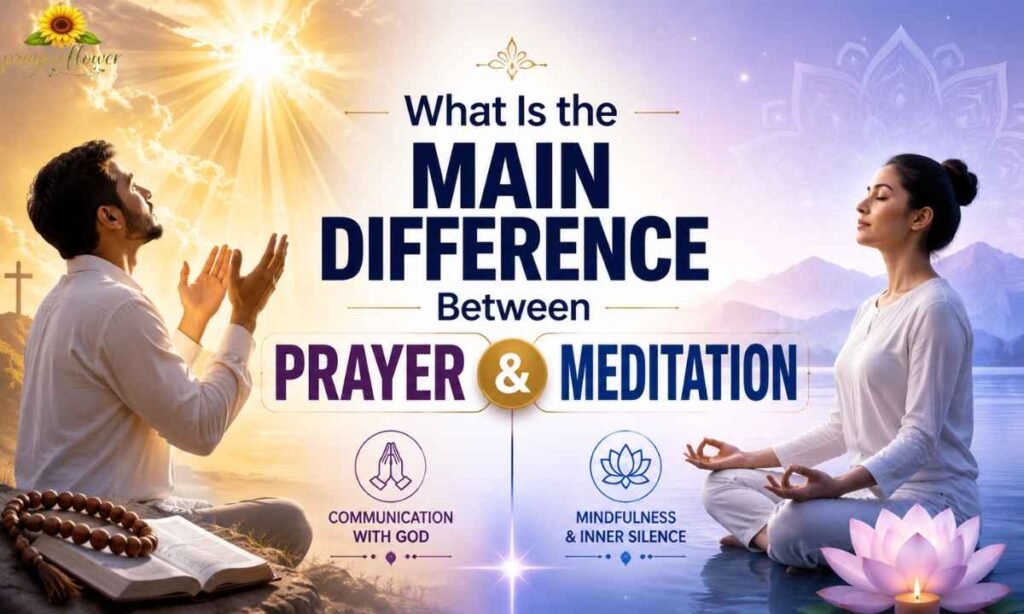
Prayer is speaking to God. Meditation, in the Christian sense, is listening for Him.
- Prayer is relational — it moves outward from the heart toward a personal God who hears and responds.
- Meditation in its Christian form involves dwelling on Scripture or God’s character with an open, attentive spirit.
- The difference between prayer and meditation is not one of value, but of direction: prayer reaches out, while meditation draws inward.
- Both are forms of spiritual communion, but prayer carries the posture of a child speaking to a Father.
- Meditation, by contrast, holds the posture of stillness — waiting, listening, receiving.
Prayer vs Meditation: Two Paths to Inner Peace Explained
Both practices offer peace, but they lead to it through different doors.
- Prayer brings peace because it transfers the weight of worry into God’s hands — it is an act of trust.
- Meditation brings peace by quieting the mental noise that anxiety feeds on.
- The difference between prayer and meditation here is that prayer is peace found through surrender, while meditation is peace found through stillness.
- A person who prays carries their trouble to a Person. A person who meditates learns to stop carrying it at all.
- Both paths lead toward God when held in faith.
How Does Prayer Differ From Meditation in Practice?
In practice, the two look and feel very different — even when they share the same quiet room.
- Prayer often involves words — spoken aloud, whispered, or written — addressed directly to God.
- Meditation involves releasing words and sitting with awareness, often focused on a single verse or the breath.
- The difference between prayer and meditation in daily life is that prayer has a voice, while meditation has a posture.
- You can pray while walking, driving, or washing dishes. Meditation typically calls you to stop and be still.
- Both require intentionality, but prayer can be spontaneous in a way that structured meditation rarely is.
The Spiritual Difference Between Prayer and Meditation
Spiritually, prayer and meditation occupy distinct but complementary spaces in the life of faith.
- Prayer is the act of presenting yourself before God — your requests, your gratitude, your confession, your praise.
- Christian meditation is the act of being transformed by what God has already said — meditating on His Word until it sinks below the surface of the mind.
- The spiritual difference between prayer and meditation is the difference between speaking and absorbing.
- Scripture honors both. Psalm 5:2 reflects the heart of prayer: “Hear my cry for help, my King and my God.” Psalm 1:2 describes the blessed person who meditates on God’s law day and night.
- Neither practice replaces the other. Together, they form a full conversation — one where we speak, and one where we learn to hear.
Prayer vs Meditation: Religious vs Secular Mindfulness
Not all meditation is the same, and the difference matters for Christians.
- Secular mindfulness meditation, rooted in Buddhist tradition, aims at mental clarity and stress relief without a divine object of focus.
- Christian meditation always has a relational anchor: it is oriented toward God, not simply toward the self.
- The difference between prayer and secular meditation is more than technique — it is a difference in destination.
- Prayer carries an address. Secular mindfulness does not. Christian meditation, like prayer, keeps God at the center.
- A believer can borrow the discipline of stillness from mindfulness practice while keeping the object of that stillness firmly in God.
How Prayer and Meditation Affect the Brain Differently
Neuroscience has begun mapping what people of faith have long experienced as real.
- Brain imaging studies show that prayer activates areas associated with social connection and language — the brain treats prayer like an intimate conversation.
- Meditation activates the default mode network differently, promoting present-moment awareness and reducing the mental chatter linked to anxiety.
- The difference between prayer and meditation neurologically is that prayer engages the brain’s relational circuitry, while meditation dials down its noise.
- According to research published by the National Institutes of Health, both practices produce measurable changes in cortisol levels and emotional regulation.
- For the believer, this is not surprising. God designed the human brain. He also designed both the invitation to pray and the wisdom to be still.
Health Benefits of Prayer vs Meditation: What Science Says
Both practices carry documented health benefits, though they operate through different mechanisms.
- Prayer has been linked to lower blood pressure, reduced depression, and increased feelings of hope and social belonging.
- Meditation has strong evidence for reducing symptoms of anxiety, chronic pain, and emotional reactivity.
- The difference between prayer and meditation in health outcomes is subtle: prayer tends to strengthen relational and emotional resilience, while meditation tends to regulate the nervous system directly.
- A landmark study from Harvard Medical School found that the relaxation response triggered by meditation reduces stress hormones measurably, and similar effects have been observed in intercessory prayer.
- Research on the psychological benefits of prayer consistently supports this, with studies from institutions like Harvard Health noting improvements in wellbeing among regular prayer practitioners.
Keep Feeding Your Faith: 100+ Powerful Prayers for Someone Who Hurt You: Heal, Forgive, and Find Peace
How Meditation and Prayer Reduce Stress in Different Ways
Stress does not discriminate. It comes for the faithful and the secular alike. Both prayer and meditation meet it, though on different ground.
- Prayer reduces stress by relocating the source of security. When you pray, you are reminding yourself that you are not alone and not ultimately in control.
- Meditation reduces stress by regulating the body’s physiological response — slowing the breath, lowering heart rate, quieting the inner critic.
- The difference between prayer and meditation in stress relief is this: prayer changes who you believe is holding the situation, while meditation changes how your body responds to it.
- Christians who understand this can use prayer to surrender the burden and meditation on Scripture to steady the body that is still shaking.
- Together they form a complete response to anxiety that neither practice can fully offer alone.
Prayer for Anxiety vs Meditation for Anxiety: Which Works Better?
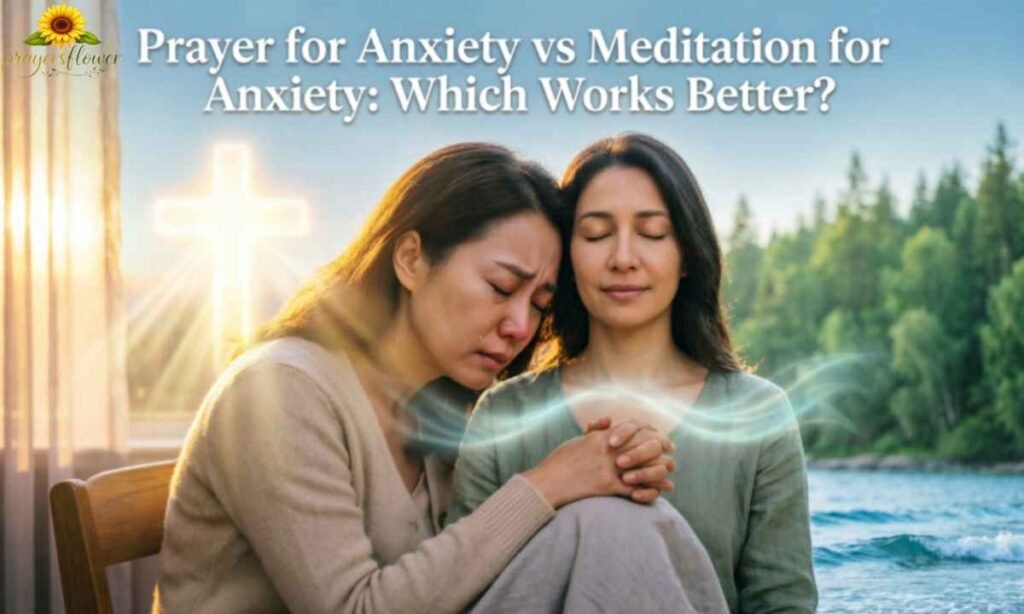
This is not a competition. Both matter. But the honest answer is that they address different layers of anxiety.
- Prayer addresses the root of anxiety: the belief that we are on our own, unheard, or unloved. It goes directly to God with the fear.
- Meditation addresses the physiological and cognitive patterns that anxiety creates — the racing thoughts, the shallow breathing, the hypervigilance.
- The difference between prayer and meditation for anxiety is that prayer goes to God with the fear, and meditation helps the body believe the answer has come.
- Philippians 4:6 is a perfect example of both working together: “Do not be anxious about anything, but in every situation, by prayer and petition… present your requests to God.” Then comes the peace that transcends all understanding — a state that sounds remarkably like what meditation trains the nervous system to receive.
- For a person struggling with anxiety, do both. Pray first. Then sit quietly and let the peace settle.
Christian Meditation vs Prayer: What the Bible Says
Scripture never pits prayer against meditation. It treats them as companions on the same road.
- The Hebrew word for meditate, “hagah,” appears throughout the Psalms and means to mutter, ponder, or dwell upon something deeply.
- Prayer in Scripture takes every form: petition (Matthew 7:7), thanksgiving (Philippians 4:6), lament (Psalm 22), and silent waiting (Psalm 46:10).
- The difference between prayer and meditation Biblically is not one of superiority but of function. Prayer speaks. Meditation absorbs.
- Joshua 1:8 commands meditation on the law day and night — not instead of prayer, but alongside it.
- The Bible’s vision of spiritual life is not prayer alone or meditation alone. It is a relationship with God that uses every means He has given us.
Contemplative Prayer vs Mindfulness Meditation: Key Differences
Contemplative prayer is one of Christianity’s oldest traditions, and it is often misunderstood.
- Contemplative prayer involves resting in God’s presence without words — not emptying the mind, but filling it with awareness of God.
- Mindfulness meditation, in its secular form, focuses on the present moment without a divine focus.
- The difference between contemplative prayer and mindfulness meditation is the object of attention: one orients toward the presence of God, the other toward the awareness of self.
- Christian contemplatives like Thomas Merton understood that silence before God is itself a form of prayer — a consent to His presence and action within.
- For a believer, contemplative prayer is not a borrowing from Eastern practice. It is a returning to an ancient Christian discipline that predates modern mindfulness by centuries.
Can You Pray and Meditate at the Same Time?
Yes — and in the Christian tradition, this is called lectio divina, or sacred reading.
- Lectio divina involves reading a passage of Scripture slowly, meditating on its words, and then allowing that meditation to become prayer.
- The difference between prayer and meditation collapses here beautifully. The line between pondering God’s Word and speaking to Him becomes almost invisible.
- Many believers find that meditating on a single verse before praying shapes the prayer that follows — their words become more aligned with God’s heart.
- You can also sit in silent prayer after speaking, allowing the stillness to be its own form of listening.
- There is no theological conflict in doing both. In fact, their combination is one of the richest spiritual disciplines available to any Christian.
Morning Prayer vs Morning Meditation: Which Habit Is More Powerful?
Both habits have power. The stronger one is the one you will actually keep.
- Morning prayer anchors the day in relationship — it begins with God and carries that conversation into every hour that follows.
- Morning meditation anchors the day in stillness — it begins with quiet and trains the mind toward clarity before the noise begins.
- The difference between prayer and meditation as morning habits is essentially a question of what you most need: connection or calm. Most people need both.
- Starting with two minutes of silent meditation, then moving into prayer, is a rhythm many Christians find deeply effective.
- The best morning spiritual habit is the one you return to faithfully — whether it begins with words or silence.
Simple Ways to Combine Prayer and Meditation in Your Daily Routine
The difference between prayer and meditation does not mean they must stay separate. They were designed to work together.
- Read one verse of Scripture slowly. Read it again. Let it move from your mind to your heart. Then speak it back to God as a prayer.
- Sit in silence for two minutes after praying. Do not fill the space. Let God speak in the quiet that follows your words.
- Use breath prayer — a short phrase repeated with the breath. “Lord Jesus” on the inhale. “Have mercy” on the exhale. This is both meditation and prayer at once.
- Journal your prayers, then pause and meditate on what you wrote. Often God speaks through the act of reflection on what we have said.
- Begin your quiet time with gratitude meditation — naming what is good — and then shift into prayer that builds on that awareness.
Is Meditation a Form of Prayer?
In the Christian tradition, it can be — but not always.
- When meditation is directed toward God, focused on Scripture, or held in awareness of His presence, it functions as a form of prayer.
- When meditation is purely secular — focused only on the breath or the self with no divine orientation — it is not prayer in the traditional sense.
- The difference between prayer and meditation here depends entirely on the object of focus and the posture of the heart.
- Christian meditation becomes prayer the moment it opens toward God. Silence offered to God is never empty.
- The intent matters. Meditation with faith is a spiritual act. Meditation without it is still beneficial — but it is not communion.
What Happens to Your Brain When You Pray vs When You Meditate?
The brain is not separate from the spirit. What happens there matters.
- When you pray, your prefrontal cortex — the seat of personality and social connection — becomes highly active. The brain treats prayer as a real conversation with a present Person.
- When you meditate, the amygdala — the brain’s alarm system — quiets. The fight-or-flight response eases.
- The difference between prayer and meditation neurologically mirrors their spiritual function: prayer connects, meditation calms.
- Together, they create a brain that is both deeply anchored in relationship and less reactive to threat.
- For the believer, this is confirmation written into biology: we were made for both conversation with God and stillness before Him.
Are Prayer and Meditation Opposites or Complements?
They are not opposites. They are two halves of a complete spiritual posture.
- Prayer without meditation can become a monologue — all speaking, no listening.
- Meditation without prayer can become navel-gazing — all inward, no relational reach.
- The difference between prayer and meditation is resolved when they are practiced together: one opens the mouth, the other opens the ear.
- The most spiritually mature people tend to do both — instinctively knowing when to speak and when to be still before God.
- They are complements in the deepest sense: each makes the other more whole.
Which Came First — Prayer or Meditation?
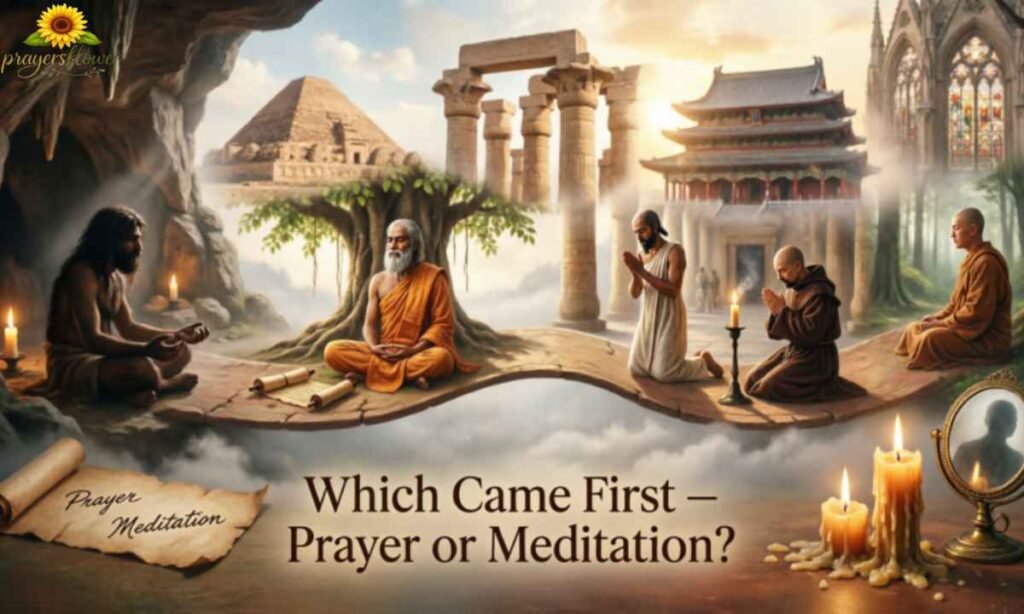
Both are ancient. Both predate modern religion by millennia.
- Prayer in recognizable form appears at the very beginning of human relationship with God — Genesis 4:26 notes that people “began to call on the name of the Lord.”
- Meditation as a spiritual practice appears in the Hebrew Scriptures, in ancient Hindu texts, and in early Buddhist teaching, all independently.
- The difference between prayer and meditation historically is that prayer emerged within covenant relationship, while meditation emerged across cultures as a universal human instinct toward stillness.
- Christians can trace the roots of both directly to Scripture — and find in both a long, unbroken line of faithful practice.
- Neither is a modern invention. Both are as old as the human longing for God.
Why Do Some Religions Discourage Meditation but Encourage Prayer?
This tension is real, and it deserves an honest answer.
- Some Christian traditions have been cautious about meditation because certain forms of it originate in Eastern religious contexts where the goal is union with an impersonal divine or the dissolution of the self.
- These concerns are not unfounded — they reflect a genuine desire to protect the relational, personal nature of Christian faith.
- The difference between prayer and meditation as understood in these traditions is that prayer keeps God as a distinct, personal, loving Being, while some forms of meditation can blur that distinction.
- Christian meditation, when properly understood, does not seek to dissolve the self but to present the self — attentive and open — before a personal God.
- The solution is not to avoid meditation altogether, but to practice it Christianly — with Scripture, with God as the object, and with prayer as its companion.
Prayer and Meditation for Beginners: Where to Start
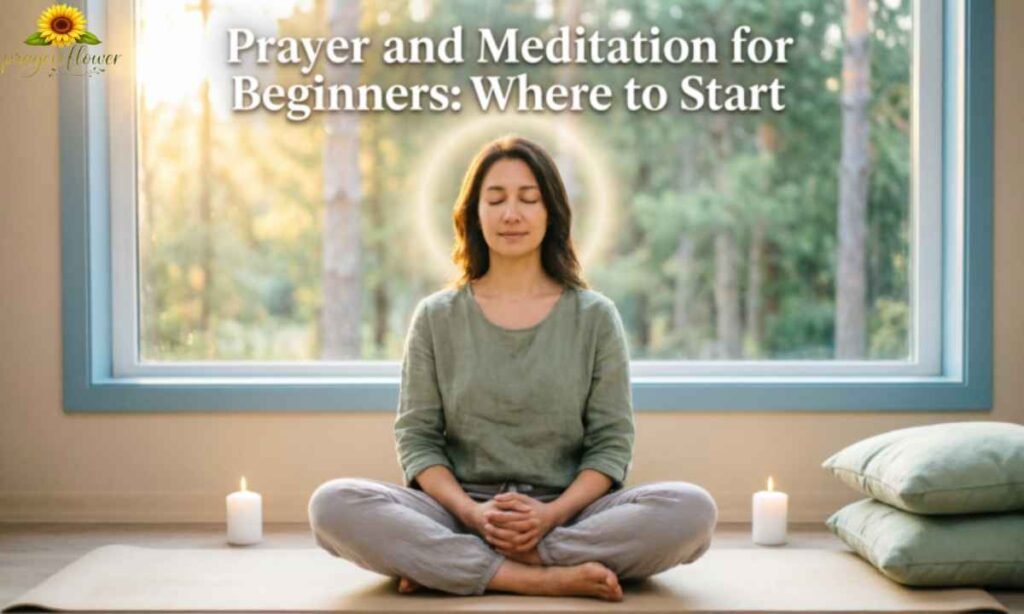
If you are new to either practice, start small and stay consistent.
- Begin with prayer. Talk to God the way you would talk to someone who loves you without condition. You do not need formal language.
- Add one minute of silence after your prayer. Breathe slowly. Let your mind settle. This is the beginning of meditation.
- Read one verse from the Psalms each morning and sit with it for two minutes before moving on. This is Christian meditation in its simplest form.
- The difference between prayer and meditation does not need to be mastered — it needs to be experienced. Just begin.
- Return tomorrow. And the day after. The practice will grow on its own if you simply show up.
Frequently Asked Questions About the Difference Between Prayer and Meditation
What is the core difference between prayer and meditation?
Prayer is direct communication with God, while meditation is the practice of stilling the mind and listening — in the Christian tradition, often for God’s voice through Scripture.
Can Christians practice meditation without compromising their faith?
Yes — Christian meditation is a Biblical practice rooted in dwelling on God’s Word, and it is entirely distinct from secular or Eastern forms of meditation that have no divine focus.
Does the difference between prayer and meditation matter for mental health?
It does — prayer strengthens relational trust and hope, while meditation regulates the nervous system, and together they address anxiety from both its spiritual and physiological roots.
What does mindfulness meditation offer that prayer does not?
Mindfulness offers structured nervous system regulation and body-awareness techniques that can complement prayer, but it lacks the relational, divine dimension that makes prayer spiritually transformative.
How does contemplative prayer relate to the difference between prayer and meditation?
Contemplative prayer sits at the intersection of both — it is a silent, receptive form of prayer that overlaps with meditation, oriented entirely toward God’s presence rather than mental self-regulation.
Closing Thoughts
The difference between prayer and meditation is not a wall — it is a doorway. One side holds your voice, your need, your love, your praise. The other side holds your silence, your listening, your willingness to be still enough to receive.
A faith that only speaks but never listens, or only meditates but never speaks, is a faith still learning to breathe fully. Let both practices teach you what the other cannot give alone — and find in their union a conversation with God that never truly ends.
“To be a Christian without prayer is no more possible than to be alive without breathing.” — Martin Luther

John Carrol is a Christian writer and prayer minister with over a decade of experience in faith-based content, devotional writing, and spiritual encouragement. Rooted in Scripture and a lifelong love of intercessory prayer, John created PrayersFlower to help believers find the right words when their own run out. His writing draws from pastoral study, personal faith practice, and a deep conviction that prayer is the most powerful act available to the human heart. When he is not writing, John is found in quiet study of the Word, mentoring young believers, and serving his local church community.