

The biblical meaning of flowers is not merely decorative — in Scripture, every bloom carries the fingerprint of God, whispering truths about His love, His warnings about human frailty, and His unbreakable promises of restoration.
There is something deeply human about reaching for a flower when words fall short — at a graveside, at an altar, in a garden where grief meets hope. People searching for the spiritual meaning of flowers are rarely doing so out of curiosity alone. They are searching because something in their soul recognizes that beauty this profound must mean something eternal. The Bible, it turns out, agrees.
From the Rose of Sharon in the Song of Solomon to the lilies Jesus used to silence anxiety, from the sunflower’s relentless turning toward light to the fading wildflower of Psalm 103, the biblical meaning of flowers runs through the whole of Scripture like a golden thread. This article walks you through every major floral symbol the Bible offers — and what each one is still saying to believers today.
Key Takeaways
- The biblical meaning of flowers spans themes of divine love, human mortality, resurrection hope, and God’s faithfulness — with roses, lilies, and sunflowers each carrying distinct theological significance rooted in specific Scripture passages.
- The Rose of Sharon (Song of Solomon 2:1) and the Lily of the Valley are among the most spiritually layered images in the Bible, used by theologians and mystics alike as names and symbols for Christ Himself.
- Jesus directly used flowers — specifically lilies of the field in Matthew 6:28–29 — to teach one of His most radical lessons about faith, provision, and releasing anxiety to God.
- While sunflowers are not named in Scripture, their behavior of heliotropism mirrors core biblical calls to seek God’s face, making them a powerful devotional symbol grounded in verses like Proverbs 3:5–6 and Malachi 4:2.
What Does the Rose of Sharon Really Mean in the Bible? (Song of Solomon 2:1 Explained)
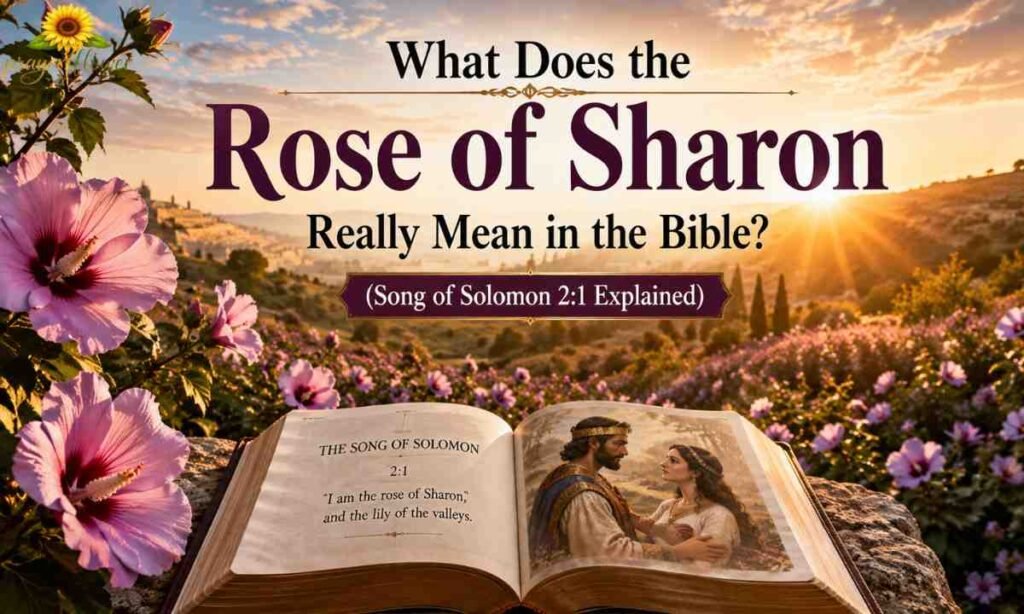
“I am the rose of Sharon, and the lily of the valleys.” So begins one of the most debated and beloved lines in all of Scripture (Song of Solomon 2:1). The speaker is the beloved — and for centuries, theologians and mystics have read her words as far more than a romantic self-description.
The identity of the Rose of Sharon has been interpreted in two primary ways. In its most immediate literary sense, the Shulamite woman uses the image of a common wildflower — the Sharon plain, stretching along Israel’s Mediterranean coast, was famous for its seasonal blooms — to describe herself as simply, naturally beautiful. She is not boasting. She is identifying with the ordinary loveliness of the land.
But Christian typology has long seen something deeper here. The early Church Fathers, including Origen and later Bernard of Clairvaux, interpreted the Rose of Sharon as a figure of Christ Himself — the One who is beautiful beyond description, who appears among humanity like a flower rising from common ground. This reading gave rise to the beloved devotional tradition of naming Christ “the Rose of Sharon,” a title still sung in hymns today.
What makes this symbolism so spiritually compelling is its paradox: the rose is both royal and humble, both fragrant and vulnerable to thorns. In Christ, these tensions are resolved. The Rose of Sharon is the King who stoops. The beauty that saves is the beauty that suffers.
The Spiritual Meaning of Roses in the Bible — Love, Purity, and Divine Grace
The rose in Scripture carries meanings that layer upon one another like petals. In Isaiah 35:1, the prophet declares that “the desert shall rejoice and blossom as the rose” — a vision of divine restoration so radical that even the wilderness erupts in beauty. Here the rose is not a garden luxury but a sign of the impossible becoming possible through God’s grace.
In Christian tradition, the red rose became a symbol of martyrdom and sacrificial love — the love that bleeds. The white rose, by contrast, was associated with purity, with the Virgin Mary, and with souls washed clean. These color associations, while not always explicit in Scripture itself, grew organically from the biblical logic of blood and holiness, of crimson sins made white as snow (Isaiah 1:18).
The spiritual meaning of roses in the Bible is, at its core, a meditation on love that costs something. Roses are beautiful, but they are not effortless — they require tending, they carry thorns, and they do not last forever in their earthly form. This is precisely why they speak so powerfully to the nature of divine love: extravagant, sacrificial, and pointing always toward something beyond the temporal.
Rose Thorns in Scripture: What They Symbolize About Suffering and Redemption
No honest reflection on roses in the Bible can ignore the thorns. In Genesis 3:17–18, thorns enter the world as a consequence of the Fall — they are a symbol of the curse, of the ground that now resists human labor, of a creation that has been fractured. Thorns are not decorative in Scripture; they are deeply theological.
The crown of thorns placed on Jesus’ head at the crucifixion (Matthew 27:29) is one of the most powerful symbolic moments in all of Scripture. The instrument of the curse becomes the crown of the King. The very thing that Genesis says entered creation through sin is now pressed into the brow of the One who came to reverse that curse. The thorns of the rose, in the light of Calvary, become symbols of redemption rather than condemnation.
Paul’s famous “thorn in the flesh” (2 Corinthians 12:7) extends this theology into the personal. Even the beloved apostle carried a thorn — some unresolved suffering that God refused to remove, because in weakness, grace is made perfect. The rose and its thorns, then, offer believers a complete theology of suffering: beauty and pain are not opposites but companions on the road toward God.
White Rose vs Red Rose vs Yellow Rose — Biblical Color Meanings Explained
Biblical color theology is rich and intentional, and applying it to roses gives us a devotional framework that many believers find meaningful, even where the Bible does not name these colors explicitly in relation to roses.
The red rose draws its symbolism from blood — the blood of the covenant, the blood of martyrs, the crimson thread that runs from Genesis through Revelation. Red in Scripture is the color of sacrifice (Leviticus 17:11), of passion, and of the love that does not flinch. A red rose, in the Christian imagination, is the rose of Calvary.
The white rose speaks of purity, holiness, and the righteousness that God imputes to sinners. In Revelation 19:8, the Bride of Christ is clothed in “fine linen, clean and white.” White in Scripture signals the absence of defilement and the presence of the divine — it is the color of the transfigured Christ (Matthew 17:2), of angels, of the new creation.
The yellow rose, less directly addressed in Scripture, has been associated with joy, warmth, and the radiance of God’s presence. The “Sun of Righteousness” in Malachi 4:2 rises with healing in His wings — a solar warmth that many believers associate with the golden tones of yellow flowers. While not a direct scriptural symbol, it resonates with the biblical theme of divine light breaking through.
Jesus as the “Rose Without Thorns” — Medieval Theology and Marian Symbolism
Medieval Christian theology produced one of its most tender images in the concept of Jesus — and by extension, Mary — as the “rose without thorns.” The logic was precise: thorns entered creation through sin; therefore, one born without sin would be a rose untouched by the curse that produces thorns.
This image was applied first to Mary, who in Catholic and Eastern Orthodox tradition is honored as the sinless vessel of the Incarnation. The white rose became her flower — present in countless Renaissance paintings, woven into rosary beads (the very word “rosary” derives from the Latin for “rose garden”), and embedded in the stained glass of medieval cathedrals.
By extension, Christ Himself was the ultimate “Rose without thorns” — not because He avoided thorns, but because He bore thorns that were never His to bear. He took upon Himself the thorns that belonged to humanity’s sin. This is the devotional poetry of medieval theology at its finest: not fantasy, but a way of seeing the Gospel through the lens of creation’s own symbols.
Biblical Meaning of Lilies: What “Consider the Lilies of the Field” Truly Teaches (Matthew 6:28–29)
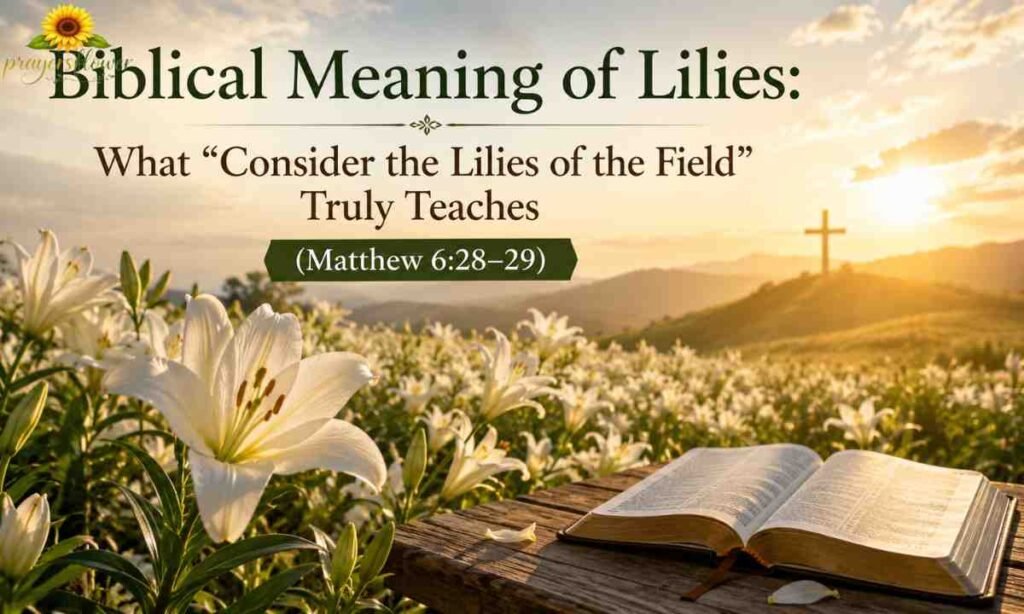
“Consider the lilies of the field, how they grow; they toil not, neither do they spin: And yet I say unto you, That even Solomon in all his glory was not arrayed like one of these.” (Matthew 6:28–29)
These two verses may be the most famous flower-related words Jesus ever spoke, and they deserve far more than a passing glance. Jesus is in the middle of the Sermon on the Mount, dismantling the anxiety architecture of human life brick by brick. He has already pointed to the birds of the air. Now He points to the lilies.
The lilies Jesus refers to are generally understood to be the wildflowers that carpeted the Galilean hillsides in spring — possibly anemones or crown flowers, blazing with color and existing for only a season. Their beauty is extraordinary, Jesus says. And they accomplished it without striving. They did not work for it, plan for it, or worry about it. God simply clothed them, and they were glorious.
The biblical meaning of lilies in this passage is a direct confrontation with the anxiety of self-sufficiency. Jesus is not teaching passivity; He is teaching a fundamental reorientation of trust. The flower does not clothe itself — God does. The believer who grasps this lives differently. Worry does not disappear, but it loses its throne.
For further study on this passage and its broader context in the Sermon on the Mount, the Bible Gateway resource on Matthew 6 offers the full text alongside multiple translations: https://www.biblegateway.com/passage/?search=Matthew+6%3A25-34&version=NIV
Lily of the Valley Meaning in the Bible — Purity, Resurrection, and the Names of Christ
The Lily of the Valley appears in Song of Solomon 2:1 alongside the Rose of Sharon, and like its companion, it carries both romantic and Christological readings. In its immediate context, it describes the beloved’s gentle, humble beauty — the valley lily, not the mountain flower, growing low and unassuming.
Christian theology has long embraced the Lily of the Valley as a name for Christ precisely because of this humility. He who was “meek and lowly in heart” (Matthew 11:29) is fittingly symbolized by a flower that does not grow on the heights but in the shaded, gentle places. The Lily of the Valley became associated with the Resurrection in Christian tradition — it blooms in spring, it is white as purity, and it carries a fragrance that seems disproportionate to its small size, just as the resurrection of one man became the fragrance of hope for all of humanity.
In Hosea 14:5, God Himself says, “I will be as the dew unto Israel: he shall grow as the lily.” Here the lily becomes a symbol of divine growth and restoration — what God causes to bloom in a person or a people who return to Him cannot be produced by human effort. It is the lily’s nature to grow when conditions are right. The condition God provides is His own presence.
Why Lilies Are Associated With the Virgin Mary and Easter in Christian Tradition
The white lily — specifically the Easter lily (Lilium longiflorum) — has become one of the most recognizable symbols of Christian celebration, and its roots go deep into both Scripture and Church history. The association with the Virgin Mary comes partly from the purity symbolism of white flowers and partly from the apocryphal tradition that when Mary’s tomb was opened after her assumption, it was found filled with lilies and roses.
The Easter lily’s association with resurrection comes from a simple but profound observation: the bulb is buried in the ground, dead-seeming through winter, and then rises again in spring in spectacular white bloom. This is the Paschal mystery in botanical form — death is not the end; what is buried can rise. Early Christians found in the Easter lily a natural sermon, one that God had planted in the earth long before the first Easter morning.
The three petals of some lily varieties were also associated with the Trinity, and the overall whiteness of the flower was tied to the sinlessness of Christ and the purity required for resurrection life. Today, Easter lilies continue to adorn churches on Resurrection Sunday, carrying this layered spiritual weight into every new generation of worshippers.
The Lily in Hosea 14:5 — God’s Promise of Restoration and Spiritual Renewal
Hosea 14 is one of Scripture’s most stunning reversals. The entire book of Hosea has been a record of Israel’s unfaithfulness — their turning away from God, their spiritual adultery, their catastrophic choices. And then, in the final chapter, God speaks not in judgment but in breathtaking tenderness.
“I will heal their waywardness and love them freely, for my anger has turned away from them. I will be like the dew to Israel; he will blossom like a lily; like a cedar of Lebanon he will send down his roots.” (Hosea 14:4–5)
The lily here is not a passive image of prettiness. It is a declaration of what God’s restorative love actually produces in a human life or a people who return to Him. The dew is the divine initiative — God moves first, God moistens the dry ground. The lily is the result: something lovely, something pure, something that would never have grown without that sovereign initiative of grace.
For the believer who has wandered and returned, this is one of the most personal promises in Scripture. You will blossom. Not because you have earned it. Because God has bent down with the dew of His mercy, and lilies grow where dew falls.
Keep Feeding Your Faith: Blood in Dream Meaning
Lily vs Rose in Scripture — How These Two Flowers Together Reveal God’s Love
When Song of Solomon places the rose and the lily side by side in 2:1, it is doing something subtle and profound. These two flowers, taken together, represent the full spectrum of divine love as the Bible presents it.
The rose speaks to love that is passionate, sacrificial, marked by depth and by the willingness to be wounded. The thorns are part of the rose’s story, just as the cross is part of the Gospel’s story. This is the love of Holy Week — ardent, costly, bleeding.
The lily speaks to love that is pure, unhurried, and given freely without earning. “Consider the lilies” — they do not strive, they do not earn, they do not perform. They simply receive and bloom. This is the love of grace — unconditional, unearned, quietly transforming.
Together, rose and lily reveal a God whose love is both fierce and tender, both costly and free. This is the full portrait: a love that went to the cross (rose) and a love that meets you in the valley of your smallness (lily) and says: you will bloom.
Biblical Meaning of Sunflowers — Faith, Devotion, and Seeking God’s Light
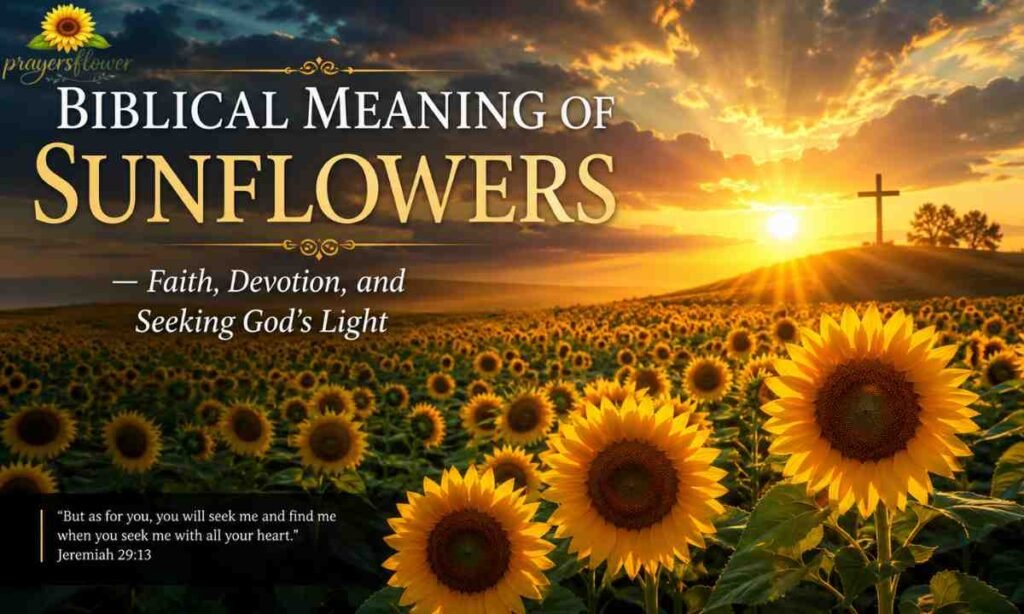
Sunflowers do not appear by name in the Bible. This is worth stating plainly — it is one of the first questions careful readers ask, and the honest answer matters. The sunflower is native to the Americas and was unknown to the ancient Near East. It is not a biblical plant.
And yet, the sunflower has become one of the most spiritually resonant flower symbols in Christian devotion, and for a reason that goes beyond sentiment. The behavior of the sunflower — its turning toward the sun — is so precise an image of what the Bible calls believers to do that the symbol has earned its place in Christian reflection.
Proverbs 3:5–6 calls the believer to “Trust in the Lord with all your heart and lean not on your own understanding; in all your ways submit to him, and he will make your paths straight.” This is sunflower theology in words. Don’t navigate by your own light. Turn toward the source. Let the light itself direct your growth.
Romans 8:28 adds the sunflower’s consistency to the picture: “And we know that in all things God works for the good of those who love him.” The sunflower does not only turn toward the sun on easy days or when the sky is clear. It tracks the light through the entire arc of the day. This is the steadfastness Scripture calls “unwavering faith” — not faith that performs when circumstances are ideal, but faith that keeps its face turned toward God regardless.
Heliotropism and the Holy: What a Sunflower Turning Toward the Sun Teaches Christians
The botanical term for a plant’s movement in response to light is heliotropism, and young sunflowers are remarkable examples of it. As they grow, they track the sun from east to west through the day and then reset overnight to face east again — ready for morning. Mature sunflowers eventually fix their face east, permanently oriented toward the dawn.
The spiritual teaching here is almost too perfect. In Psalm 5:3, David writes: “In the morning, Lord, you hear my voice; in the morning I lay my requests before you and wait expectantly.” The discipline of morning orientation — bringing your face first to God before the day turns you in a hundred directions — is exactly what the sunflower practices biologically. What the flower does by nature, the believer is called to do by devotion.
The reset overnight — turning back east in darkness to be ready for morning light — speaks to the biblical practice of repentance and renewal. Lamentations 3:22–23 declares that God’s mercies “are new every morning.” The sunflower doesn’t carry yesterday’s sun into tomorrow. Neither does grace work that way. Every morning is a new turning, a fresh orientation, a renewed facing of the Light.
Sunflowers and the “Sun of Righteousness” in Malachi 4:2 — A Prophetic Connection
Malachi 4:2 is one of the final prophetic utterances of the Old Testament: “But for you who revere my name, the sun of righteousness will rise with healing in its rays. And you will go out and frolic like well-fed calves released from the stall.”
The “Sun of Righteousness” is understood in Christian theology as a messianic title — a promise of the One who would come bringing healing, justice, and light in a way that the natural sun only approximates. When the sunflower turns toward the sun, then, its devotional meaning deepens considerably. It is not merely seeking warmth and photosynthetic energy. In the Christian imagination, it is turning toward the One who was promised in Malachi — the Sun who rises with healing.
This is why the sunflower works as a Christian symbol even without a direct biblical reference. Its meaning is not imposed from the outside; it is drawn from the logic of the whole scriptural narrative. The sunflower does naturally what every soul is designed to do: face the source of all light and life. When that source is the Sun of Righteousness Himself, the sunflower becomes an act of involuntary worship.
Are Sunflowers Mentioned in the Bible? Separating Scripture From Symbolism
This question deserves a clear and honest answer. No — sunflowers are not mentioned in the Bible. The common sunflower (Helianthus annuus) is indigenous to North America and was not introduced to Europe or the Middle East until after the Spanish colonization of the Americas in the 16th century. The biblical canon was completed long before any biblical writer could have encountered a sunflower.
This matters for intellectual integrity in faith. A spiritually grounded approach to floral symbolism distinguishes between what Scripture explicitly teaches and what theological tradition has layered onto flowers over centuries. Both are valuable, but they are not the same thing. Treating a devotional association as a direct biblical mandate is a form of carelessness that actually weakens faith rather than strengthening it.
The right approach is to say: the sunflower is not a biblical flower, but its properties are so deeply aligned with biblical themes — seeking light, consistent devotion, turning toward the source — that it has become a meaningful devotional symbol within Christian tradition. That is not a diminishment of its spiritual value. It is an honest account of where the symbolism comes from, and honest faith is always stronger than inflated faith.
Sunflower as a Symbol of Unwavering Trust — Lessons From Proverbs 3:5–6 and Romans 8:28
The sunflower’s most compelling spiritual contribution is not its beauty — it is its consistency. In a world that buffets believers with distraction, doubt, suffering, and competing demands, the image of a flower that simply keeps its face turned toward the light is quietly revolutionary.
Proverbs 3:5–6 calls believers to a total trust — not partial, not conditional, not limited to the pleasant seasons. “With all your heart.” The sunflower does not turn toward the sun with part of itself while keeping the rest facing some other direction. Its entire being orients toward the light. This is the wholeness of trust that Proverbs calls wisdom.
Romans 8:28 provides the theological ground for this kind of trust: it is not blind optimism but reasoned confidence. “We know” — Paul uses the language of settled conviction. The sunflower doesn’t worry about what the clouds might do. It continues its orientation because the sun is always there behind the clouds. Believers who have internalized Romans 8:28 live like sunflowers in overcast weather: still facing east, still trusting the light, still growing — because they know what they are turning toward, even when they cannot see it.
What Flowers Symbolize in the Bible — A Complete Guide to Floral Spiritual Meaning
The biblical meaning of flowers operates on several distinct levels, and a complete guide must address each one. First, flowers in Scripture often represent human frailty and the brevity of earthly life. Second, they represent beauty, divine provision, and the generosity of a Creator who did not have to make the world this lovely but chose to. Third, specific flowers carry Christological significance — they are used as images for Christ Himself or for the work of the Holy Spirit. Fourth, flowers symbolize restoration — God’s promise that what has died or withered will bloom again.
Across the garden of Scripture, each flower adds a distinct fragrance to this unified theology. The rose brings passion and sacrifice. The lily brings purity and grace. The hyssop used in Passover brings cleansing. The almond blossom on Aaron’s rod (Numbers 17:8) brings the miraculous sign of divine approval. Even the fading grass-flower of Isaiah 40:6–8 — “The grass withers and the flowers fall, but the word of our God endures forever” — contributes to this garden: a flower can be both beautiful and temporary, and its very transience points us toward the eternal.
Together, the flowers of Scripture compose a theology of beauty that is never decorative alone. Every bloom in the Bible is doing theological work, teaching something about the nature of God, the condition of humanity, or the hope of redemption.
Flowers as Symbols of Human Mortality in Psalm 103 and Isaiah 40 — Eternal vs Earthly Life
Two of the most powerful meditations on human mortality in the entire Bible use flowers as their central image, and they do so with a combination of realism and tenderness that no other imagery could achieve.
Psalm 103:15–16 says: “The life of mortals is like grass, they flourish like a flower of the field; the wind blows over it and it is gone, and its place remembers it no more.” Read in isolation, this is sobering almost to the point of despair. Human life is exquisite — “they flourish” — and it is brief. The wind comes. It is over.
But Psalm 103 does not leave us there. The very next verse grounds this mortal fragility in divine love: “But from everlasting to everlasting the Lord’s love is with those who fear him.” The flower fades; the love does not. The biblical meaning of flowers in this passage is not nihilism — it is proportion. You are a flower, yes. But you are a flower held in the hands of an eternal God whose love outlasts every season.
Isaiah 40:6–8 makes the same contrast even more cosmic: all flesh is like grass, all human glory like field flowers that wither when the breath of the Lord blows. Then the declaration: “The word of our God endures forever.” The eternal is not the human. But the eternal God has entered the human — and that changes everything the flower means.
Biblical Meaning of Receiving Flowers in a Dream — God’s Messages Through Floral Visions
Scripture takes dreams seriously as a medium of divine communication — from Joseph’s dreams in Genesis to the visions of Daniel to the angelic dream-communications in Matthew’s Gospel. It follows that many believers wonder about the spiritual significance of flowers received in dreams.
The honest theological framework here is discernment rather than formula. The Bible does not give us a dream dictionary where “roses mean this” and “lilies mean that” in a one-to-one correspondence. What the Bible does give us is a set of principles for receiving any communication that may be from God: test it against Scripture (1 Thessalonians 5:21), hold it with humility, seek the counsel of mature believers, and never build doctrine on dream imagery alone.
That said, the symbolism Scripture associates with flowers can inform a prayerful interpretation. If a believer dreams of lilies at a time of anxiety, the connection to Matthew 6:28–29 is worth prayerful consideration. If roses appear in a context of suffering, the theology of redemptive beauty through thorns may speak. The dream does not override Scripture; the dream, if from God, will harmonize with Scripture. Flowers in that space carry the biblical meaning of flowers into the personal — always pointing toward the God who tends the garden of human souls.
Flowers in the Song of Solomon — Romantic Love, Divine Love, and Sacred Poetry
The Song of Solomon is the Bible’s most concentrated garden. Flowers appear throughout its eight chapters as part of an extended love poem that has generated more interpretive controversy — and more spiritual richness — than almost any other book in the canon.
On its surface, the Song celebrates human romantic love with astonishing candor and beauty. The beloved is compared to a garden of spices, to a lily among thorns, to the rose of Sharon. The lover moves “like a gazelle” through mountains, calling his beloved to come away as winter ends and flowers appear on the earth (Song of Solomon 2:11–12). This is not spiritualized away — it is human love in full bloom, and the Bible is not embarrassed by it.
But Jewish and Christian tradition alike have read the Song as also — and perhaps primarily — an allegory of divine love. The Talmud called it the holiest of all Scripture. The Church Fathers read it as the love between Christ and His Church, or between God and the individual soul. The flowers in this reading are the signs of spiritual spring — the blooming of the soul when it is in right relationship with God, the fragrance of a life lived in divine intimacy.
Both readings are true, and the Song insists on holding them together. The biblical meaning of flowers here is that love — human and divine — is the original context for beauty. Flowers do not merely illustrate love. They grow in love’s presence.
What Do Flowers Mean at Christian Funerals, Weddings, and Easter? — Biblical Contexts
Christian rites of passage have been accompanied by flowers for as long as the Church has gathered, and each context draws on the biblical meaning of flowers in distinct ways.
At Christian funerals, flowers do not deny grief — they contextualize it. The cut flower in the arrangement is itself a brief beauty that has been taken from its root, which is an honest acknowledgment of what death is. But the lily, the rose, the white flower placed beside a casket carries the resurrection promise: this is not the end of the story. Just as the lily bulb rises again, so will the believer. Flowers at Christian funerals are an act of eschatological hope placed in the hands of mourners.
At Christian weddings, flowers speak the language of Song of Solomon — they say that this love is good, that beauty matters, that the union being formed is worth celebrating with the finest things creation offers. The bridal bouquet echoes the garden imagery of the beloved in Solomon’s poetry. There is theology in every bloom arranged for a wedding ceremony, whether or not the participants know it.
At Easter, the white lily dominates because it enacts the resurrection narrative in visual form. It rises, it is white, it is pure, it is alive. Easter flowers announce before a word is spoken: the tomb is empty, and beauty has returned to the world.
Top Bible Verses About Flowers — Scripture References for Roses, Lilies, and Sunflowers
Song of Solomon 2:1 — “I am the rose of Sharon, and the lily of the valleys.” The foundational floral verse of Scripture, carrying both romantic and Christological depth.
Matthew 6:28–29 — Jesus on the lilies of the field, offering the most direct biblical teaching on flowers as a lesson in faith and divine provision.
Hosea 14:5 — God’s promise that the restored Israel will “blossom like a lily” — restoration theology through floral imagery.
Isaiah 35:1–2 — “The desert shall rejoice and blossom as the rose” — prophetic vision of divine renewal expressed in floral abundance.
Psalm 103:15–16 — The human life compared to a flower of the field — a meditation on mortality grounded in the love of God.
Isaiah 40:6–8 — “All flesh is grass, and all the goodliness thereof is as the flower of the field” — one of Scripture’s most powerful contrasts between the temporal and the eternal.
Luke 12:27 — The Lukan parallel to Matthew 6, where Jesus again uses lilies to teach radical trust in God’s provision.
Numbers 17:8 — Aaron’s rod blossoms almond flowers overnight — flowers as divine vindication and miraculous sign.
Malachi 4:2 — The “Sun of Righteousness” rising with healing — the prophetic text that grounds sunflower devotional symbolism.
1 Kings 7:19–22 — Lily-shaped capitals on the temple pillars of Solomon — flowers built into the architecture of Israel’s worship.
How to Create a Biblical Garden With Roses, Lilies, and Spiritually Significant Flowers
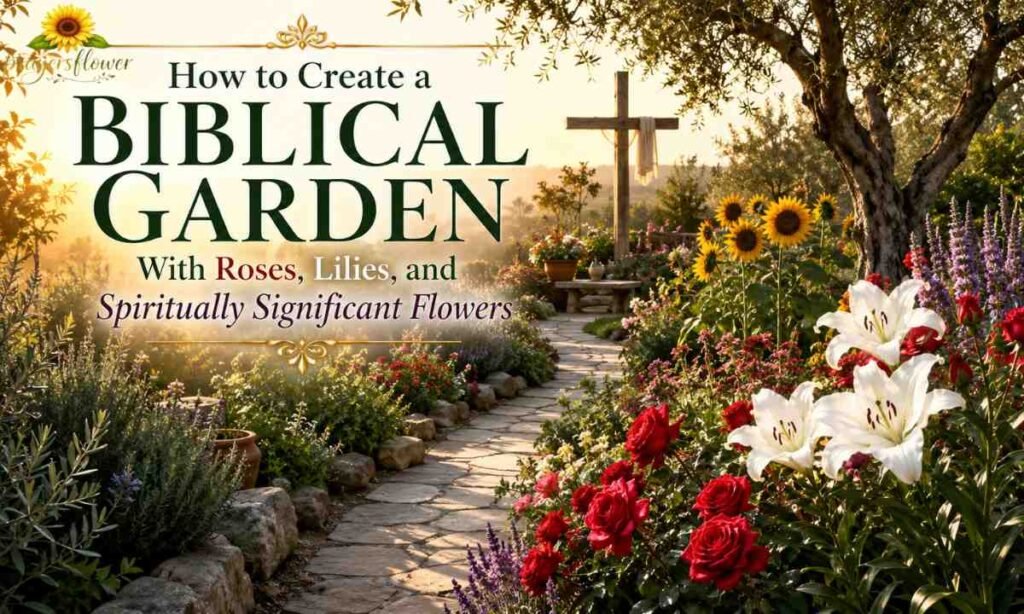
Creating a biblical garden is an act of worship in soil and seed — a living theology growing in whatever space you have, from a windowsill to a half-acre. The concept is ancient: monastic communities maintained herb and flower gardens as places of prayer and contemplation for centuries.
Begin with the flowers that appear most prominently in Scripture. Roses and lilies are the natural starting points. If you have outdoor space, the Madonna lily (Lilium candidum) is the closest modern relative to the lilies of the biblical world and is widely cultivated. For roses, heritage varieties with fragrance more closely approximate what ancient gardeners might have encountered than many modern cultivars.
Add hyssop (Hyssopus officinalis) — used in the Passover ritual and mentioned in Psalm 51:7 (“Purge me with hyssop, and I shall be clean”). Plant almond trees if your climate allows, or grow them in containers — the almond is the first tree to blossom in Israel each year, making it a symbol of watchfulness and anticipation (Jeremiah 1:11–12). Include sunflowers as a devotional addition, clearly acknowledged as a symbol rather than a scriptural plant, but no less meaningful for that honesty.
Place Scripture markers throughout the garden — small signs with the verses that correspond to each plant. Let the garden be a place where you pray as you tend, where the act of watering and weeding becomes its own liturgy. A biblical garden is not a museum of ancient plants. It is a living conversation between creation and the Word that spoke it into being.
Frequently Asked Questions
What is the biblical meaning of flowers in general?
Flowers in the Bible serve as symbols of divine love and human frailty, pointing simultaneously to God’s abundant provision and the brevity of earthly life.
What does the Rose of Sharon mean spiritually in Song of Solomon 2:1?
The Rose of Sharon represents both the humble beauty of the beloved and, in Christian typology, the person of Christ — the King who descends to the lowly places to meet His people.
What did Jesus mean when He said “consider the lilies of the field” in Matthew 6:28?
Jesus used the lily as a living parable of grace-sustained provision, teaching that a God who clothes wildflowers in such glory can certainly be trusted to care for His children.
Are sunflowers a Christian symbol even though they are not in the Bible?
Sunflowers have become a meaningful devotional symbol in Christian tradition because their heliotropism mirrors the biblical call to seek God’s face — even though the flower itself is not a biblical plant.
What do lilies symbolize at Christian Easter services?
The Easter lily symbolizes resurrection hope — its white blooms and springtime emergence from a buried bulb visually enact the death and rising of Christ celebrated on Resurrection Sunday.
Conclusion
The biblical meaning of flowers is not a minor theological footnote — it is woven into the fabric of Scripture from the garden of Eden to the garden where the risen Christ was first mistaken for a gardener. In roses, lilies, and the devotional image of the sunflower, the Bible offers believers a living vocabulary for the deepest truths of faith: love that costs, grace that is freely given, and a God who tends the souls He created with the same care that causes lilies to bloom in the Galilean spring.
Let these flowers do their work. Let the rose remind you of love that bleeds and redeems. Let the lily quiet your anxious striving. Let the sunflower call you back, every morning, to face the Light. The God who made beauty this extravagant and this meaning-laden has not forgotten the garden of your soul — and in His hands, every season of withering is followed by bloom.

John Carrol is a Christian writer and prayer minister with over a decade of experience in faith-based content, devotional writing, and spiritual encouragement. Rooted in Scripture and a lifelong love of intercessory prayer, John created PrayersFlower to help believers find the right words when their own run out. His writing draws from pastoral study, personal faith practice, and a deep conviction that prayer is the most powerful act available to the human heart. When he is not writing, John is found in quiet study of the Word, mentoring young believers, and serving his local church community.