

The Apostles Creed Prayer is one of the oldest, most powerful summaries of Christian faith ever spoken — twelve lines that have anchored believers through centuries of doubt, grief, wonder, and worship.
There are moments when you do not know what to pray. The words feel distant. Your heart is heavy or scattered or simply quiet. In those moments, the Church has always offered something to hold onto — a declaration that does not depend on your mood or your eloquence. It depends on what is true.
The Apostles Creed Prayer gives voice to that truth. This guide covers the full text in traditional and modern versions, the meaning behind every line, the history of where it came from, how Catholics and Protestants use it differently, and how you can make it a living part of your daily faith. Whether you are brand new to this creed or have recited it your whole life, there is something here for you.
Key Takeaways
- The full text of the Apostles Creed Prayer in traditional, modern, and Latin versions
- A line-by-line breakdown of what every article of the creed declares and why it matters
- The real history of the creed, including who wrote it and when it took its current form
- Practical guides for praying it during the Rosary, in daily devotion, and in times of doubt
What Is the Apostles Creed? Definition, Purpose, and Importance in Christian Faith
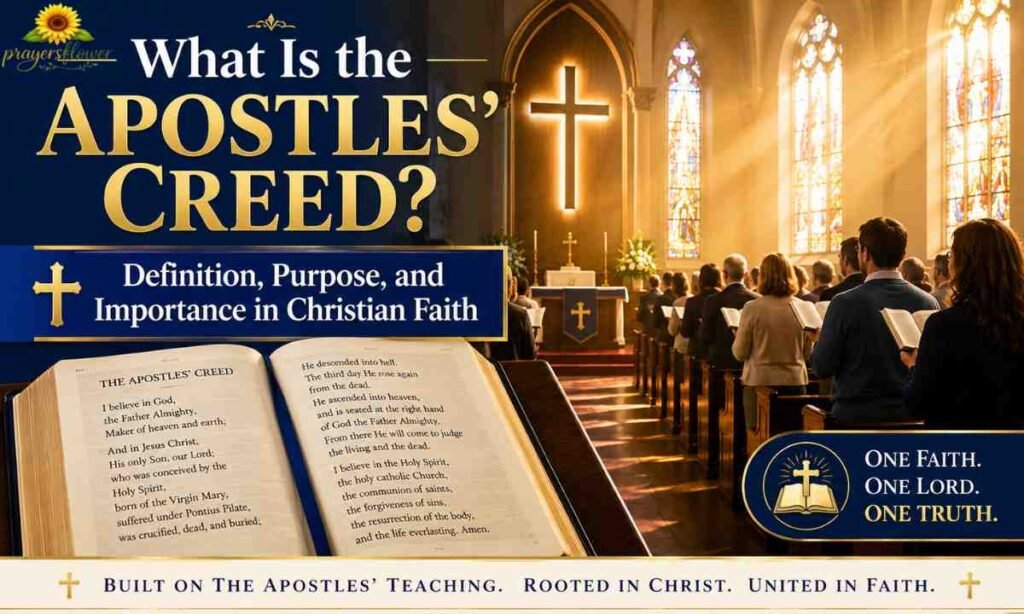
The Apostles Creed Prayer is a concise profession of the core truths of Christianity. It covers the Father, the Son, the Holy Spirit, the Church, forgiveness, resurrection, and eternal life. Its purpose is not decoration. It is a guardrail for the mind and a comfort for the soul. When the culture grows confused and theology grows complicated, the creed stays clear. It tells you what Christians have always believed, in language plain enough to memorise and deep enough to spend a lifetime unpacking.
Is the Apostles Creed a Prayer or a Statement of Faith? (The Answer May Surprise You)
Many Protestant traditions treat the Apostles Creed as a creed only — a doctrinal statement recited corporately. The Catholic Church holds it as both creed and prayer, a direct address of faith offered to God. The truth is that the line between confession and prayer has always been thin. When you say “I believe,” you are not just stating a position. You are placing yourself before God and declaring your trust. That act is prayer. Whether you come from a liturgical tradition or a free-church background, the Apostles Creed Prayer functions as one of the most honest conversations a believer can have with heaven.
Apostles Creed Full Text — Traditional and Modern Versions (Catholic and Protestant)
Here is the traditional text, the version most widely used in both Catholic and Protestant worship.
I believe in God, the Father Almighty, Creator of heaven and earth. And in Jesus Christ, His only Son, our Lord, who was conceived by the Holy Spirit, born of the Virgin Mary, suffered under Pontius Pilate, was crucified, died, and was buried. He descended into hell. On the third day He rose again from the dead. He ascended into heaven and is seated at the right hand of God the Father Almighty. From there He will come to judge the living and the dead. I believe in the Holy Spirit, the holy catholic Church, the communion of saints, the forgiveness of sins, the resurrection of the body, and life everlasting. Amen.
A modern simplified version used in some Protestant congregations reads:
I believe in God, the Father Almighty, maker of heaven and earth. I believe in Jesus Christ, his only Son, our Lord. He was conceived by the power of the Holy Spirit and born of the Virgin Mary. He suffered under Pontius Pilate, was crucified, died, and was buried. He descended to the dead. On the third day he rose again. He ascended into heaven and is seated at the right hand of the Father. He will come again to judge the living and the dead. I believe in the Holy Spirit, the holy catholic Church, the communion of saints, the forgiveness of sins, the resurrection of the body, and the life everlasting. Amen.
Apostles Creed in Latin: Original Text, Transliteration, and English Translation
The Latin title is Symbolum Apostolorum. The opening line reads: Credo in Deum Patrem omnipotentem, Creatorem caeli et terrae. Credo means I believe. Deum Patrem means God the Father. Omnipotentem means Almighty. The Latin text was the standard form of the Apostles Creed Prayer for more than a thousand years in the Western Church. Hearing it or reading it even today carries a weight of continuity — you are joining a voice that has prayed these words across fifteen centuries of Christian history.
Apostles Creed Printable Version — Traditional Wording for Daily Prayer and Study
For personal use, family prayer, small groups, or children learning the faith, print the traditional version above. Write it out by hand once. Something about the physical act of writing these lines slows you down and lets each truth settle. Place it somewhere visible — beside your bed, above your desk, inside your Bible. The Apostles Creed Prayer was designed to be carried, not stored.
History of the Apostles Creed — Origins, Development, and Who Really Wrote It
The apostles did not write the Apostles Creed. That legend was widespread in the early Church, with writers like Rufinus of Aquileia suggesting each of the twelve apostles contributed one article. Theologians had largely set that story aside by the Renaissance. What the creed does carry is apostolic content — the same faith the apostles taught, summarised and shaped over the first centuries of Christian life.
The Old Roman Creed: The Ancient Source Behind the Apostles Creed
The Apostles Creed Prayer developed from an earlier text known as the Old Roman Symbol or Creed, a baptismal confession used in Rome from at least the second century. That earlier creed covered the same three-part structure — Father, Son, Holy Spirit — but in shorter form. Over generations, the Church expanded and clarified the language until the text took the stable shape we recognise today.
When Was the Apostles Creed Written? Timeline from the Early Church to Today
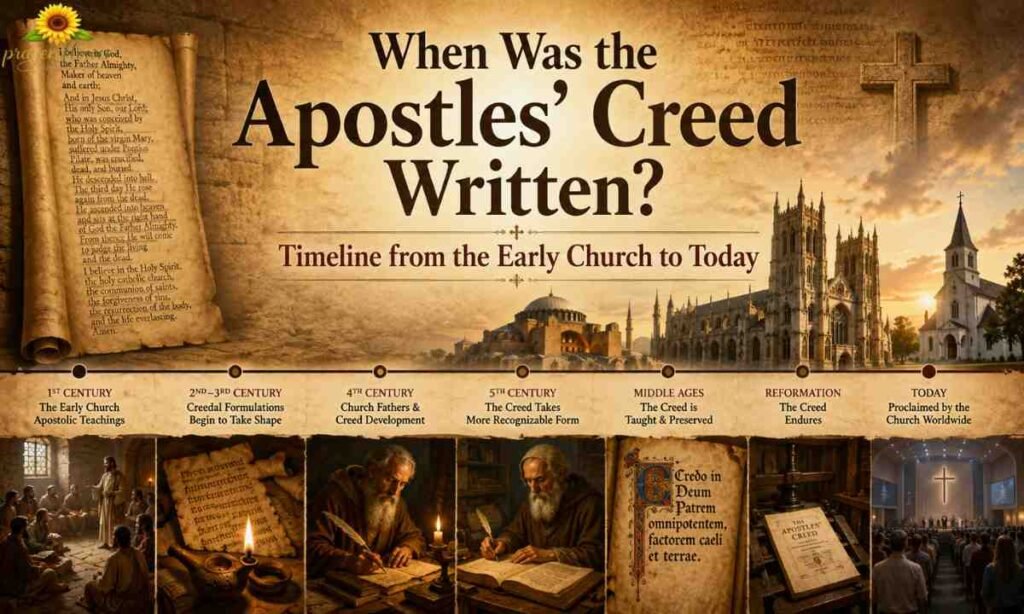
The name Apostles Creed appears first in a letter from the Synod of Milan in AD 390. The current standard form of the text was largely settled by the eighth century, with the version attributed to Pirminius around AD 710 to 714 matching closely what the Church uses now. So the creed you pray today is both ancient and refined — a living document shaped by centuries of faithful use.
Apostles Creed Line-by-Line Meaning: What Every Word Declares About Your Faith
The Apostles Creed Prayer is not a checklist. It is a portrait of God and a map of salvation. Each line carries theological weight that entire books have been written to explore. Reading it slowly is its own form of devotion.
“I Believe in God the Father Almighty” — Meaning of the First Article Explained
The creed opens with the most personal word in the English language: I. Not we, not the Church, not tradition. You. The first article declares that behind all creation stands a Father — not an impersonal force, not a distant architect, but a Father who is also Almighty. This combination is everything. Power without love is terrifying. Love without power is helpless. The God of the Apostles Creed Prayer is both, fully.
“He Descended into Hell” — What Does This Line in the Apostles Creed Actually Mean?
This is the line that stops people. Theologians have debated its meaning for centuries. The most widely held understanding is that Christ, between death and resurrection, entered the realm of the dead — what the Hebrew scriptures call Sheol and the New Testament calls Hades. He did not suffer there. He conquered there. As one reading holds, He descended as a victor, not a prisoner. Some Protestant traditions replace the phrase with “He descended to the dead,” preserving the same theological point with less confusion.
“I Believe in the Holy Catholic Church” — What Protestants and Catholics Understand by This
The word catholic here means universal, not Roman Catholic. The Apostles Creed Prayer was written before the later divisions of Christianity, and the line simply affirms belief in the one Church that Christ founded and that spans all times and places. Protestants who recite this line are not affirming Rome. They are affirming the same thing the early Church affirmed: that the community of believers across history is one body, held together by the same Lord.
“The Resurrection of the Body and Life Everlasting” — The Creed’s Final Hope Unpacked
The creed does not end with forgiveness. It ends with hope. The resurrection of the body is a statement that matter matters — that God does not discard what He made. The body you inhabit will one day be raised. Life everlasting is not a vague spiritual continuation. It is relationship with God without end. The Apostles Creed Prayer closes not with a sigh but with a promise.
Keep Feeding Your Faith: Prayer for Traveling Mercies — Powerful Prayers for Safe Journey and Divine Protection
The Apostles Creed in the Catholic Church — Role in the Rosary, Baptism, and the Catechism
In Catholic life, the Apostles Creed Prayer appears at three defining moments: at Baptism, as the original profession of faith; at the opening of the Rosary, to place Marian devotion firmly within the framework of Christ; and in the Catechism of the Catholic Church, which uses the creed as the organising structure for all doctrinal teaching. To pray the creed in a Catholic context is to place yourself within a stream of faith that stretches from the earliest Christian communities to the present day.
How to Pray the Apostles Creed During the Rosary — Step-by-Step Guide
Begin by holding the crucifix and making the Sign of the Cross. Then pray the Apostles Creed Prayer slowly, line by line, as a declaration of the faith that gives the Rosary its foundation. Move to the Our Father on the first large bead. The creed is not a warm-up. It is the theological ground on which the entire prayer rests. Pray it as though you mean every word — because when you do, the rest of the Rosary opens differently.
Apostles Creed vs. Nicene Creed — Key Differences Every Catholic Should Know
The Apostles Creed Prayer is older in structure, simpler in language, and tied historically to Baptism and personal profession. The Nicene Creed, formulated at the Council of Nicaea in AD 325 and expanded at Constantinople in AD 381, is longer, more theologically precise, and written in response to specific heresies about the nature of Christ. Both are orthodox. Both are authoritative. The Apostles Creed is the creed of initiation. The Nicene Creed is the creed of the gathered Eucharistic community.
Do Protestants Recite the Apostles Creed? How Baptists, Anglicans, and Lutherans Use It
Anglican and Episcopal churches use the Apostles Creed Prayer in Morning Prayer and Evening Prayer, with the congregation traditionally facing the altar at that moment. Lutheran churches include it in both baptismal services and Sunday worship. Many Baptist and non-denominational churches do not recite it liturgically but affirm its content as consistent with Scripture. The creed belongs to the whole Church, even where it is not formally recited.
The Apostles Creed in Anglican and Episcopal Worship — Matins, Evensong, and Morning Prayer
In Anglican services, the Apostles Creed Prayer follows the Canticles in both Matins and Evensong. It is the moment in the service when the congregation traditionally turns to face the altar — a physical act that mirrors the inward turn of the soul toward God. The Episcopal Church in the United States uses it in both Morning Prayer and Evening Prayer, making the creed a daily anchor for worshippers across the liturgical hours.
How to Pray the Apostles Creed — A Step-by-Step Devotional Guide for Beginners
Find a quiet moment. Read the Apostles Creed Prayer once through without stopping. Then go back to the beginning and read it again, one line at a time. After each line, pause. Ask yourself what that truth means today. Where do you need to believe more deeply in the Father’s power? Where does the resurrection of the body speak into something you are carrying? The creed is not a race. It is a conversation.
Research on the psychology of repetitive devotional practice, including studies covered by Psychology Today on the emotional benefits of prayer, consistently shows that structured daily prayer reduces anxiety and increases a sense of meaning — which is exactly what the Apostles Creed Prayer, prayed regularly, is designed to do.
When Should You Pray the Apostles Creed? Best Times in Daily and Liturgical Life
Pray it in the morning as a foundation for the day. Pray it during Lent to renew your baptismal faith. Pray it when doubt comes and the words of your own heart feel thin. The Apostles Creed Prayer is especially fitting before any other prayer — it reminds you who you are praying to and what you already believe, even when believing feels hard.
How to Teach the Apostles Creed to Children — Simple Methods and Memory Aids
Break the creed into its three natural sections: what we believe about the Father, about the Son, and about the Holy Spirit and the Church. Teach one section at a time. Use call and response — you say a line, the child repeats it. Draw simple pictures for each article. Let children ask questions about the lines that confuse them. Their questions are almost always the best theology. The Apostles Creed Prayer is old enough to teach and simple enough to mean.
How to Memorize the Apostles Creed — Tips, Techniques, and Practice Schedule
Write it out once a day for seven days. On day one, read it. On day two, cover the last line and fill it in from memory. Build backwards, line by line, until you can speak the entire Apostles Creed Prayer without looking. Pair it with something you already do — morning coffee, the drive to work, the moment before sleep. Habit carries memory further than effort alone.
Biblical Basis of the Apostles Creed — Scripture References Behind Every Article
Every line of the Apostles Creed Prayer has scriptural roots. “Father Almighty” draws from Matthew 6:9 and Revelation 1:8. The Virgin Birth is found in Luke 1:35. The crucifixion in Luke 23:33. The resurrection in 1 Corinthians 15:4. The ascension in Acts 1:9. The final judgment in 2 Timothy 4:1. The forgiveness of sins throughout the Pauline epistles. The resurrection of the body in 1 Corinthians 15:42 to 44. The creed is Scripture compressed into memory.
The Trinity in the Apostles Creed — How the Three Persons of God Are Professed
The structure of the Apostles Creed Prayer is Trinitarian from its first word to its last. It moves from the Father who creates, to the Son who redeems, to the Holy Spirit who sanctifies and dwells in the Church. This is not coincidental. The creed was shaped by the baptismal formula of Matthew 28:19 — in the name of the Father, and of the Son, and of the Holy Spirit. To pray the creed is to immerse yourself in the Trinitarian life of God.
The Apostles Creed and the Gospel — Does the Creed Summarise Salvation?
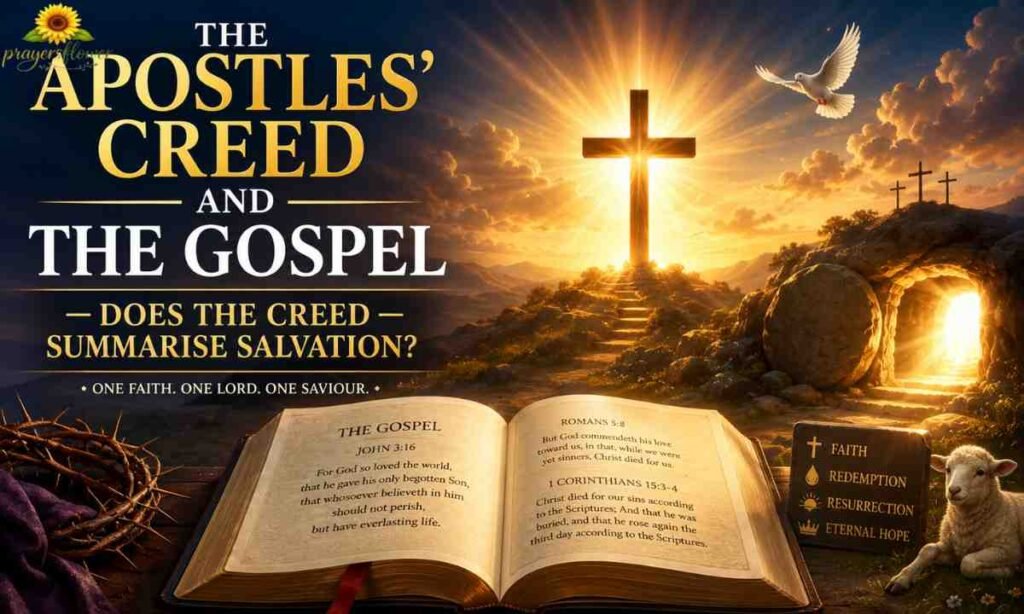
Yes — and remarkably well. The Apostles Creed Prayer moves from creation to incarnation to crucifixion to resurrection to ascension to return. That arc is the Gospel arc. It begins with God’s sovereignty over all things and ends with the promise of life everlasting. Every essential element of the saving story is present. What the creed does not include is an explicit call to personal faith — but the word “I believe” at the start is itself that call, spoken afresh every time the creed is prayed.
Apostles Creed vs. Lord’s Prayer — What Is the Difference and When Is Each Used?
The Apostles Creed Prayer is a declaration of what we believe. The Lord’s Prayer is a model for what we ask. One faces toward doctrine; the other faces toward God in conversation. Both belong together in the life of a believer. In the Rosary, they appear side by side for exactly this reason — the creed grounds the mind, and the Our Father opens the heart.
Is the Apostles Creed in the Bible? What Scripture Says (and Doesn’t Say)
The Apostles Creed Prayer as a unified text does not appear in Scripture. What does appear are the individual truths it affirms, scattered across both testaments. Early Christians gathered those truths into a single confessional form for the purpose of baptism and teaching. The creed is biblical in content even where it is not biblical in form.
Why Is It Called the Apostles Creed If the Apostles Didn’t Write It?
The name reflects the content, not the authorship. The Apostles Creed Prayer carries apostolic teaching — the faith handed down from those who walked with Jesus and proclaimed the Gospel to the world. By the fourth century, the Church used the name to signal that this creed was consistent with what the apostles had taught, not that they had composed it word for word. The name is a statement of fidelity, not attribution.
Common Misconceptions About the Apostles Creed — Myths vs. Historical Facts
Misconception: The twelve apostles each wrote one article. Fact: This legend was repeated widely but rejected by scholars well before the modern era. Misconception: “Holy catholic Church” means the Roman Catholic Church. Fact: The word catholic simply means universal, and the line predates the divisions of Christianity. Misconception: The Apostles Creed Prayer is only for Catholics. Fact: It has been used across Anglican, Lutheran, Reformed, and many evangelical traditions for centuries.
Praying the Apostles Creed in Moments of Doubt — How the Creed Anchors Struggling Faith
There will be seasons when you do not feel your faith. The creed was given for exactly those seasons. When your own words run dry, you borrow the words of the Church. The Apostles Creed Prayer does not ask you to manufacture certainty. It asks you to say what the Church has always said and to trust that the God it describes is present even when He feels distant. Many believers have found that praying the creed in the dark is what kept them from walking away entirely.
The Apostles Creed as a Daily Declaration — What Happens When You Pray It Every Morning
When you begin each morning with the Apostles Creed Prayer, something gradual and significant happens. You stop treating your faith as a feeling and start treating it as a foundation. The creed reminds you before the day begins that you live inside a story — a story authored by a Father who is Almighty, redeemed by a Son who rose from the dead, and sustained by a Spirit who has not left. That is not a bad way to face a difficult day.
Using the Apostles Creed in Personal Bible Study and Small Group Discussion
The Apostles Creed Prayer makes an excellent framework for a twelve-week Bible study. Take one article per week. Find the key scriptures behind it. Discuss what the Church has understood it to mean and where believers today might need to hear it more deeply. In small groups, the creed can also serve as a unifying declaration — recited together at the beginning of a session to remind the group that they share a common faith before they share their varying opinions.
The Apostles Creed in Baptism — Its Historical Role as the Original Baptismal Profession
The Apostles Creed Prayer originated as a baptismal creed. Before a person was baptised in the early Church, they were asked three questions, each corresponding to one person of the Trinity: Do you believe in God the Father? Do you believe in Jesus Christ? Do you believe in the Holy Spirit? Their answers were the creed. To this day, many baptismal rites retain this question-and-answer form. The creed is not only a prayer about faith. It is the prayer through which faith is first publicly named.
Apostles Creed in Lent and Easter — Why the Church Emphasises It in Sacred Seasons
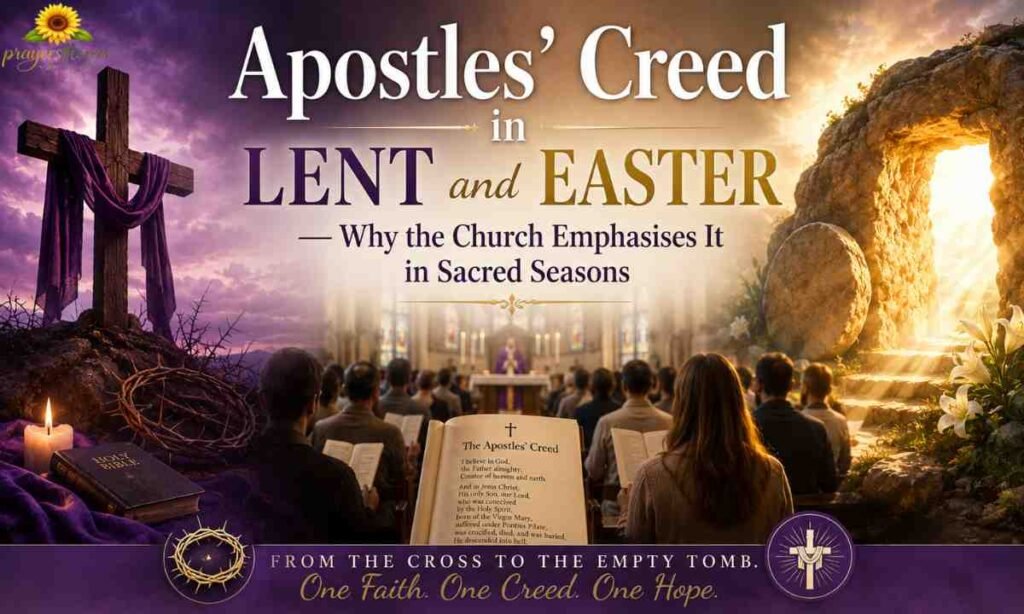
During Lent, many churches invite the faithful to renew their baptismal faith — which means returning to the Apostles Creed Prayer. The creed traces the path that Lent follows: from the suffering under Pontius Pilate to the crucifixion and burial, and finally to the resurrection that Easter proclaims. Praying the creed during these forty days is not repetition. It is preparation. You are rehearsing the story that Easter will confirm.
Frequently Asked Questions About the Apostles Creed Prayer
What is the Apostles Creed Prayer and why does it matter?
The Apostles Creed Prayer is the oldest summary of Christian faith, covering the Trinity, salvation, and eternal life in twelve essential articles.
How is the Apostles Creed used in the Rosary?
It is prayed first, while holding the crucifix, to establish the doctrinal foundation before the decades of Hail Marys begin.
Is the Apostles Creed Prayer the same as the Nicene Creed?
No — the Apostles Creed is simpler and older, while the Nicene Creed is longer and was written to address specific fourth-century theological disputes.
What does “descended into hell” mean in the Apostles Creed?
It refers to Christ entering the realm of the dead between His crucifixion and resurrection, affirming both the reality of His death and His victory over it.
Can Protestants pray the Apostles Creed Prayer in good conscience?
Yes — the creed’s content is rooted in Scripture and affirmed across Anglican, Lutheran, Reformed, and many evangelical traditions worldwide.
Closing Thoughts
The Apostles Creed Prayer has outlasted empires, endured heresies, and been whispered over the dying and shouted at the baptised for more than fifteen centuries. It is not a relic. It is a living confession, and every time you pray it, you add your voice to a chorus that has never stopped.
Take it slowly. Let each line land. The God it describes is the God who made you, redeemed you, and is holding you still — and that truth does not grow old.
“To be a Christian without prayer is no more possible than to be alive without breathing.”
— Martin Luther

John Carrol is a Christian writer and prayer minister with over a decade of experience in faith-based content, devotional writing, and spiritual encouragement. Rooted in Scripture and a lifelong love of intercessory prayer, John created PrayersFlower to help believers find the right words when their own run out. His writing draws from pastoral study, personal faith practice, and a deep conviction that prayer is the most powerful act available to the human heart. When he is not writing, John is found in quiet study of the Word, mentoring young believers, and serving his local church community.