

A daily prayer routine for beginners is one of the most transformative spiritual habits you can build, and it begins with nothing more than a willing heart and a few quiet minutes.
Many people feel the pull to pray more consistently but do not know where to start. They sit down, close their eyes, and then stare at the ceiling wondering if they are doing it right. If that is you, you are not alone, and you are not failing. God is not waiting for you to perform, he is waiting for you to show up.
This guide will walk you through everything you need to build a daily prayer routine for beginners that feels real, sustainable, and spiritually alive. From choosing the right time to pray, to simple methods that keep prayer from feeling like a chore, every section here is written for someone who genuinely wants to grow closer to God, one day at a time.
Lord, meet and bless every reader here, guide them closer to Your heart, and grant them success in every area of their life.
Key Takeaways
- You will learn exactly how to start a daily prayer routine for beginners, even with no prior experience.
- You will discover simple prayer methods like ACTS, breath prayers, and prayer journaling to keep your time with God focused and meaningful.
- You will receive a sample 7-day beginner prayer plan you can start using today.
- You will find practical answers to the most common struggles new pray-ers face, including what to do when prayer feels unanswered.
What Is a Daily Prayer Routine and Why Does It Matter?
Prayer is not a religious ritual you perform to earn God’s attention. It is a conversation with the One who already knows your name.
- A daily prayer routine for beginners is simply a consistent, intentional time set aside to speak with and listen to God, no script required.
- It matters because consistent prayer changes not just your circumstances, but the way you see them.
- Research published by the American Psychological Association found that regular spiritual practices including prayer are linked to greater psychological resilience and reduced anxiety, a finding that aligns with what Scripture has told believers for centuries.
- Building a morning devotional or evening prayer habit creates a spiritual anchor that steadies you when life moves fast.
How to Start Praying Every Day (Even If You Have Never Done It Before)
You do not need eloquent words. You need honesty and a few minutes.
- Begin your daily prayer routine for beginners by choosing one consistent time each day, even five minutes counts.
- Start with gratitude. Name one specific thing you are thankful for and speak it aloud or write it down.
- Then bring your need, your worry, or your question, and lay it before God without editing yourself.
- End by sitting in silence for sixty seconds, not to hear an audible voice, but to practice the posture of listening.
- Do not judge the quality of your prayer. God responds to the heart, not the vocabulary.
Keep Feeding Your Faith: 70 Powerful Bible Verses About Good Luck Prayers
Best Time of Day to Pray: Morning, Evening, or Both?

The best time to pray is the time you will actually keep.
- Morning prayer for beginners anchors the day before the noise begins, Psalm 5:3 describes this as crying out to God at dawn and watching for his answer.
- Evening prayer allows you to process the day, release what troubled you, and close in gratitude rather than anxiety.
- A daily prayer routine for beginners does not require both, but if you choose one, choose the time when you are most mentally present.
- Many new pray-ers find the morning devotional habit easier to protect because the day has not yet made its demands.
How Long Should a Beginner Pray Each Day?
More time does not automatically mean more closeness with God.
- Start with five to ten minutes for your daily prayer routine for beginners. That is enough to be meaningful.
- Consistency over duration is the rule. Ten minutes every day outweighs one hour once a week spiritually.
- As prayer becomes a natural part of your rhythm, the time will naturally expand without effort.
- Jesus often slipped away to pray in solitude, but he also prayed short, direct prayers in crowds, both were fully heard.
Simple Prayer Methods for Beginners: ACTS, Breath Prayers and More
Structure gives beginners something to hold onto when words feel hard to find.
- The ACTS method organises prayer into four movements: Adoration, Confession, Thanksgiving, and Supplication. It is one of the most accessible ways to build a daily prayer routine for beginners.
- Adoration means opening with who God is, not what he has done. Acknowledge his character before your request.
- Confession is honest naming of what came between you and God. Brief and sincere is enough.
- Thanksgiving is specific gratitude, not a blanket thank-you, but naming real moments from real days.
- Supplication is where you bring your requests, for yourself and for others you are carrying in your heart.
- Breath prayers are a simpler option: inhale a truth (“You are with me”) and exhale a release (“I let this go”). They are an ancient Christian practice that fits beautifully into a busy life.
- Praying Scripture aloud is another method. Take a verse like Psalm 23 and personalise it line by line.
How to Create a Sacred Prayer Space at Home
You do not need a prayer room. You need a corner that tells your mind it is time to be still.
- Choose one consistent spot, a chair by a window, a corner of your bedroom, a small table in the hallway.
- Place a few items that draw your attention toward God: a Bible, a candle, a journal, a photograph that reminds you of answered prayer.
- A dedicated space trains your brain to enter a posture of quiet before you even close your eyes, which is especially valuable for those building a morning devotional habit.
- Keep it simple. Clutter competes with stillness.
How to Build a Prayer Habit That Actually Sticks
The enemy of a new prayer habit is not busyness. It is inconsistency.
- Attach your daily prayer routine for beginners to an existing habit. Pray after your first cup of coffee, or just before your nightly skincare routine.
- Habit stacking is the psychological principle of pairing a new habit with one already rooted. It dramatically increases the chance of a daily prayer practice lasting.
- Set a soft reminder on your phone for the first thirty days, not an alarm that jolts you, but a gentle notification with a word that matters to you.
- If you miss a day, do not restart the count. Just return tomorrow. Grace applies to prayer schedules too.
Using a Prayer Journal to Deepen Your Daily Prayer Life
A prayer journal does something that memory alone cannot. It shows you that God has been faithful when you have forgotten.
- Writing prayers is one of the most powerful ways to sustain a daily prayer routine for beginners because it slows the mind and deepens honesty.
- Date every entry. Months later, those dates become a personal record of God’s faithfulness.
- Write what you are asking for. Write what you are afraid to ask for. Write what you are grateful for. Do not edit.
- Reviewing old entries regularly is one of the most faith-strengthening practices available to any Christian, beginner or otherwise.
Best Prayer Apps and Tools to Support Your Routine
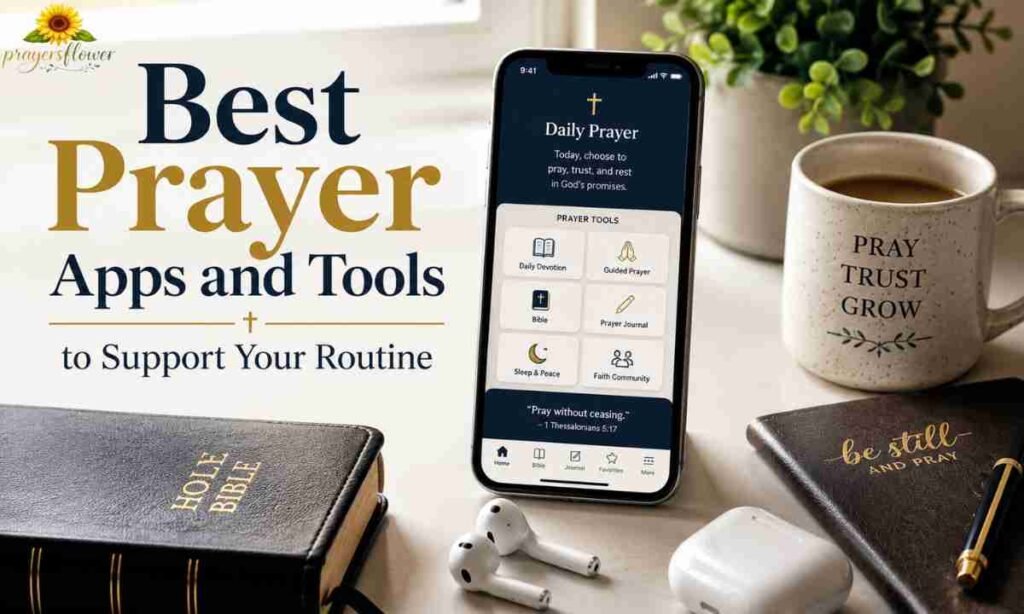
Technology does not replace prayer. It removes the friction that prevents it.
- Pray.com offers guided daily prayer, Scripture, and bedtime meditations, and it is designed with beginners in mind.
- The Echo Prayer app functions as a digital prayer journal and reminder system, useful for those building a daily prayer practice for the first time.
- YouVersion Bible App includes reading plans with built-in prayer prompts that connect Scripture directly to your spiritual routine.
- The best app is the one you will actually open. Try one for two weeks before deciding if it serves your daily prayer routine for beginners.
What to Do When You Feel Like Your Prayers Are Not Working
This is not a failure of faith. It is a deeply human experience that almost every person of prayer has walked through.
- First, remember that silence is not absence. God’s timeline is not your timeline, and his answer is sometimes a different answer than the one you asked for.
- Continue the daily prayer routine for beginners even when it feels hollow. The practice of showing up is itself an act of faith.
- Shift from petition-heavy prayer to listening prayer. Spend time simply sitting and reading Scripture without asking for anything.
- Talk to someone in your faith community. Prayer was never designed to be entirely private, shared prayer carries its own power.
How to Pray When You Are Busy: Praying Throughout the Day
A daily prayer routine for beginners does not have to live only in a dedicated morning or evening slot.
- Micro-prayers, brief, honest conversations with God woven into ordinary moments, are entirely valid. “Lord, I need wisdom right now” is a full prayer.
- Pray during commutes, while washing dishes, while walking, while waiting. These in-between spaces are holy ground if you invite God into them.
- Brother Lawrence, a 17th-century monk, called this “the practice of the presence of God,” maintaining constant awareness of and conversation with God throughout the day.
- For beginners, micro-prayers prevent the daily prayer routine from collapsing when life is loud, because they make prayer portable.
Signs That Your Prayer Life Is Growing
Growth in prayer is rarely loud. It shows up in small, steady shifts in how you see and respond to life.
- You begin to pray before reacting rather than after. This is a significant sign of spiritual maturity taking root in your daily prayer routine for beginners.
- Gratitude starts appearing in moments where anxiety used to live first.
- You notice that you are holding other people’s pain differently, more tenderly, because you have been carrying their names before God.
- Your prayer time starts to feel less like a duty and more like the part of the day you actually look forward to.
What the Bible Says About Daily Prayer
Scripture is not quiet on the subject of consistent prayer.
- Philippians 4:6 instructs believers to bring everything to God through prayer and thanksgiving, a verse that forms the heartbeat of any daily prayer routine for beginners.
- 1 Thessalonians 5:17 gives one of the shortest and most challenging commands in the New Testament: pray without ceasing.
- Luke 18 opens with Jesus teaching a parable specifically about the need to pray always and not give up, which tells us that persistence in prayer is not just encouraged, it is taught by Jesus himself.
- These passages are not pressure. They are an invitation from a God who genuinely wants to hear your voice every single day.
Sample 7-Day Beginner Prayer Routine to Get You Started
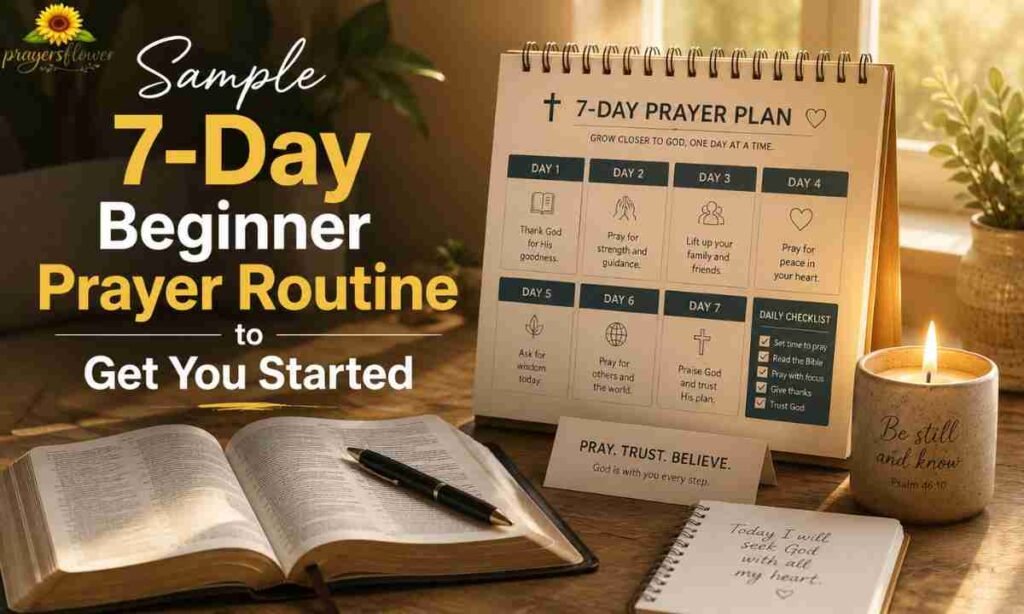
Each day takes no more than ten minutes. Each prayer is written to be spoken aloud.
Day 1: Gratitude
- Lord, I thank you for one specific mercy I noticed today, the kind only you could have arranged.
- Open my eyes this week to the ways you are already working in the spaces I have forgotten to look.
Day 2: Confession and Renewal
- God, I bring the thing I have been quietly carrying and ask you to forgive me and make me clean.
- Renew a right spirit within me today, because I cannot do this without you.
Day 3: Praying for Others
- I lift the person on my heart right now and ask that you meet them in the exact place they are hurting.
- Teach me how to love the people around me the way you love me, without condition and without limit.
Day 4: Listening Prayer
- God, I am not asking for anything today. I am simply here and I want to know you more.
- Speak to me through your Word, through stillness, or through the ordinary moments of this day.
Day 5: Praying Scripture
- As Psalm 23 says, you are my shepherd. Lead me today along paths I cannot see but choose to trust.
- Where my soul is restless, restore it. Where I have wandered, bring me back.
Day 6: Intercession for the World
- Lord, I pray for those who are suffering today in places I will never see.
- Use my ordinary life as part of something larger than I can imagine.
Day 7: Surrender and Praise
- Everything I am carrying today, I release into your hands because you are trustworthy and I am not in control.
- You are worthy of praise not because of what you give me but because of who you are.
Frequently Asked Questions About Starting a Daily Prayer Routine for Beginners
How long should a daily prayer routine for beginners actually be?
Five to ten focused minutes is an excellent starting point, and consistency matters far more than duration when building a daily prayer routine for beginners.
What is the best prayer method for someone who has never prayed before?
The ACTS method (Adoration, Confession, Thanksgiving, Supplication) gives beginners a simple, structured way to enter prayer without feeling lost.
Can a daily prayer routine for beginners include written prayers?
Yes, writing prayers in a journal is one of the most effective ways for beginners to deepen focus and track spiritual growth over time.
What should I do if my daily prayer routine for beginners starts to feel repetitive?
Try switching your prayer method, adding praying Scripture aloud, or shifting your prayer time to a different part of the day to refresh the habit.
How do I know if my morning devotional and prayer time is actually making a difference?
You will begin to notice greater peace in moments of stress, more awareness of gratitude, and a growing tendency to bring situations to God before trying to manage them alone.
Closing Thoughts
A daily prayer routine for beginners is not about achieving a spiritual level or performing for an audience. It is about turning your face toward the God who has been waiting for you all along. Start with five minutes and a single honest sentence. That is enough.
As your prayer life grows, you will find that it is less about the words you say and more about the relationship you are building. The goal of any daily prayer routine for beginners is not perfect prayer. It is faithful presence.
“Prayer is not asking. Prayer is putting oneself in the hands of God, at His disposition, and listening to His voice in the depth of our hearts.” — Saint Teresa of Calcutta

John Carrol is a Christian writer and prayer minister with over a decade of experience in faith-based content, devotional writing, and spiritual encouragement. Rooted in Scripture and a lifelong love of intercessory prayer, John created PrayersFlower to help believers find the right words when their own run out. His writing draws from pastoral study, personal faith practice, and a deep conviction that prayer is the most powerful act available to the human heart. When he is not writing, John is found in quiet study of the Word, mentoring young believers, and serving his local church community.