

The biblical meaning of colors is one of Scripture’s most overlooked spiritual languages — a divine visual code woven from Genesis to Revelation.
Color has always carried weight in the human soul. Long before we could name what we felt, we knew that certain hues stirred something ancient and sacred within us. People searching for the biblical meaning of colors are rarely just curious about theology — they are standing at the edge of something personal, wondering whether God speaks in shades, whether the crimson on a sunset or the blue of a river might carry a message meant for them. That longing is real, and it is holy.
The Bible does not leave that longing unanswered. From the scarlet thread in Rahab’s window to the white robes of the redeemed in Revelation, God consistently uses color as spiritual language throughout Scripture. This article is a thorough, reverent walk through what the Bible actually says about color symbolism — grounded in verses, rooted in historical context, and written for the believer who wants more than a color chart. Stay close, because what follows may reshape the way you read your Bible forever.
Lord, meet and bless every reader here, guide them closer to Your heart, and grant them success in every area of their life.
Key Takeaways
- The biblical meaning of colors spans both Old and New Testaments, with each major color carrying consistent theological symbolism across multiple books
- Colors like red, white, blue, purple, and gold appear in the Tabernacle, priestly garments, prophecy, and visions — making them central to understanding biblical symbolism in Scripture
- Understanding the spiritual meaning of colors in the Bible helps unlock deeper layers of passages in Isaiah, Ezekiel, the Psalms, and the Book of Revelation
- Color symbolism in the Bible is not superstition — it is a carefully embedded divine language that reveals God’s character, covenants, and redemptive purposes
The Origin of Color Symbolism in the Bible
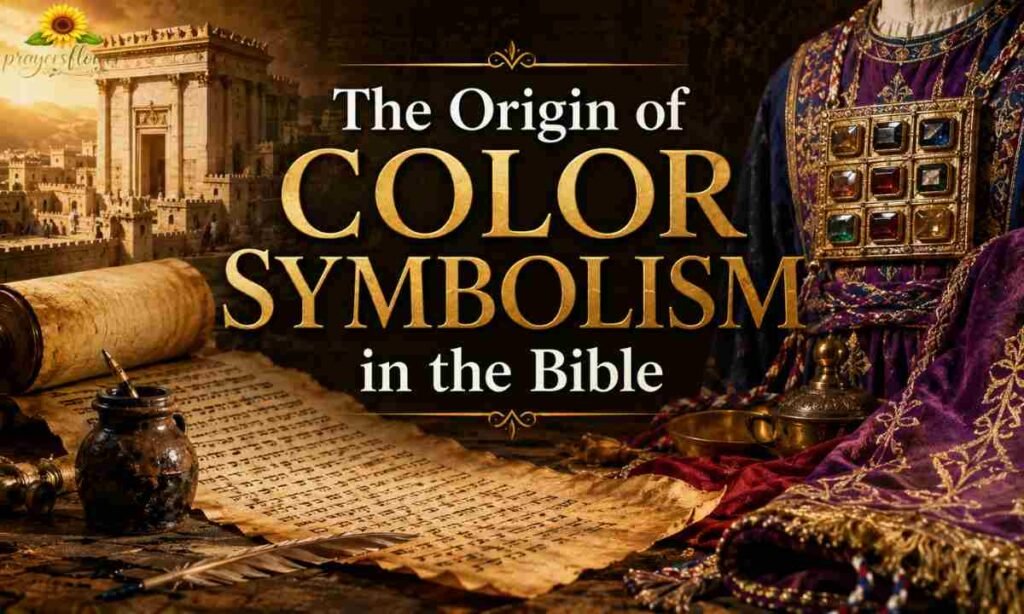
Color in Scripture did not emerge from human creativity. It was assigned meaning by God Himself. When God instructed Moses to build the Tabernacle, He did not leave the color palette to human preference. He specified blue, purple, scarlet, and fine white linen with exact intentionality (Exodus 26:1). This was not interior design — it was theology expressed in thread and dye.
Ancient Hebrew culture understood that the physical world was a mirror of spiritual reality. Colors were not decorative. They were declarative. They announced rank, holiness, mourning, celebration, and divine presence. The priests wore specific colors for specific reasons. The high priest carried those colors into the presence of God. To miss the color language of the Bible is to miss a layer of communication God deliberately placed into His Word.
Biblical Meaning of Colors: A Complete Spiritual Guide
Red and Scarlet — The Color of Blood, Sacrifice, and Redemption
Of all colors in Scripture, red carries perhaps the heaviest spiritual load. It is the color of life itself — blood — and therefore the color of both sin and salvation.
In Isaiah 1:18, God says plainly: “Though your sins are like scarlet, they shall be as white as snow.” The contrast is deliberate. Scarlet represents the weight and visibility of sin — it does not hide, it stains. And yet this same God promises transformation.
The scarlet thread runs through the whole Bible like a lifeline. Rahab hung a scarlet cord from her window in Jericho (Joshua 2:18), and her household was spared. Theologians have long seen this as a foreshadowing of the blood of Christ — a visible mark of covenant protection. The Passover blood on the doorposts, the sacrificial system of Leviticus, the crown of thorns placed on Jesus — all echo the same crimson theology: life is in the blood, and redemption comes through it.
Red also appears in prophetic and apocalyptic literature with a different weight. In Revelation 6:4, a red horse is given power to take peace from the earth. Red here speaks of war and conflict. The same color holds both grace and judgment — a reminder that God’s palette is never one-dimensional.
Key scriptural references: Isaiah 1:18, Joshua 2:18, Leviticus 17:11, Revelation 6:4, Matthew 27:28
White — Purity, Holiness, and the Righteousness of God
White is Scripture’s clearest symbol of holiness. It is the absence of stain, the visual language of what God is and what He restores in us.
At the Transfiguration, Jesus’s clothes became white as light (Matthew 17:2). No bleaching process on earth could produce that white — it was the white of glory breaking through flesh. Daniel saw the Ancient of Days with clothing white as snow (Daniel 7:9). In Revelation, the redeemed stand before the throne in white robes, which are identified as the righteous acts of God’s holy people (Revelation 19:8).
The biblical meaning of white is not merely moral perfection — it is the very nature of God’s character transferred to those He has redeemed. White in Scripture always points upward. It is the color of arrival, of completion, of the promise finally fulfilled.
The white of the empty tomb on resurrection morning is perhaps the most powerful expression of this symbolism — absence of darkness, presence of glory, new life where death had been.
Key scriptural references: Matthew 17:2, Daniel 7:9, Revelation 7:9, Revelation 19:8, Psalm 51:7
Blue — Heaven, Divine Revelation, and the Law of God
Blue in the Bible consistently points to the heavenly realm. It is the color of sky and sea — the great stretches of creation that remind human beings they are not the ceiling of the universe.
God commanded that blue threads be woven into the Tabernacle curtains (Exodus 26:31) and into the tassels on the garments of the Israelites (Numbers 15:38-40). The purpose was explicit: seeing the blue tassel was meant to remind the wearer of God’s commandments. Blue was a built-in spiritual discipline — a visible prompt to look heavenward and live accordingly.
In Ezekiel’s vision of God’s throne, the expanse above the living creatures was the color of an awe-inspiring crystal (Ezekiel 1:22-26), with lapis lazuli blue associated with the divine throne in ancient Hebrew understanding. Blue was not just pretty. It was directional — it pointed the eye and the heart toward God’s dwelling place.
For the believer today, blue in Scripture is a gentle but persistent reminder: your citizenship is not here. Your King is above. His Word comes from beyond.
Key scriptural references: Exodus 26:31, Numbers 15:38-40, Ezekiel 1:26, Exodus 28:31
Purple — Royalty, Authority, and Priestly Intercession
Purple in the ancient world was extraordinarily expensive. Extracted from sea snails through a laborious process, true purple dye cost more than gold by weight. To wear purple was to announce power, status, and authority. Every reader of Scripture in the ancient world understood this immediately.
When Roman soldiers draped Jesus in a purple robe before His crucifixion (Mark 15:17), the mockery cut both ways. They meant to demean a man they saw as a failed king. But the biblical truth embedded in that moment was different: they were, unknowingly, dressing the true King of all kings in His rightful color.
Lydia, the first recorded European convert to Christianity in Acts 16:14, was a dealer in purple cloth. Her profession was not incidental — it placed her in the world of wealth, influence, and civic authority. God chose this businesswoman to open the door of Europe to the Gospel.
Purple appears throughout the Tabernacle and in the garments of the High Priest, linking royal and priestly functions together — a connection that reaches its fulfillment in Jesus, who is both King and High Priest (Hebrews 4:14-16).
Key scriptural references: Mark 15:17, Acts 16:14, Exodus 28:5-6, Hebrews 4:14, Judges 8:26
Gold — The Glory of God, Divine Nature, and Eternal Worth
Gold in Scripture is the color and material of God’s glory. It does not merely represent wealth — it represents the weight, permanence, and brilliance of the divine nature.
The Ark of the Covenant was overlaid with pure gold (Exodus 25:11). The lampstand in the Tabernacle was made of pure gold (Exodus 25:31). The New Jerusalem, described in Revelation 21:18-21, is made of pure gold, transparent as glass — a city that is itself a display of the uncreated glory of God.
Gold is also the color of what survives refinement. Job declared: “When He has tested me, I will come forth as gold” (Job 23:10). Peter echoed this in the New Testament — faith proven through trials is more valuable than gold that perishes (1 Peter 1:7). Gold is not just the color of heaven’s streets. It is the color of a faith that has been through fire and come out undiminished.
Key scriptural references: Exodus 25:11, Revelation 21:18, Job 23:10, 1 Peter 1:7, Zechariah 13:9
Green — Life, Growth, Restoration, and God’s Provision
Green in biblical symbolism is the color of vitality — of what is alive, nourished, and flourishing under God’s care.
Psalm 23 places the believer in green pastures — a picture of God’s provision, peace, and pastoral care. This is not poetic accident. Green pastures meant safety, food, and rest for a sheep that would otherwise face starvation and danger. The green of that psalm is the color of a God who knows exactly what His people need.
Jeremiah 17:8 describes the person who trusts in God as a tree planted by water, with leaves that stay green even in drought. Green here becomes a symbol of spiritual resilience — the ability to remain fruitful and alive when everything around you is dying.
In contrast, Jeremiah also uses the image of a tree withering as a symbol of spiritual decay (Jeremiah 11:16). Green and its absence are a spiritual diagnostic — is your soul planted in living water, or is it slowly going dry?
For a deeper exploration of how these colors appear in prophetic literature, the Blue Letter Bible’s color symbolism study offers excellent original language resources.
Key scriptural references: Psalm 23:2, Jeremiah 17:8, Psalm 52:8, Revelation 8:7
Black — Mourning, Judgment, and the Absence of Light
Black in Scripture carries the weight of grief, famine, and divine judgment. It is not evil in itself — but it is consistently associated with the consequences of sin, the depth of suffering, and the darkness that comes when God’s light is withdrawn.
In Revelation 6:5-6, a black horse appears representing famine — scarcity so severe that a day’s wages buys only a day’s food. The color announces catastrophe before a word is spoken. In Lamentations, Zion’s princes are described as blacker than soot, unrecognized in the streets — an image of devastation and humiliation (Lamentations 4:8).
Yet even in biblical darkness, there is a theological thread: God does not abandon those who mourn. The psalms of lament are thick with darkness, and they are still Scripture. Black in the Bible is honest — it does not pretend suffering away. It holds it, names it, and still points toward dawn.
Key scriptural references: Revelation 6:5, Lamentations 4:8, Joel 2:6, Jeremiah 4:28
Bronze or Copper — Judgment, Strength, and Human Accountability
Bronze appears consistently in contexts of divine judgment and human accountability. The bronze altar in the Tabernacle was where sacrifices were made — the place where sin was met with consequence (Exodus 27:1-2). Bronze serpent in the wilderness (Numbers 21:8-9) was both judgment and mercy — a strange object that foreshadowed the crucifixion.
In Revelation 1:15, the feet of the glorified Christ are described as glowing bronze, refined in a furnace. His feet — the part of the body that treads, that walks in authority — are the color of judgment. He who walks through the churches is the one before whom all things are accountable.
Key scriptural references: Exodus 27:1-2, Numbers 21:8-9, Revelation 1:15, Ezekiel 1:7
Silver — Redemption, Refinement, and the Word of God
Silver in Scripture is the metal and color of redemption and refinement. It was the price paid for a slave’s freedom under Mosaic law. It was the metal of the Temple treasury. And in one of the most haunting moments in the New Testament, it was the price paid to betray the Son of God — thirty pieces of silver (Matthew 26:15).
Psalm 12:6 describes the words of the Lord as silver refined seven times — pure beyond measure, tested beyond doubt. Silver here speaks to the absolute trustworthiness of God’s Word. No matter how many times it is tested, it holds.
Zechariah 13:9 uses the image of silver refined in fire to describe God’s process of purifying His remnant people. The silver color is the color of what remains after dross is burned away — the irreducible, indestructible truth of who God is and who His people are.
Key scriptural references: Psalm 12:6, Matthew 26:15, Zechariah 13:9, Proverbs 10:20
Colors in the Tabernacle: God’s Palette of Presence
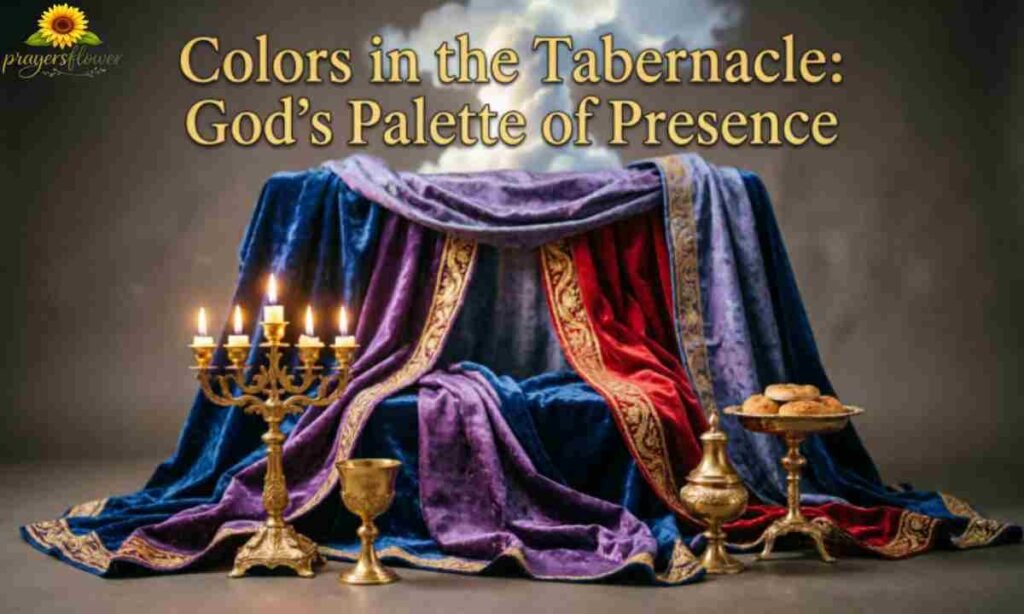
The Tabernacle is arguably the single richest source of color symbolism in all of Scripture. God designed it as a dwelling place, and every color He specified carries meaning.
The four colors of the Tabernacle curtains — blue, purple, scarlet, and white — are widely understood to represent different aspects of Christ. Blue: His heavenly origin. Purple: His royal authority. Scarlet: His sacrifice. White: His righteousness. Standing inside the Tabernacle, an ancient Israelite was surrounded by a portrait of the Messiah painted in thread.
The Tabernacle also demonstrates that God is not random with beauty. Color, in God’s design, always serves revelation. He could have made everything beige. He made it luminous, layered, and intentional — because He wanted His people to see, to wonder, and to worship.
Colors in the Book of Revelation: A Vision in Full Spectrum
Revelation is the most visually intense book in the Bible, and color is central to its language. John sees a throne surrounded by a rainbow (Revelation 4:3) — God’s covenant sign from Genesis, now blazing in full glory around the seat of divine sovereignty. He sees white horses, red horses, black horses, pale horses. He sees a woman clothed in purple and scarlet, and another clothed with the sun.
The Four Horsemen of Revelation use color as the first and fastest signal of what each horseman brings. White: conquest or false peace. Red: war. Black: famine. Pale (Greek: chloros, a sickly yellow-green): death.
Understanding the biblical meaning of colors in Revelation is not about cracking a secret code — it is about learning to read the way John’s first audience read, with eyes trained to see divine meaning in every hue.
The Spiritual Meaning of Colors in Dreams and Prayer
Many believers today wonder whether the biblical meaning of colors applies to their personal spiritual experience — dreams, visions, impressions in prayer. While Scripture does not provide a dream dictionary, it does establish that God has historically communicated through vision and imagery (Joel 2:28, Acts 2:17).
The colors of Scripture give us a vocabulary — a starting point for discernment. When a color appears with consistent spiritual weight across dozens of biblical passages, it forms a legitimate framework for understanding spiritual experience. Blue has meant heaven throughout the whole of Scripture. White has meant holiness. That does not change because the context shifts to a dream.
Discernment, prayer, and the counsel of mature believers remain essential. But the color language of the Bible is real, it is consistent, and it is a gift from God to those with eyes to see.
Keep Feeding Your Faith: Prayer Points for Spiritual Warfare: How to Fight, Stand, and Win in the Spirit
FAQs
What is the biblical meaning of colors in the Bible overall?
The biblical meaning of colors in the Bible reflects God’s nature, redemptive purposes, and covenant promises — each color carries consistent spiritual significance from Genesis through Revelation.
What does the color purple mean spiritually in Scripture?
Purple symbolizes royalty and priestly authority in the Bible, pointing directly to Jesus as both King and High Priest.
What is the spiritual meaning of the color red in the Bible?
Red and scarlet represent blood, sacrifice, and redemption — most powerfully seen in the atonement of Christ and the Passover narrative.
What does white symbolize in biblical color symbolism?
White represents the holiness and purity of God, and the righteousness He clothes His redeemed people in through Christ.
How are colors used as symbols in the Book of Revelation?
In Revelation, colors carry prophetic weight — the Four Horsemen’s colors signal conquest, war, famine, and death, while white robes and gold represent God’s glory and the purity of the redeemed.
Conclusion
The biblical meaning of colors is not a minor footnote in Scripture — it is a living thread woven through every covenant, every vision, and every moment of divine encounter from Eden to the New Jerusalem. God has never communicated in black and white alone. He speaks in the full spectrum of His glory, and learning that language is an act of worship.
Let these colors become lenses through which you read your Bible with fresh attention. The next time you encounter scarlet in Joshua, blue in the Tabernacle, or gold in Revelation, you are not looking at decoration — you are reading the signature of a God who means everything He does.
God, let the depth of Your Word stir in us a deeper life of prayer and trust in Your name.

John Carrol is a Christian writer and prayer minister with over a decade of experience in faith-based content, devotional writing, and spiritual encouragement. Rooted in Scripture and a lifelong love of intercessory prayer, John created PrayersFlower to help believers find the right words when their own run out. His writing draws from pastoral study, personal faith practice, and a deep conviction that prayer is the most powerful act available to the human heart. When he is not writing, John is found in quiet study of the Word, mentoring young believers, and serving his local church community.