

The rosary prayer is one of the most beautiful and structured ways a Christian can meditate on the life of Jesus Christ while drawing close to God through the intercession of Mary.
There is something quietly powerful about holding a string of beads and knowing that millions of believers across centuries have held the same prayers in their hands. Whether you are new to the faith, returning after years away, or simply looking for a more intentional way to pray, the rosary offers a path that is both deeply personal and rooted in Scripture.
This guide walks you through everything you need to know about the rosary prayer — from the meaning of every bead, to the full text of every prayer, to how to find ten quiet minutes on a busy Tuesday morning and make them count.
Lord, meet and bless every reader here and grant them success in every area of their life.
Key Takeaways
- You will find the full text of every rosary prayer, including the Hail Mary, Our Father, Apostles’ Creed, and Hail Holy Queen.
- You will learn exactly how to pray the rosary step by step, even if you have never held a rosary before.
- You will understand the four sets of mysteries — Joyful, Sorrowful, Glorious, and Luminous — and when to pray each one.
- You will discover practical ways to build the rosary prayer into your daily life, whether alone, with family, or on the go.
What Is the Rosary Prayer? Understanding This Sacred Catholic Devotion
The rosary prayer is a Scripture-rooted meditation that moves through key moments in the lives of Jesus and Mary using a structured sequence of vocal prayers and silent reflection.
- It combines the Apostles’ Creed, the Our Father, the Hail Mary, the Glory Be, and the Fatima Prayer into a flowing cycle.
- Each prayer is not merely recited — it is meant to be a doorway into a mystery of faith.
- The rosary prayer is both communal and intimate; it works equally in a cathedral and in a car.
Why Catholics Pray the Rosary — Spiritual Purpose, Power, and Meaning
People turn to the rosary prayer not out of ritual obligation but out of a hunger to be close to God in a world that rarely slows down.
- It centers the mind on Christ when distractions are relentless.
- It offers the comfort of Mary’s intercession in moments of grief or uncertainty.
- It trains the soul to meditate — a discipline that research on contemplative prayer and mental wellbeing links to measurable reductions in anxiety and deeper emotional resilience.
What Does the Rosary Symbolize? The Deep Meaning Behind Every Bead
Every element of the rosary prayer carries symbolic weight that was placed there with spiritual intention.
- The crucifix represents the foundation of all Christian prayer: the death and resurrection of Christ.
- The beads are not counting tools — they are anchors that keep the mind present in prayer.
- The circular shape of the rosary symbolizes eternity and the unbroken chain of grace.
Parts of a Rosary Explained: Beads, Crucifix, Decades, and Medals
Before you begin the rosary prayer, it helps to understand the physical object in your hands.
- The crucifix hangs at the bottom and is where the prayer begins.
- A single large bead follows, then three small beads, then another large bead — this is the introductory section.
- The main body is made up of five decades, each containing one large bead and ten small beads.
- A medal — often bearing an image of Mary — connects the introductory section to the circular body.
How Many Beads Are on a Rosary — And What Each One Represents
A standard rosary prayer has 59 beads total.
- The 53 small beads are for the Hail Mary.
- The 6 large beads are for the Our Father.
- Together they guide you through five decades of meditation on the mysteries of Christ’s life.
Do You Need Rosary Beads to Pray? What to Do If You Don’t Have One
You do not need physical beads to pray the rosary prayer — your fingers will do.
- Count each Hail Mary on your fingers, ten per decade.
- A printed rosary diagram or a rosary app works just as well for beginners.
- What matters is not the object but the intention — the beads simply help the body stay engaged while the heart prays.
All the Prayers of the Rosary — Full Text for Every Beginner to Learn
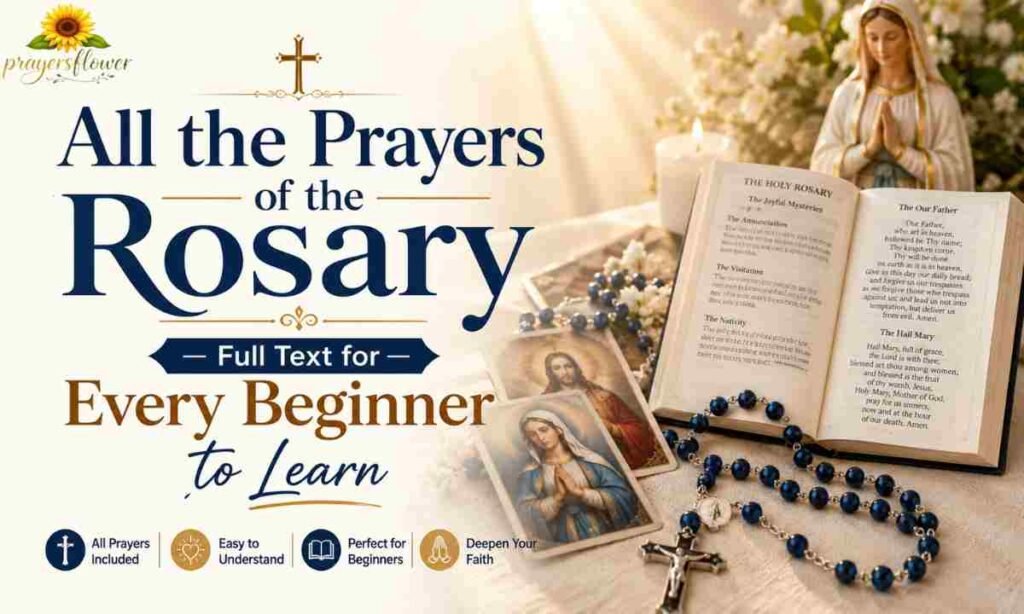
These are every prayer you will need to pray the rosary prayer from beginning to end.
The Hail Mary Prayer: Words, Meaning, and How It Anchors the Rosary
The Hail Mary is the heartbeat of the rosary prayer, repeated 53 times across a full rosary.
- Hail Mary, full of grace, the Lord is with thee; blessed art thou among women, and blessed is the fruit of thy womb, Jesus.
- Holy Mary, Mother of God, pray for us sinners, now and at the hour of our death. Amen.
- The first half comes directly from Scripture — Gabriel’s greeting in Luke 1:28 and Elizabeth’s blessing in Luke 1:42.
- The second half is the Church’s petition, added over centuries of devotional practice.
The Apostles’ Creed, Our Father, and Glory Be — Opening Prayers Explained
The rosary prayer opens with three foundational declarations of faith.
Apostles’ Creed:
- I believe in God, the Father Almighty, Creator of Heaven and earth; and in Jesus Christ, His only Son, our Lord.
- He was conceived by the Holy Spirit, born of the Virgin Mary, suffered under Pontius Pilate, was crucified, died, and was buried.
- He descended into Hell; the third day He rose again from the dead; He ascended into Heaven, and sits at the right hand of God the Father Almighty.
- From thence He shall come to judge the living and the dead. I believe in the Holy Spirit, the holy Catholic Church, the communion of saints, the forgiveness of sins, the resurrection of the body, and life everlasting. Amen.
Our Father:
- Our Father, who art in heaven, hallowed be Thy name; Thy kingdom come; Thy will be done on earth as it is in heaven.
- Give us this day our daily bread; and forgive us our trespasses as we forgive those who trespass against us.
- And lead us not into temptation; but deliver us from evil. Amen.
Glory Be:
- Glory be to the Father, and to the Son, and to the Holy Spirit.
- As it was in the beginning, is now, and ever shall be, world without end. Amen.
What Is the Fatima Prayer (O My Jesus) and Where Does It Fit in the Rosary?
The Fatima Prayer is a short petition added at the end of each decade of the rosary prayer, following the Glory Be.
- O my Jesus, forgive us our sins, save us from the fires of hell, lead all souls to Heaven, especially those who are in most need of Thy mercy. Amen.
- It was given to three shepherd children in Fatima, Portugal, in 1917, during reported apparitions of Mary.
- It takes less than fifteen seconds to pray and carries enormous weight for those who mean every word of it.
Hail Holy Queen: The Closing Prayer of the Rosary With Full Text
After the five decades, the rosary prayer ends with this ancient Marian antiphon.
- Hail, Holy Queen, Mother of Mercy, our life, our sweetness, and our hope.
- To thee do we cry, poor banished children of Eve; to thee do we send up our sighs, mourning and weeping in this valley of tears.
- Turn then, most gracious advocate, thine eyes of mercy toward us; and after this our exile, show unto us the blessed fruit of thy womb, Jesus.
- O clement, O loving, O sweet Virgin Mary. Pray for us, O Holy Mother of God, that we may be made worthy of the promises of Christ. Amen.
How to Pray the Rosary Step by Step — Complete Beginner’s Walkthrough
Here is the rosary prayer in exact sequence, from the first sign of the cross to the last amen.
- Step 1: Hold the crucifix and make the Sign of the Cross.
- Step 2: Pray the Apostles’ Creed while holding the crucifix.
- Step 3: On the first large bead, pray the Our Father.
- Step 4: On each of the three small beads, pray a Hail Mary — traditionally for faith, hope, and charity.
- Step 5: Pray the Glory Be and the Fatima Prayer.
- Step 6: Announce the first mystery and pray the Our Father on the next large bead.
- Step 7: Pray ten Hail Marys on the ten small beads while meditating on that mystery.
- Step 8: Pray the Glory Be and the Fatima Prayer.
- Step 9: Repeat Steps 6 through 8 for each of the remaining four decades.
- Step 10: After the fifth decade, pray the Hail Holy Queen to close the rosary prayer.
How Long Does It Take to Pray the Rosary? (And How to Fit It Into Your Day)
A full rosary prayer takes between fifteen and twenty minutes for most people.
- Beginners often take longer — and that is perfectly fine.
- The morning commute, a lunch break, or the quiet after children go to bed are all natural homes for the rosary prayer.
- Consistency matters more than speed; ten focused minutes beats twenty distracted ones every time.
How to Pray One Decade of the Rosary When You’re Short on Time
One decade of the rosary prayer — one Our Father and ten Hail Marys — takes about two minutes.
- Choose one mystery that feels relevant to what you are carrying that day.
- Pray it slowly and mean it, rather than rushing through all five.
- A single decade prayed with a full heart is more valuable than five decades prayed on autopilot.
Common Mistakes Beginners Make When Praying the Rosary — and How to Avoid Them
The rosary prayer is forgiving of imperfection, but these habits will limit your experience if left unchecked.
- Racing through the words without pausing to picture the mystery drains the rosary of its depth.
- Skipping the Fatima Prayer because it feels unfamiliar robs each decade of its closing intention.
- Treating the rosary prayer as a task to complete rather than a conversation to enter will leave you feeling empty.
- Giving up after one distracted session — distraction is normal; return your mind gently and continue.
The Four Sets of Rosary Mysteries Explained: Joyful, Sorrowful, Glorious, and Luminous
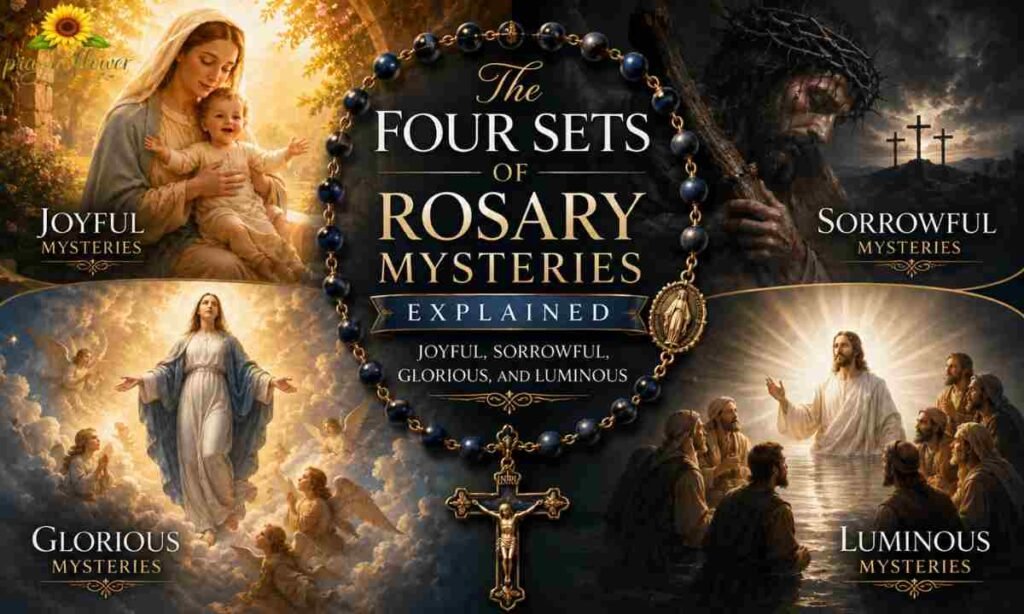
The mysteries are the heart of the rosary prayer — fifteen events in the life of Christ expanded to twenty by Pope John Paul II in 2002.
- Each set of five mysteries corresponds to a stage of Christ’s earthly journey.
- You meditate on one set of mysteries per rosary prayer session, not all twenty at once.
- The mysteries transform the rosary from a series of repetitions into a walk through the Gospel.
The Joyful Mysteries of the Rosary — What They Are and When to Pray Them
The Joyful Mysteries are prayed on Mondays and Saturdays during the rosary prayer.
- First: The Annunciation — the angel Gabriel tells Mary she will bear the Son of God.
- Second: The Visitation — Mary visits her cousin Elizabeth, who is pregnant with John the Baptist.
- Third: The Nativity — Jesus is born in Bethlehem.
- Fourth: The Presentation — the infant Jesus is presented at the Temple in Jerusalem.
- Fifth: The Finding of Jesus in the Temple — the twelve-year-old Jesus is found among the teachers after three days.
Keep Feeding Your Faith: Prayer to St. Anthony for Lost Things (and Lost People)
The Sorrowful Mysteries of the Rosary — Meditating on Christ’s Passion
The Sorrowful Mysteries are prayed on Tuesdays and Fridays.
- First: The Agony in the Garden — Jesus prays in Gethsemane the night before his death.
- Second: The Scourging at the Pillar — Jesus is brutally flogged.
- Third: The Crowning with Thorns — soldiers mock Jesus as king.
- Fourth: The Carrying of the Cross — Jesus carries the instrument of his own execution to Calvary.
- Fifth: The Crucifixion — Jesus dies on the cross for the sins of the world.
The Glorious Mysteries of the Rosary — From the Resurrection to the Coronation of Mary
The Glorious Mysteries are prayed on Wednesdays and Sundays.
- First: The Resurrection — Christ rises from the dead on the third day.
- Second: The Ascension — Jesus ascends to heaven forty days after the Resurrection.
- Third: The Descent of the Holy Spirit — the Spirit comes upon the Apostles at Pentecost.
- Fourth: The Assumption of Mary — Mary is taken body and soul into heaven.
- Fifth: The Coronation of Mary — Mary is crowned Queen of Heaven and Earth.
The Luminous Mysteries of the Rosary — The Five Mysteries Added by Pope John Paul II
The Luminous Mysteries are prayed on Thursdays and were added to the rosary prayer in 2002.
- First: The Baptism of Jesus in the Jordan — the Father’s voice declares Jesus His beloved Son.
- Second: The Wedding at Cana — Jesus performs his first miracle at Mary’s request.
- Third: The Proclamation of the Kingdom — Jesus calls all to repentance and announces the Good News.
- Fourth: The Transfiguration — Jesus is revealed in glory on the mountaintop before Peter, James, and John.
- Fifth: The Institution of the Eucharist — Jesus gives the Church his body and blood at the Last Supper.
Which Rosary Mystery to Pray on Which Day of the Week (Full Weekly Schedule)
This is the traditional weekly schedule for the rosary prayer:
- Monday: Joyful Mysteries
- Tuesday: Sorrowful Mysteries
- Wednesday: Glorious Mysteries
- Thursday: Luminous Mysteries
- Friday: Sorrowful Mysteries
- Saturday: Joyful Mysteries
- Sunday: Glorious Mysteries
Is the Rosary in the Bible? The Scriptural Foundation of Every Rosary Prayer
Every prayer in the rosary prayer has roots in Scripture.
- The Hail Mary draws from Luke 1:28 and Luke 1:42.
- The Our Father comes directly from Matthew 6:9 through 13.
- The Glory Be reflects the doxologies found throughout the Psalms and the New Testament.
- The mysteries themselves are drawn from the four Gospels.
The Rosary as Meditation on the Life of Christ — Scripture Behind Each Mystery
The rosary prayer is essentially a Gospel walk in prayer form.
- The Joyful Mysteries draw from Luke 1 and 2, and Matthew 2.
- The Sorrowful Mysteries draw from Matthew 26 through 27, Mark 14 through 15, Luke 22 through 23, and John 18 through 19.
- The Glorious Mysteries draw from Luke 24, Acts 1 and 2, and Revelation 12.
- The Luminous Mysteries draw from Matthew 3, John 2, Mark 1, Matthew 17, and Luke 22.
The History of the Rosary: From Ancient Prayer Beads to the Modern Devotion
The rosary prayer as we know it developed gradually over several centuries.
- Early Christians used knotted cords to count prayers as far back as the third century.
- The practice of meditating on scenes from Christ’s life while praying grew through the medieval period.
- By the fifteenth century, the structure of the rosary prayer was largely recognizable to modern practitioners.
Who Invented the Rosary? St. Dominic, Dominic of Prussia, and the True Origin Story
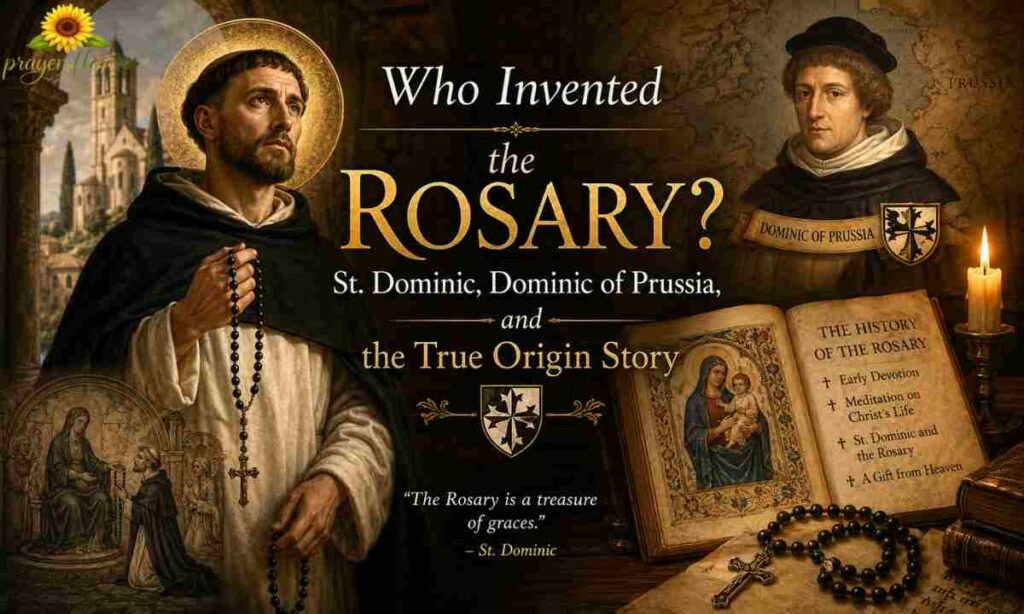
The rosary prayer is most popularly attributed to St. Dominic in the thirteenth century, based on a vision of Mary.
- Modern historians credit Dominic of Prussia, a Carthusian monk, with formally attaching meditations to each Hail Mary in the early 1400s.
- Alan de la Roche further popularized the devotion later in the fifteenth century.
- The tradition of attributing it to St. Dominic remains deeply embedded in Catholic devotion, even if the history is more layered.
What Does “Rosary” Mean? The Etymology, Symbolism, and “Crown of Roses” Tradition
The word rosary comes from the Latin “rosarium,” meaning a rose garden or a garland of roses.
- Each Hail Mary in the rosary prayer was traditionally understood as offering a rose to Mary.
- The full rosary of fifty or one hundred and fifty prayers was seen as presenting a crown of roses to the Mother of God.
- This image of prayer as an act of gentle beauty is part of what makes the rosary prayer so enduring.
Can Non-Catholics Pray the Rosary? What You Need to Know Before You Begin
The rosary prayer is a Catholic devotion, but it is not closed to those outside the Church.
- Many Anglican, Lutheran, and non-denominational Christians pray some form of the rosary as a meditative practice.
- The core of the rosary prayer — Scripture, the life of Christ, and petition to God — is broadly Christian.
- If you are not Catholic, you may find the Marian prayers less familiar; you are welcome to approach them slowly and prayerfully.
Is the Rosary Only for Catholics? How Christians of Other Denominations View It
Christians from many traditions have found the rosary prayer valuable as a meditative practice.
- Some Protestants focus on the Our Father decades and use the mysteries as Gospel meditations without the Hail Mary.
- The ecumenical interest in contemplative prayer has made rosary-like practices more common outside Catholicism.
- The rosary prayer belongs first to the Catholic tradition, but its roots in Scripture make it accessible and enriching for many believers.
How to Stay Focused While Praying the Rosary — Practical Tips for Beginners
Distraction during the rosary prayer is not failure — it is the normal experience of every person who prays.
- Picture the mystery as a scene in your mind while your lips say the words.
- Return gently to the prayer each time your thoughts wander, without frustration or self-criticism.
- Praying with soft instrumental music or in a quiet physical space helps the body support the spirit.
How to Make the Rosary a Daily Habit: Building a Consistent Prayer Routine
The rosary prayer becomes most powerful when it becomes as natural as morning coffee.
- Attach it to an existing habit — right after waking, during a walk, or before sleep.
- Begin with one decade a day for the first week rather than committing to a full rosary.
- The goal is not perfection; the goal is showing up, day after day, bead after bead.
Praying the Rosary While Walking, Driving, or Commuting — Does It Count?
The rosary prayer has always been a devotion for real life, not just for chapels.
- Praying while walking, driving, or folding laundry is entirely valid and widely practiced.
- The physical act of movement can actually deepen focus for some people.
- As long as your heart is directing the prayer, the location is between you and God.
How to Pray the Rosary With Your Family or in a Group
The communal rosary prayer has been a family devotion for generations.
- One person leads each mystery and begins the first half of each prayer; everyone else responds with the second half.
- Children can participate by holding the beads and saying the responses, even if they do not yet know every word.
- A family that prays the rosary together builds a rhythm of faith that sustains them through seasons of joy and grief alike.
Best Apps and Audio Guides to Help You Pray the Rosary as a Beginner
If you find it hard to hold the structure of the rosary prayer in your head, guided audio is a gift.
- The Hallow app offers guided rosary prayers with calming music and visual mystery meditations.
- The iBreviary app includes the full text of every rosary prayer in multiple languages.
- Searching “guided rosary prayer” on YouTube will surface dozens of options, including ones recorded in natural settings like forests and chapels.
Guided Rosary vs. Solo Rosary: Which Is Better for Beginners?
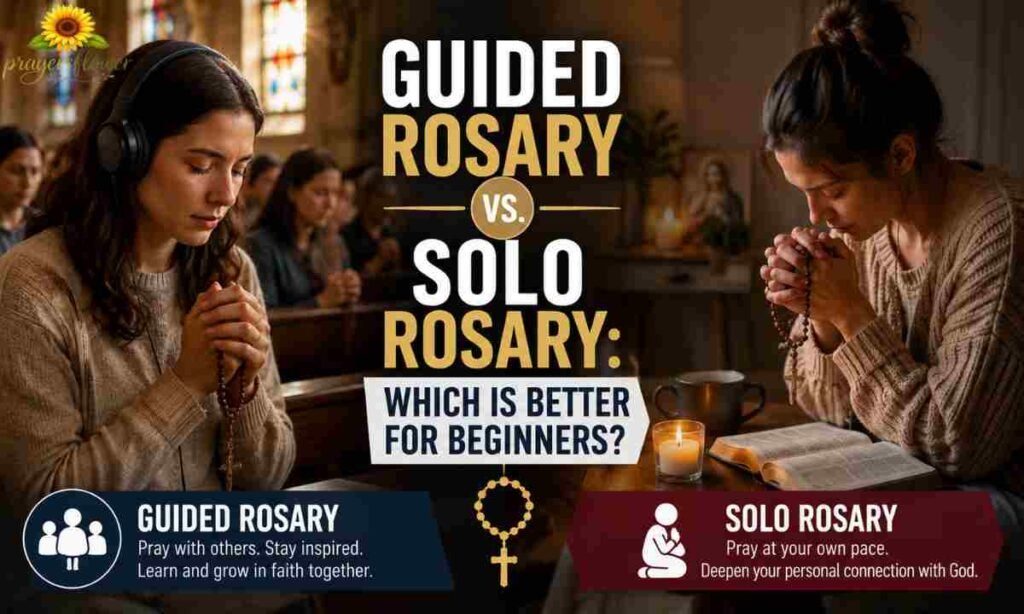
Both approaches to the rosary prayer have real value.
- A guided rosary holds the structure for you, freeing your mind to focus on the mysteries.
- A solo rosary invites deeper personalization — you can pause, linger, and pray at your own pace.
- Most beginners find that starting with guided audio for the first few weeks builds confidence before praying alone.
Frequently Asked Questions About the Rosary Prayer
What is the rosary prayer and what does it involve?
The rosary prayer is a Scripture-rooted Catholic devotion that guides believers through meditation on twenty mysteries of Christ’s life using a structured cycle of the Hail Mary, Our Father, Glory Be, and other prayers.
How long does it take to pray the full rosary prayer?
A full rosary prayer typically takes between fifteen and twenty minutes, though beginners may take a little longer as they learn the sequence and the mysteries.
Can someone who is not Catholic pray the rosary prayer?
Yes — the rosary prayer draws directly from Scripture and many Christians outside Catholicism use it as a meditative practice, sometimes adapting the Marian elements to their own tradition.
What are the mysteries of the rosary and why do they matter?
The mysteries are twenty events from the Gospels — divided into Joyful, Sorrowful, Glorious, and Luminous sets — that give each rosary session a Gospel meditation to anchor the vocal prayers.
Do I need rosary beads to pray the rosary prayer?
No — you can count decades on your fingers, use a printed guide, or follow a rosary app; the beads are a helpful tool but not a requirement for a valid, heartfelt rosary prayer.
Closing Thoughts
The rosary prayer is not a performance of faith — it is a daily return to the One who already knows your name. Whether you are praying it for the first time tonight or the ten-thousandth time this morning, what God receives is not your perfection but your presence.
Pick up the beads, find two honest minutes, and let the rosary prayer do what it has done for centuries — draw you, quietly and surely, closer to the heart of Christ.
“Prayer is not asking. It is a longing of the soul. It is daily admission of one’s weakness. It is better in prayer to have a heart without words than words without a heart.” — Mahatma Gandhi (attributed in the devotional tradition)

John Carrol is a Christian writer and prayer minister with over a decade of experience in faith-based content, devotional writing, and spiritual encouragement. Rooted in Scripture and a lifelong love of intercessory prayer, John created PrayersFlower to help believers find the right words when their own run out. His writing draws from pastoral study, personal faith practice, and a deep conviction that prayer is the most powerful act available to the human heart. When he is not writing, John is found in quiet study of the Word, mentoring young believers, and serving his local church community.