
The Hail Mary Prayer is one of the most beloved and widely prayed prayers in the Catholic faith, carrying centuries of Scripture, devotion, and grace in just a few dozen words.
Every day, millions of Catholics around the world reach for this prayer — in the quiet of the morning, in the middle of grief, in the pew before Mass, in the car on the way to something they are afraid of. The Hail Mary Prayer is not a formula. It is a turning of the heart toward the woman who said yes to God when everything was uncertain. People who pray it are not performing religion. They are reaching.
This guide covers the full text of the Hail Mary Prayer in English, Latin, and Spanish, along with its biblical roots, its history, its meaning line by line, and practical ways to make it a living part of your daily faith. Whether you are praying it for the first time or the ten-thousandth, there is always more to discover here.
Lord, meet and bless every reader here and grant them success in every area of their life.
Key Takeaways
- The full text of the Hail Mary Prayer is provided here in English, Latin, and Spanish for personal use and printing.
- Every line of the prayer traces back to Scripture, specifically the Gospel of Luke, chapters 1 and 2.
- Catholics do not worship Mary when praying the Hail Mary — this guide explains exactly what the prayer is asking and why.
- You will find a step-by-step guide on how to pray the Hail Mary, how it fits into the Rosary, and how to teach it to children.
What Is the Hail Mary Prayer? Overview and Significance in Catholic Faith
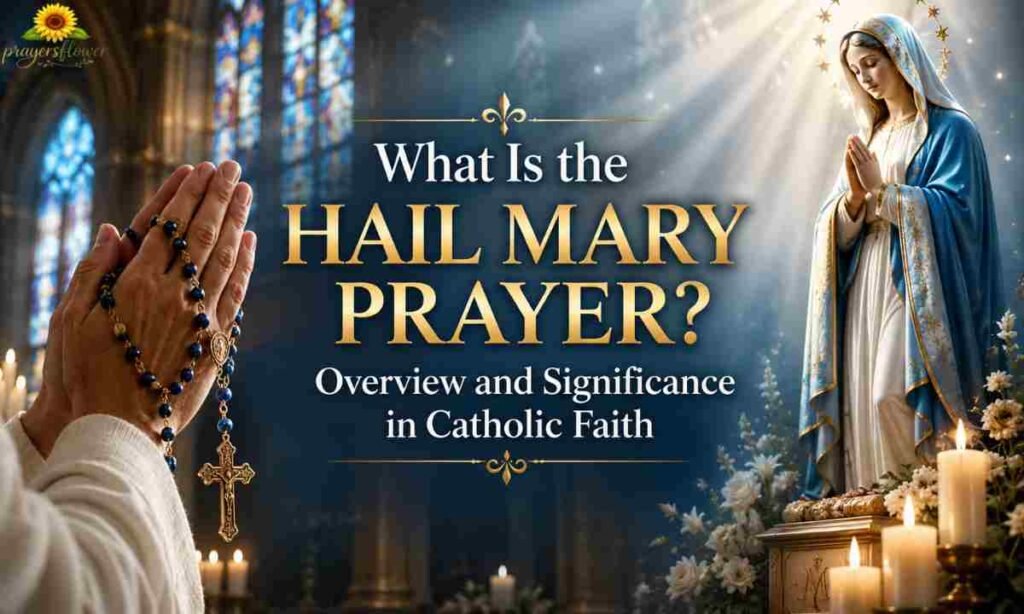
The Hail Mary Prayer is a Marian devotion addressed to the Virgin Mary, rooted entirely in the words of Scripture and the historic prayer of the Church.
- The Hail Mary Prayer is the central prayer of the Rosary, repeated fifty times across its full mysteries.
- It is a prayer of petition, praise, and trust — asking Mary to intercede for us, now and at the hour of our death.
- Catholics across every continent pray it daily, making it one of the most recited prayers in human history.
- It connects the faithful to the Annunciation, the moment the Angel Gabriel greeted Mary and changed the world.
What Does the Hail Mary Prayer Mean? A Complete Line-by-Line Explanation
Each phrase of the Hail Mary Prayer carries weight that rewards slow reading.
- “Hail Mary, full of grace” echoes the angel Gabriel’s greeting in Luke 1:28, affirming Mary’s unique holiness.
- “The Lord is with thee” is a direct quote from Gabriel, acknowledging God’s presence dwelling in Mary.
- “Blessed art thou among women” comes from Elizabeth’s greeting in Luke 1:42, a Spirit-filled recognition of Mary’s role.
- “And blessed is the fruit of thy womb, Jesus” names the source of all blessing — not Mary herself, but the child she carries.
- “Holy Mary, Mother of God” is the Church’s profession of the Incarnation: Jesus is fully God, and Mary is truly His mother.
- “Pray for us sinners, now and at the hour of our death” is the petition — an honest, human cry for intercession in life’s two most urgent moments.
The Full Text of the Hail Mary Prayer — Traditional English Version
Here is the full traditional text of the Hail Mary Prayer in English, as prayed by Catholics worldwide.
Hail Mary, full of grace, the Lord is with thee. Blessed art thou among women, and blessed is the fruit of thy womb, Jesus. Holy Mary, Mother of God, pray for us sinners, now and at the hour of our death. Amen.
Hail Mary Prayer in Latin — Ave Maria Full Text and Pronunciation Guide
The original Latin text, known as the Ave Maria, is the form in which this prayer echoed through medieval Europe and still resonates in formal liturgical settings.
Ave Maria, gratia plena, Dominus tecum. Benedicta tu in mulieribus, et benedictus fructus ventris tui, Iesus. Sancta Maria, Mater Dei, ora pro nobis peccatoribus, nunc et in hora mortis nostrae. Amen.
Pronunciation note: “Ave” is AH-vay. “Gratia” is GRAH-tsee-ah. “Benedicta” is beh-neh-DEEK-tah. “Peccatoribus” is pek-kah-TOH-ree-boos.
Hail Mary Prayer in Spanish — Ave María Texto Completo (Full Spanish Text)
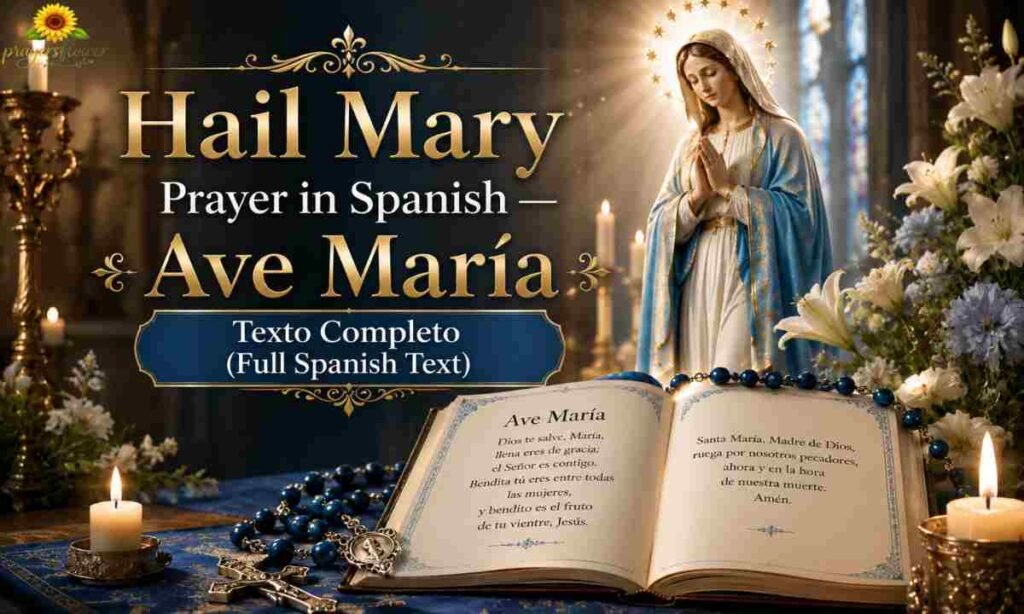
The Hail Mary Prayer in Spanish is prayed daily by hundreds of millions of Spanish-speaking Catholics worldwide.
Dios te salve, María, llena eres de gracia, el Señor es contigo. Bendita tú eres entre todas las mujeres, y bendito es el fruto de tu vientre, Jesús. Santa María, Madre de Dios, ruega por nosotros, pecadores, ahora y en la hora de nuestra muerte. Amén.
Hail Mary Prayer Printable Versions — English, Latin, and Spanish (Free Download)
A printed copy of the Hail Mary Prayer can anchor a family’s daily devotion, travel in a wallet, or rest on a nightstand.
- Print the English version and place it somewhere you will see it each morning — a mirror, a desk, or the inside cover of your Bible.
- The Latin Ave Maria makes a beautiful framed devotional piece for a home altar or prayer space.
- The Spanish Ave María is ideal for sharing with Spanish-speaking family members, children, or new Catholic friends.
- All three versions are available to copy directly from this page at no cost.
Keep Feeding Your Faith: Sinner’s Prayer: How to Accept Jesus Christ Right Now
Biblical Origins of the Hail Mary — The Annunciation, the Visitation, and Luke 1 Explained
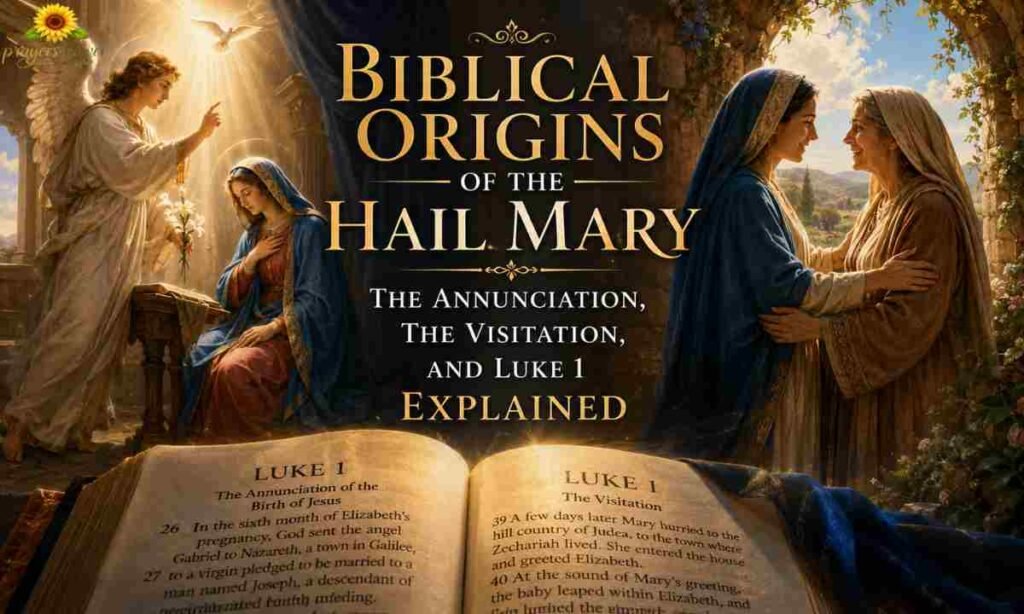
The Hail Mary Prayer is Scripture before it is anything else.
- Luke 1:28 records the angel Gabriel saying, “Hail, full of grace, the Lord is with you” — the first half of the prayer is nearly verbatim.
- Luke 1:42 records Elizabeth, filled with the Holy Spirit, declaring, “Blessed are you among women, and blessed is the fruit of your womb.”
- The title “Mother of God” was formally affirmed at the Council of Ephesus in 431 AD, grounding the prayer’s second half in doctrinal history.
- The petition “pray for us sinners, now and at the hour of our death” was the final addition, reflecting the Church’s deep instinct for intercessory prayer.
History of the Hail Mary Prayer — How It Developed Over the Centuries
The Hail Mary Prayer did not appear fully formed. It grew, slowly and with prayer, across more than a thousand years.
- The earliest form consisted only of the biblical verses, used in liturgical antiphons as early as the seventh century.
- Devotional recitation of the angelic greeting became widespread in the eleventh and twelfth centuries, especially among monastic communities.
- The name “Jesus” was inserted at the end of the first section in the thirteenth century, emphasizing the centrality of Christ even within a Marian prayer.
- The petition — “pray for us sinners, now and at the hour of our death” — was added in the fifteenth century and became standard after the Council of Trent.
How the Hail Mary Prayer Changed After the Council of Trent
The Council of Trent (1545 to 1563) did not create the Hail Mary Prayer, but it standardized it.
- The Roman Breviary of 1568 formalized the complete text of the Hail Mary Prayer as it is known and prayed today.
- Trent’s reforms ensured that the same prayer was spoken from Mexico to Manila, from Poland to Peru.
- This standardization made the Hail Mary Prayer a universal sign of Catholic identity across all cultures and languages.
Marian Devotion Explained — Why Catholics Pray to Mary
Praying the Hail Mary is an act of honoring the mother of Jesus, not an act of replacing God.
- Catholics pray to Mary as an intercessor, in the same way a person might ask a trusted friend or a saint to pray for them.
- Mary’s role in salvation history is unique: she carried, bore, and raised the Son of God — her prayers carry the intimacy of a mother’s voice.
- Research into the psychological effects of intercessory prayer, including a study referenced by the American Psychological Association on prayer and wellbeing, suggests that the act of asking others to pray for us deepens our sense of connection and reduces feelings of spiritual isolation.
- The Hail Mary Prayer is not a replacement for prayer to God but a pathway through Mary to Christ.
Is Praying the Hail Mary Worshipping Mary? The Catholic Answer
This question deserves a clear, honest answer.
- Worship, in Catholic theology, is reserved for God alone — the technical term is “latria,” and it is directed only to the Trinity.
- The veneration given to Mary is called “hyperdulia” — a special honor that falls entirely below the level of worship.
- When a Catholic prays the Hail Mary Prayer, they are asking Mary to intercede, not commanding her as a deity.
- The prayer itself makes this clear: it ends not with praise of Mary, but with a request that she pray for us to God.
The Hail Mary vs. the Our Father — What Is the Difference?
Both prayers are essential to Catholic devotion, but they move in different directions.
- The Our Father is addressed directly to God the Father — it is vertical worship and petition.
- The Hail Mary Prayer is addressed to Mary — it is a request for intercession, a horizontal turning to a trusted mother in faith.
- The Our Father was taught by Jesus Himself (Matthew 6:9-13); the Hail Mary was assembled from Scripture and the Church’s prayer tradition.
- Together in the Rosary, they create a rhythm of adoration and intercession that has shaped Catholic prayer for centuries.
The Hail Mary and the Rosary — How Many Times It Is Prayed and Why It Matters
The Rosary is, at its heart, a meditation on the life of Christ — and the Hail Mary Prayer is its heartbeat.
- In a full Rosary of twenty mysteries, the Hail Mary Prayer is prayed two hundred times across four sets of five decades.
- In a single set of five decades (the more common daily practice), the Hail Mary is prayed fifty times.
- The repetition is not emptiness — it is an immersive rhythm meant to free the mind for contemplation of the Gospel mysteries.
- Each Hail Mary while meditating on a mystery is a breath of prayer wrapped around an image of Christ’s life, death, or resurrection.
The Hail Mary in the Angelus — How It Is Used Outside the Rosary
The Hail Mary Prayer appears in devotional life well beyond the Rosary.
- The Angelus is a short devotion prayed three times daily — at 6 AM, noon, and 6 PM — and includes three recitations of the Hail Mary.
- It commemorates the Annunciation: the moment Gabriel came to Mary and the Word became flesh.
- The Angelus bell, once the organizing sound of Catholic village life, still rings in many parishes, calling the faithful to pause and pray.
- Praying the Hail Mary three times in the Angelus connects every hour of the working day to the mystery of the Incarnation.
When Should You Pray the Hail Mary? Occasions, Times, and Intentions
There is no wrong moment to pray the Hail Mary Prayer.
- Pray it in moments of fear — “now and at the hour of our death” speaks directly into life’s most terrifying thresholds.
- Pray it for someone you love who is suffering, letting each word become an act of intercession.
- Pray it before sleep, as generations of Catholics have done, entrusting the night to Mary’s prayer.
- Pray it when words fail, because sometimes the most honest prayer is one you borrowed from someone else’s faith.
The Role of the Hail Mary in Daily Catholic Prayer and Devotional Life
The Hail Mary Prayer is not reserved for formal occasions. It belongs in the ordinary.
- Many Catholics begin the day with a Hail Mary before any other prayer, offering the morning to Mary before the noise of the day begins.
- It is prayed at the conclusion of decades of the Rosary, between the mysteries, and as a response to the Gloria.
- The Hail Mary is often the first prayer a Catholic child memorizes, and the last prayer spoken at deathbeds.
- Its brevity makes it endlessly portable — it fits in a moment of waiting, a breath before a difficult conversation, or a silent pause in a crowded room.
How to Pray the Hail Mary — Step-by-Step Guide for Beginners
Praying the Hail Mary Prayer well is less about technique and more about presence.
- Step one: Slow down. The Hail Mary is twenty-one words in its simplest form. Give each one a moment to land.
- Step two: Hold an intention. Pray it for someone specific, or for a need that is pressing on your heart.
- Step three: Address Mary personally. You are not reciting — you are speaking to someone who hears.
- Step four: Let the final phrase mean something. “Now and at the hour of our death” is not liturgical decoration. It is an honest prayer for the two moments that matter most.
- Step five: End in silence. Give God space to respond before you move on.
How to Pronounce the Hail Mary — Audio and Phonetic Guide (English and Latin)
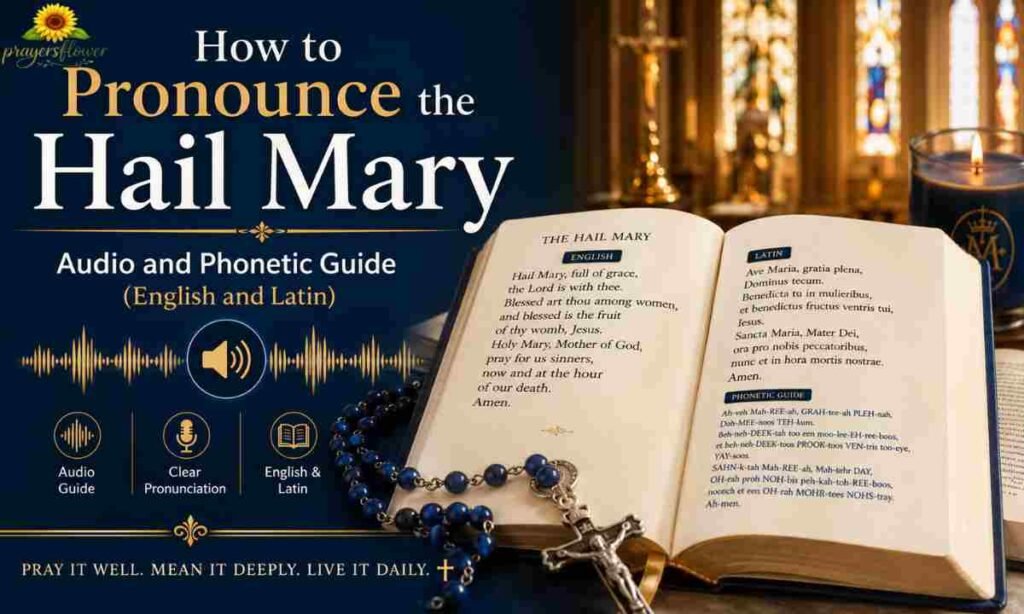
Pronunciation matters less than intention, but knowing how to say the words confidently helps prayer flow.
- In English: “Hail” rhymes with “mail.” “Thee” and “thou” are traditional forms — do not substitute “you” if praying in a formal or communal setting.
- In Latin: “Ave” is AH-vay. “Plena” is PLAY-nah. “Nunc” is NOONK. “Mortis” is MOR-tees.
- “Iesus” in Latin is YAY-soos. “Nostrae” is NOH-stry.
- The rhythm of the Latin Ave Maria has a natural cadence — allow it to breathe rather than rushing through it.
The Hail Mary Prayer for Children — How to Teach It Simply and Memorably
Teaching a child the Hail Mary Prayer is one of the most lasting gifts a parent or godparent can give.
- Begin with only the first two lines: “Hail Mary, full of grace, the Lord is with thee.” Let those settle before adding more.
- Explain it in honest terms: “We are saying hello to Mary, the mother of Jesus, and asking her to pray for us.”
- Practice it at bedtime — the natural rhythm of the prayer suits the quiet of a child winding down.
- Let children hold Rosary beads while learning, so the tactile memory reinforces the spoken prayer.
Can Non-Catholics Pray the Hail Mary? What Other Christians Believe
The Hail Mary Prayer belongs to the wider Christian tradition, even if its role differs outside Catholicism.
- Nothing in the Hail Mary Prayer contradicts Scripture — every phrase derives directly from the Bible or from historic Trinitarian faith.
- Many Anglican and Lutheran Christians pray forms of the Hail Mary, particularly in high-church or liturgical traditions.
- Evangelical Christians may be more hesitant, due to theological concerns about praying to saints — but the prayer itself is an act of asking, not worshipping.
- A non-Catholic who prays the Hail Mary with honest faith and a Scriptural understanding of Mary’s role does so on solid theological ground.
The Hail Mary in Other Christian Traditions — Orthodox, Anglican, and Lutheran Views
The Hail Mary Prayer has never been exclusively Roman Catholic.
- Eastern Orthodox Christians use a similar prayer called the Theotokion, addressing Mary as the God-bearer in language that parallels the Hail Mary.
- The Church of England’s Book of Common Prayer has historically included Marian antiphons drawn from the Hail Mary tradition.
- Martin Luther himself spoke warmly of Mary and maintained a high view of her role in salvation history, though Lutheran practice has largely moved away from formal Marian prayer.
- The universal resonance of the Hail Mary Prayer across traditions speaks to the depth of its Scriptural foundation.
Common Mistakes and Misconceptions About the Hail Mary Prayer
A few misunderstandings follow this prayer wherever it goes.
- Misconception one: That praying the Hail Mary replaces prayer to God. It does not — it is a request for intercession, not an alternative to worship.
- Misconception two: That repetition in the Rosary makes the prayer meaningless. Repetition in prayer is as old as the Psalms — it is a rhythm, not a rut.
- Misconception three: That the Hail Mary Prayer was invented by the medieval Church. Its core is directly from Luke 1 — the Church assembled it, but God provided the words.
- Misconception four: That “Mother of God” implies Mary existed before God. The title refers to the Incarnation: Jesus, who is God, was born of Mary. She is His mother.
How to Make the Hail Mary a Meaningful Daily Habit — Practical Tips

Anchor It to an Existing Routine
Stack it onto something you already do — morning coffee, before bed, leaving the house, or a daily phone alarm labeled “Mary.” Consistency comes from linking prayer to an existing trigger.
Pray It Slowly
Speed kills meaning. Pause at key phrases, breathe between lines, or say it once with full attention rather than ten times on autopilot.
Engage the Imagination
Picture Mary as a real person and speak the words to her. On “pray for us sinners,” bring a specific person or struggle to mind.
Use It as a Response to Daily Moments
Reach for it instinctively — when anxious, when you hear a siren, when someone shares bad news, or when you feel grateful. The prayer was made for ordinary moments.
Reflect on the Words
Spend a week sitting with one phrase at a time. The prayer is theologically rich: “full of grace,” “Mother of God,” “now and at the hour of our death” — each phrase rewards slow attention.
Keep a Small Reminder Visible
Rosary beads in your pocket, an image of Mary on your desk, or the prayer written on your mirror — small anchors make a big difference.
The habit itself is the act of faith. Meaning often follows consistency, not the other way around.
Hail Mary Prayer FAQs — Common Questions Answered
What is the Hail Mary Prayer and where does it come from?
The Hail Mary Prayer comes from the Gospel of Luke, chapters 1 and 42, combined with the Church’s petition for Mary’s intercession, standardized after the Council of Trent.
How many times is the Hail Mary Prayer said in the Rosary?
The Hail Mary Prayer is said fifty times in a five-decade Rosary and two hundred times across all twenty mysteries of the full Rosary.
Is praying the Hail Mary the same as worshipping Mary?
No — the Hail Mary Prayer is a request for intercession, not worship; Catholic theology reserves worship exclusively for the Trinity.
What does “full of grace” mean in the Hail Mary?
“Full of grace” reflects Mary’s unique holiness and her complete openness to God, as affirmed by the Archangel Gabriel in Luke 1:28.
Can beginners learn to pray the Hail Mary without prior Catholic knowledge?
Yes — the Hail Mary Prayer is short, Scriptural, and straightforward, and this guide provides the full text, meaning, and step-by-step instructions for anyone starting out.
Closing Thoughts
The Hail Mary Prayer has survived wars, reformations, and centuries of doubt — not because it is famous, but because it is true. It speaks the words of an angel and the cry of a sinner in the same breath, and that tension is exactly where most of us live. If you have never prayed it before, start tonight. If you have prayed it ten thousand times, pray it once more as if for the first time.
Mary said yes before she understood everything. The Hail Mary Prayer invites us to do the same — to place our “now” and our “hour of death” into the hands of one who has already walked that road with God. There is no safer place to put them.
“Prayer is not asking. It is a longing of the soul.” — Mahatma Gandhi is often cited here, but for the Christian tradition, the truer word belongs to Thomas Merton: “In prayer we discover what we already have. You start from where you are and you deepen what you already have.”

John Carrol is a Christian writer and prayer minister with over a decade of experience in faith-based content, devotional writing, and spiritual encouragement. Rooted in Scripture and a lifelong love of intercessory prayer, John created PrayersFlower to help believers find the right words when their own run out. His writing draws from pastoral study, personal faith practice, and a deep conviction that prayer is the most powerful act available to the human heart. When he is not writing, John is found in quiet study of the Word, mentoring young believers, and serving his local church community.