

The Chaplet of Divine Mercy is one of the most powerful Catholic prayers ever given to the Church, revealed by Jesus Himself to St. Faustina Kowalska in the 1930s as a channel of mercy for sinners, the dying, and souls in need.
There are moments in life when ordinary words simply are not enough. You may be sitting beside someone who is slipping away, carrying a burden too heavy for your own prayers to hold, or longing for a deeper encounter with God’s mercy. In those moments, believers across the world turn to the Chaplet of Divine Mercy, not because it is a formula, but because it is a cry from the heart of the Church.
This article gives you everything you need: the complete prayer text, a step-by-step guide on how to use rosary beads, the promises Jesus made to those who pray it, its history, connection to Divine Mercy Sunday, and answers to the questions people ask most. Whether you are praying for a dying loved one or simply seeking mercy for yourself, this guide was written for exactly where you are.
Key Takeaways
The Chaplet of Divine Mercy includes specific promises made by Jesus to St. Faustina for those who pray it faithfully, especially at the hour of death.
You will find the full, word-for-word prayer text, including opening and closing prayers, so you can begin praying immediately.
The chaplet is prayed on standard rosary beads and takes approximately fifteen minutes, making it accessible every day.
This guide covers the 3 PM Hour of Mercy, Divine Mercy Sunday, praying for the dying, souls in purgatory, and the nine-day novena.
What Is the Chaplet of Divine Mercy? History, Origin, and Meaning Explained
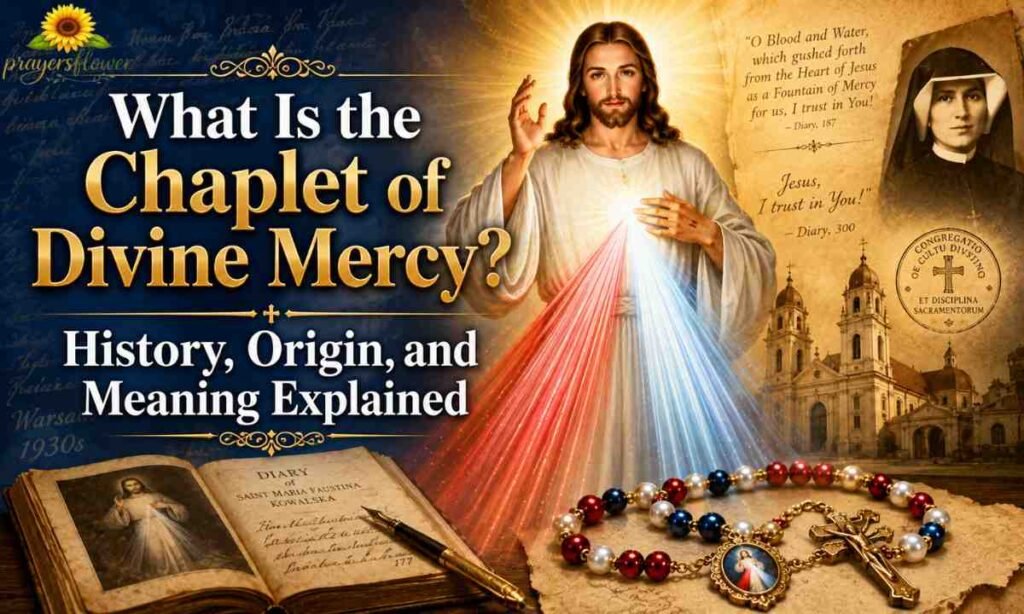
The Chaplet of Divine Mercy is a Christian prayer rooted in the message of God’s boundless compassion, revealed to offer mercy to the world before the Day of Justice.
On September 13, 1935, in Vilnius, Poland, St. Faustina received a vision of an angel preparing to strike the earth with divine punishment. She prayed intensely, and the words of what would become the Chaplet of Divine Mercy came to her in that moment of intercession. Jesus later confirmed the prayer, instructing her to pray it for sinners, for the dying, and for the whole world. The chaplet draws its power from the Passion of Christ, offering His body, blood, soul, and divinity to the Father as an act of mercy on behalf of humanity.
St. Faustina Kowalska and the Divine Mercy Revelation: The Story Behind the Prayer
St. Faustina was a Polish nun, mystic, and apostle of Divine Mercy whose diary contains some of the most intimate accounts of encounters with Christ recorded in modern Christian history.
Born Helena Kowalska in 1905, she entered the Congregation of the Sisters of Our Lady of Mercy and received visions of Jesus beginning in 1931. He appeared to her with two rays of light streaming from His heart, red and white, representing the blood and water that flowed at the Crucifixion. Jesus asked her to record His messages of mercy and spread the Chaplet of Divine Mercy to the world. She died in 1938 and was canonised by Pope John Paul II in 2000. Her diary, Divine Mercy in My Soul, is the primary source for every promise and instruction attached to this prayer.
Church Approval of the Chaplet of Divine Mercy: What the Vatican Says
The Chaplet of Divine Mercy was not always widely accepted, and its journey to full Church approval is itself a testimony to how truth sometimes moves slowly through institutions before it shines clearly.
After initial concerns in the 1950s, the Divine Mercy devotion was restricted for a period. However, in 1978, Pope John Paul II, who had a personal devotion to the message of St. Faustina, helped restore and elevate the entire Divine Mercy devotion. He canonised St. Faustina in 2000 and established Divine Mercy Sunday as a universal feast for the Catholic Church in 2001. Today the Chaplet of Divine Mercy carries full Vatican approval and is prayed by millions worldwide.
Full Text of the Chaplet of Divine Mercy: Every Prayer Word for Word
Here is the complete, word-for-word text of the Chaplet of Divine Mercy, exactly as received by St. Faustina and approved for use by the Church.
Opening (Optional but traditional):
You expired, Jesus, but the source of life gushed forth for souls, and the ocean of mercy opened up for the whole world. O Fount of Life, unfathomable Divine Mercy, envelop the whole world and empty Yourself out upon us.
O Blood and Water, which gushed forth from the Heart of Jesus as a fount of mercy for us, I trust in You.
On the Our Father beads (say once): Eternal Father, I offer You the Body and Blood, Soul and Divinity of Your dearly beloved Son, Our Lord Jesus Christ, in atonement for our sins and those of the whole world.
On the ten Hail Mary beads (say ten times per decade): For the sake of His sorrowful Passion, have mercy on us and on the whole world.
Conclude with (say three times): Holy God, Holy Mighty One, Holy Immortal One, have mercy on us and on the whole world.
Closing (Optional): Eternal God, in whom mercy is endless and the treasury of compassion inexhaustible, look kindly upon us and increase Your mercy in us, that in difficult moments we might not despair nor become despondent, but with great confidence submit ourselves to Your holy will, which is Love and Mercy itself.
How to Pray the Chaplet of Divine Mercy Step by Step on Rosary Beads
Standard rosary beads are all you need to pray the Chaplet of Divine Mercy, and the structure is straightforward once you learn it.
Begin on the crucifix with the optional opening prayer. Move to the first large bead and pray the Our Father prayer. On each of the ten small beads, pray the Hail Mary bead prayer: “For the sake of His sorrowful Passion, have mercy on us and on the whole world.” Repeat this sequence for all five decades. After the fifth decade, conclude by praying “Holy God, Holy Mighty One, Holy Immortal One, have mercy on us and on the whole world” three times. End with the optional closing prayer if you wish.
Opening and Closing Prayers of the Chaplet: Optional but Powerful Additions
The opening and closing prayers of the Chaplet of Divine Mercy are not required, but those who include them often describe the prayer feeling more complete, more anchored in the mystery of Christ’s Passion.
The opening prayer recalls the moment of Christ’s death and connects the soul immediately to the source of mercy. The closing prayer is an act of surrender and trust, particularly helpful for those praying through anxiety, grief, or spiritual dryness. Both prayers appear in St. Faustina’s diary and have been passed down as natural complements to the chaplet’s core text.
The 3 PM Hour of Mercy: Why This Is the Most Powerful Time to Pray the Chaplet
Three o’clock in the afternoon is not simply a time on a clock for those who pray the Chaplet of Divine Mercy. It is the hour Jesus identified to St. Faustina as the Hour of Mercy, the moment of His death on the cross.
In her diary, St. Faustina recorded Jesus saying: “At three o’clock, implore My mercy, especially for sinners; and, if only for a brief moment, immerse yourself in My Passion, particularly in My abandonment at the moment of agony. This is the hour of mercy for the whole world.” Praying the Chaplet of Divine Mercy at 3 PM is therefore not a ritual but a deliberate act of entering into the Passion. Research on prayer and wellbeing, including studies highlighted by Harvard Health, suggests that structured, intentional prayer at fixed times significantly deepens spiritual attentiveness and reduces anxiety, which aligns with what the Church has practised for centuries through the Liturgy of the Hours.
How Often Should You Pray the Chaplet of Divine Mercy? Daily, Weekly, or at Death?
Jesus made clear in the diary of St. Faustina that the Chaplet of Divine Mercy was intended for daily use, not occasional devotion.
He specifically promised extraordinary graces to those who pray it faithfully every day. The chaplet takes approximately fifteen minutes, making daily prayer genuinely possible even in a busy life. Praying it at 3 PM daily aligns with the Hour of Mercy. At a minimum, many spiritual directors recommend praying the Chaplet of Divine Mercy daily during Lent, during the nine-day novena before Divine Mercy Sunday, and at the bedside of the dying.
Keep Feeding Your Faith: Act of Contrition Prayer: Full Text, Meaning, and How to Pray It for Confession
Chaplet of Divine Mercy vs the Rosary: Key Differences and When to Pray Each
Both the Chaplet of Divine Mercy and the Rosary are prayed on beads and flow through decades, but their focus and spiritual purpose are distinct.
The Rosary meditates on the mysteries of Christ’s life through Mary’s intercession. The Chaplet of Divine Mercy focuses entirely on Christ’s Passion and the mercy that flows from it, offering the Father the body, blood, soul, and divinity of Jesus as an act of atonement. The Rosary is a contemplative journey. The Chaplet of Divine Mercy is an urgent intercession. Pray the Rosary for meditation and Marian devotion. Pray the Chaplet of Divine Mercy when interceding for sinners, the dying, or yourself in a moment of deep need for mercy.
The 14 Promises of the Chaplet of Divine Mercy: What Jesus Promised St. Faustina
The promises connected to the Chaplet of Divine Mercy are recorded across several entries in St. Faustina’s diary and are among the most consoling words Christ ever spoke to her.
The key promises include:
Whoever will recite the Chaplet of Divine Mercy will receive great mercy at the hour of death.
When prayed at the bedside of the dying, Jesus will stand between His Father and the dying person, not as a judge but as a merciful Saviour.
Souls who pray the Chaplet of Divine Mercy will be defended by Jesus Himself at the hour of judgment.
The prayer obtains everything if what is asked is compatible with God’s will.
Priests who recommend it to the dying will receive special graces themselves.
Hardened sinners who pray it with even small contrition will receive the grace of repentance.
Those who pray it daily will receive mercy for themselves and for those they love.
Families who pray the Chaplet of Divine Mercy together will receive special protection.
The dying, even if they have been the greatest sinners, if they trust in God’s mercy, will receive consolation at the hour of death.
The Chaplet of Divine Mercy appeases the anger of God and obtains an ocean of blessings for those who pray it with faith.
Those who spread devotion to Divine Mercy will be protected during their lifetime and at the hour of death.
No soul who prays it will perish, even if it has been in the greatest misery of sin.
Those who pray the Chaplet of Divine Mercy will intercede for others with great power before God’s throne.
The grace of final perseverance is promised to those who faithfully trust in Divine Mercy throughout their lives.
Praying the Chaplet for the Dying: Graces, Intercession, and What the Diary Promises
There is perhaps no more urgent or tender use of the Chaplet of Divine Mercy than praying it beside someone who is dying.
In her diary, St. Faustina records Christ saying that when the chaplet is prayed at the bedside of the dying, He will shield that soul with His mercy. He promised that even for the most hardened sinner who hears the Chaplet of Divine Mercy in their final moments, the grace of a peaceful death is available. Many Catholic nurses, priests, and hospice workers have incorporated this prayer into end-of-life care. You do not need to be ordained or formally trained. You need only the beads, the words, and a willing heart.
Can the Chaplet of Divine Mercy Help Souls in Purgatory? What St. Faustina’s Diary Reveals
St. Faustina’s diary contains moving accounts of souls in purgatory asking for prayer, and the Chaplet of Divine Mercy is among the prayers she was directed to offer for them.
Jesus indicated to her that the chaplet could obtain mercy not only for the living but also for those undergoing purification after death. Praying the Chaplet of Divine Mercy for deceased loved ones is therefore a deeply Catholic act of charity, rooted in the Church’s teaching on the communion of saints. It can be offered intentionally for a specific soul or for all the souls in purgatory, trusting in God’s mercy to apply these prayers where they are most needed.
The Divine Mercy Novena: How to Pray the Chaplet for Nine Days from Good Friday to Divine Mercy Sunday
The Divine Mercy Novena begins on Good Friday and concludes on the Saturday before Divine Mercy Sunday, with each of the nine days carrying a different intention given by Jesus to St. Faustina.
Each day, Jesus asked her to bring a different group of souls to His mercy: on the first day, all mankind; on the second, priests and religious; on the third, devout souls; on the fourth, those who do not believe; on the fifth, those who have separated from the Church; on the sixth, the meek and humble; on the seventh, souls who especially venerate His mercy; on the eighth, souls in purgatory; on the ninth, lukewarm souls. Praying the Chaplet of Divine Mercy once each day during this novena, alongside the intention for that day, is one of the most complete ways to participate in the Divine Mercy devotion.
What Is Divine Mercy Sunday? The Feast, Its History, and How to Celebrate It
Divine Mercy Sunday is the Second Sunday of Easter and one of the most grace-filled days in the Catholic liturgical calendar.
Jesus promised St. Faustina that on this day, the very depths of His mercy would be open and any soul that approaches the Sacrament of Reconciliation and receives Holy Communion with trust will receive complete forgiveness of sin and punishment, what the Church calls a plenary indulgence. The feast was established universally by Pope John Paul II in 2001, fulfilling the wish Christ expressed to St. Faustina decades earlier. On Divine Mercy Sunday, parishes often hold public recitation of the Chaplet of Divine Mercy, veneration of the Divine Mercy image, and exposition of the Blessed Sacrament.
The Divine Mercy Image: The Meaning of the Red and White Rays Explained
The Divine Mercy image, showing Jesus with two rays of light streaming from His heart, is inseparable from the chaplet and its spirituality.
Jesus told St. Faustina that the red ray represents the blood He shed, while the white ray represents the water that flowed from His pierced side at the Crucifixion, both of which are the source of the sacraments. He said, “The two rays denote Blood and Water. The pale ray stands for the Water which makes souls righteous. The red ray stands for the Blood which is the life of souls.” When you pray the Chaplet of Divine Mercy before this image, you are praying directly into that mystery, offering Christ’s own sacrifice back to the Father on behalf of a broken world.
Chaplet of Divine Mercy After Holy Communion: Why the Eucharist Connection Matters
Praying the Chaplet of Divine Mercy immediately after receiving Holy Communion places the prayer in one of its most powerful contexts.
In the Eucharist, you have just received the Body and Blood, Soul and Divinity of Jesus, the very words you will now offer to the Father in every decade of the chaplet. This creates a profound unity between what you have received and what you are offering. Spiritual directors across the Catholic tradition have long recommended this pairing, and many retreat houses include the Chaplet of Divine Mercy as the devotional prayer following Mass precisely for this reason.
Free Printable Chaplet of Divine Mercy Guide: Download and Pray Anywhere
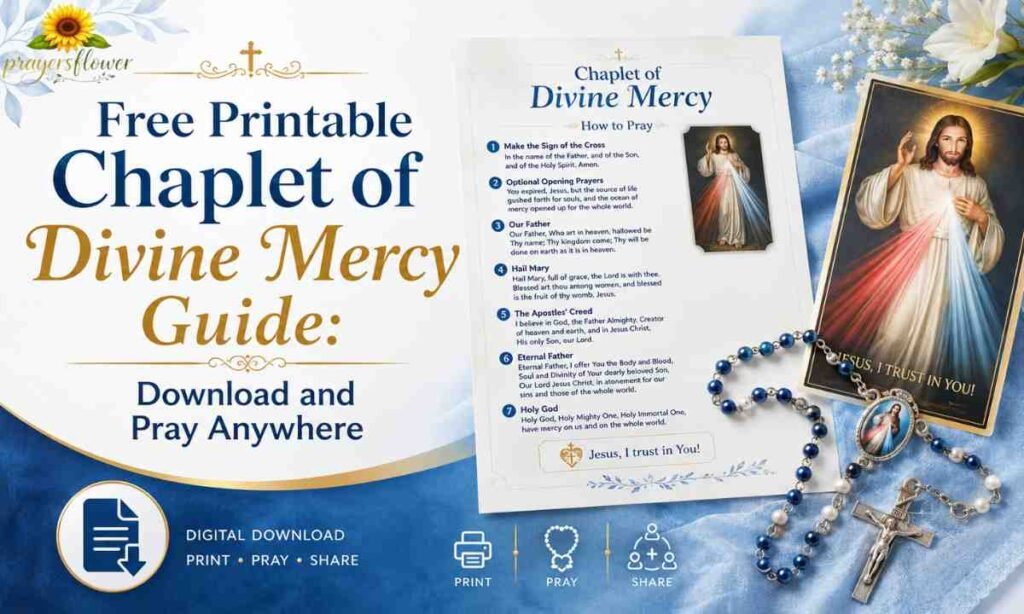
A printed guide for the Chaplet of Divine Mercy means you can pray it anywhere, including in a hospital room, a car, a chapel without books, or beside someone who is dying without access to a screen.
To create your own printable guide, include the optional opening prayer, the Our Father bead prayer, the decade prayer for the ten beads, the closing Holy God prayer, and the optional closing prayer. Print it double-sided on a single card and laminate it if possible. Keep one in your Bible, one in your car, and one beside your bed. The prayer that has consoled millions deserves to be with you everywhere you go.
Frequently Asked Questions About the Chaplet of Divine Mercy
What is the Chaplet of Divine Mercy and how is it different from the Rosary?
The Chaplet of Divine Mercy is a distinct Catholic prayer revealed to St. Faustina that focuses on Christ’s Passion and God’s mercy, while the Rosary meditates on the mysteries of Christ’s life through Marian reflection.
How long does it take to pray the Chaplet of Divine Mercy?
The Chaplet of Divine Mercy takes approximately ten to fifteen minutes to pray in full, including the optional opening and closing prayers.
Can non-Catholics pray the Chaplet of Divine Mercy?
Yes, the Chaplet of Divine Mercy can be prayed by any Christian who trusts in God’s mercy, though its promises are recorded within the Catholic devotional tradition.
What are the most important promises Jesus made about the Chaplet of Divine Mercy?
The most frequently cited promise is that those who pray the Chaplet of Divine Mercy faithfully will receive great mercy at the hour of death and will not be left without consolation.
When is the best time to pray the Chaplet of Divine Mercy?
The 3 PM Hour of Mercy, identified by Jesus Himself to St. Faustina, is considered the most powerful time to pray the Chaplet of Divine Mercy each day.
Closing Thoughts
The Chaplet of Divine Mercy is not simply a devotional exercise. It is an act of trust, a declaration that no matter how deep the sin or how close the darkness, God’s mercy is deeper still. To pray it is to place yourself and everyone you love inside the wound of Christ’s side and say, with everything you have, that you believe in a God who does not abandon.
If you have read this far, perhaps something in you already knows that this prayer is for you, for this season, for the person you are carrying in your heart today. Begin tonight. Begin at 3 PM. Begin at the bedside of someone you love. The grace is already waiting for you there.

John Carrol is a Christian writer and prayer minister with over a decade of experience in faith-based content, devotional writing, and spiritual encouragement. Rooted in Scripture and a lifelong love of intercessory prayer, John created PrayersFlower to help believers find the right words when their own run out. His writing draws from pastoral study, personal faith practice, and a deep conviction that prayer is the most powerful act available to the human heart. When he is not writing, John is found in quiet study of the Word, mentoring young believers, and serving his local church community.