

Biblically accurate angels are nothing like the soft-winged figures on greeting cards — they are fearsome, glorious, and utterly devoted to the purposes of God. When people first encounter the real biblical descriptions of angels, something shifts. The manufactured images of pop culture fall away, and in their place stands something far more overwhelming and magnificent. The gap between what we have been handed by culture and what Scripture actually says is wide enough to change the way you pray, the way you read your Bible, and the way you understand the unseen world.
This article walks through what the Bible actually reveals about biblically accurate angels — their appearance, their hierarchy, their roles in history and prophecy, and what they mean for believers today. From the terrifying living creatures of Ezekiel to the archangels who stand before God’s throne, every section here is rooted in Scripture and written for those who want their faith grounded in truth rather than tradition.
Lord, meet and bless every reader here, guide them closer to Your heart, and grant them success in every area of their life.
Key Takeaways
- Biblically accurate angels bear little resemblance to popular cultural depictions — Scripture describes them as multi-faced, fire-covered, and awe-inspiring beings.
- Angels operate within a structured heavenly hierarchy that includes seraphim, cherubim, archangels, and general messengers.
- The Bible addresses guardian angels, fallen angels, and the role of angels in the life of Jesus and the early Church.
- Understanding biblically accurate angels deepens reverence for God’s sovereignty and the vast scope of His creation.
The Biblical Foundation of Angels
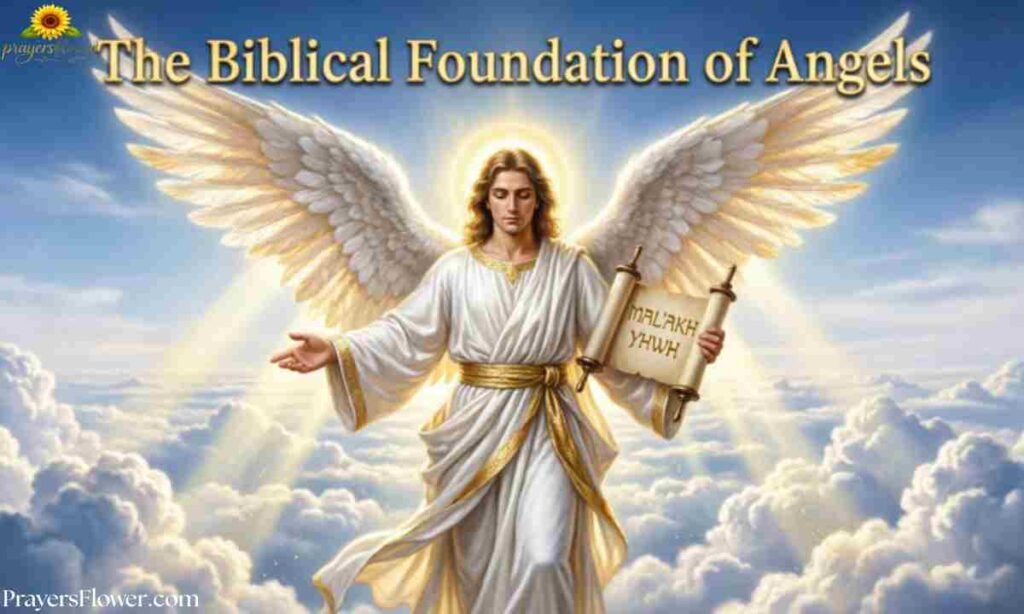
Angels appear from Genesis to Revelation, and their presence in Scripture is never decorative.
- They are created spiritual beings who exist to serve and glorify God.
- Their first recorded appearance in Genesis involves guarding Eden after the Fall, which tells us immediately that biblically accurate angels carry real authority and purpose.
- Every encounter humans have with angels in Scripture results in either worship-correcting instruction (“Do not worship me”) or overwhelming fear — a clue that these beings are far beyond anything our imagination produces.
- The Hebrew word for angel, malak, simply means messenger — and yet the beings described in the text are anything but simple.
What Do Angels Look Like According to the Bible?
The appearance of biblically accurate angels in Scripture was never meant to comfort — it was meant to reveal the holiness of God by proximity.
- When the angel Gabriel appeared to Daniel, the prophet fell on his face as though dead.
- Ezekiel described the angelic beings he saw as having four faces, four wings, and hands beneath their wings — a form no human hand could sketch without losing something essential.
- The angels at the tomb of Jesus appeared as lightning and as blinding white — not soft or pastel, but radiant with a light that belongs to another order of reality.
- Biblically accurate angels do not have halos or chubby infant faces. They have the kind of presence that drives grown men to the ground.
Comparison Table
| Heavenly Being | Appearance | Bible Reference | Primary Role |
|---|---|---|---|
| Cherubim | Four faces (man, lion, ox, eagle), four wings, wheels nearby | Ezekiel 1, Ezekiel 10 | Guard God’s holiness and throne |
| Seraphim | Six wings: two cover face, two cover feet, two for flying | Isaiah 6:1–7 | Worship God and proclaim His holiness |
| Ophanim (Wheels) | Wheels within wheels, covered with many eyes | Ezekiel 1:15–21 | Move with God’s throne and symbolize His presence |
| Gabriel | Appears as a man | Daniel 8–9, Luke 1 | Delivers God’s messages |
| Michael | Warrior angel | Daniel 10, Jude 9, Revelation 12 | Protects God’s people and defeats evil |
Just as many people have misconceptions about angels, questions also arise about the biblical meaning of owls, making it important to distinguish biblical teaching from popular myths and symbolism.
Biblically Accurate Angels and Their Roles
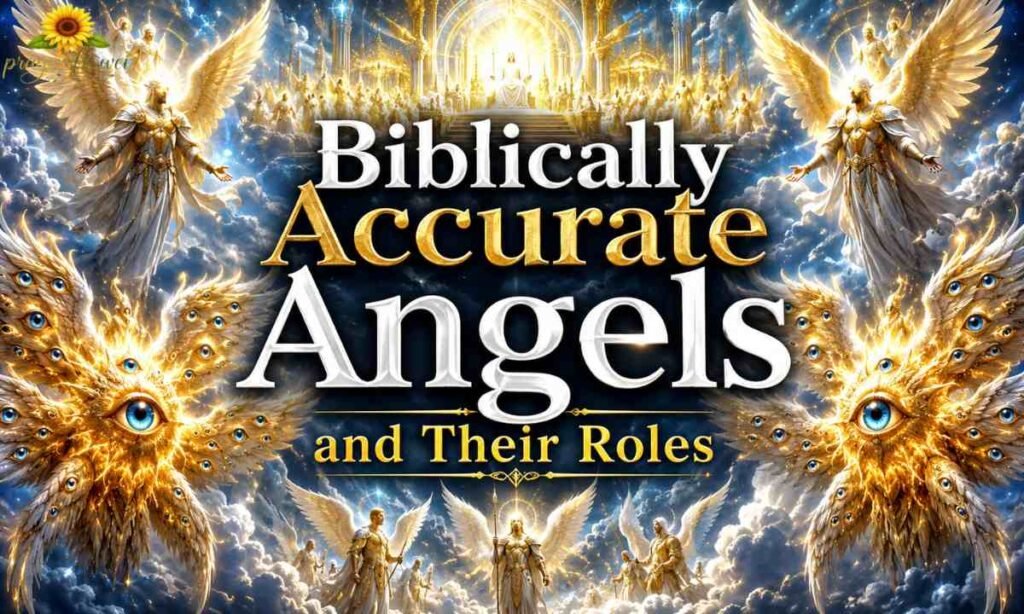
Their roles are as varied as the needs of God’s unfolding plan.
- They deliver messages, as Gabriel did to Mary and to Zechariah before John the Baptist was born.
- They execute judgment, as in the angel who struck down 185,000 Assyrian soldiers in a single night (2 Kings 19:35).
- They worship without ceasing, surrounding God’s throne in a posture of endless, holy adoration.
- Biblically accurate angels also strengthen the weary — an angel ministered to Elijah when he was broken under a broom tree, which means angelic care is not only reserved for dramatic moments.
The Angelic Hierarchy: God’s Organised Order of Heavenly Beings
Scripture and early theological reflection both suggest that biblically accurate angels exist within a structured order.
GOD
│
┌───────────────┼───────────────┐
│ │ │
Seraphim Cherubim Living Creatures
│
Ophanim (Wheels)
│
┌─────────────┴──────────────┐
│ │
Archangel Michael Gabriel
│
Ministering Angels
- Paul’s letter to the Colossians references thrones, dominions, rulers, and authorities — categories that imply organisation, not chaos.
- The book of Daniel speaks of Michael as a chief prince, suggesting rank and distinction among heavenly beings.
- This hierarchy is not about competition but about purpose — each class of angelic being is designed for a specific role within God’s governance of creation.
- Understanding this order helps believers see the spiritual realm not as random or mysterious, but as a kingdom with the same precision God applies to everything He creates.
Seraphim: The Fiery Worshipers at God’s Throne
Isaiah 6 contains the only direct mention of seraphim, and the passage burns with urgency.
- The word seraphim means burning ones, and these beings stand above the throne of God with six wings each.
- Two wings cover their faces — even in the presence of God, they shield themselves from the fullness of His holiness.
- Two wings cover their feet, and two wings carry them in flight, and their voices shake the doorposts of the temple.
- Seraphim, as biblically accurate angels, exist entirely for the worship of God, and they do not stop.
Cherubim: The Multi-Faced Guardians of Holy Places
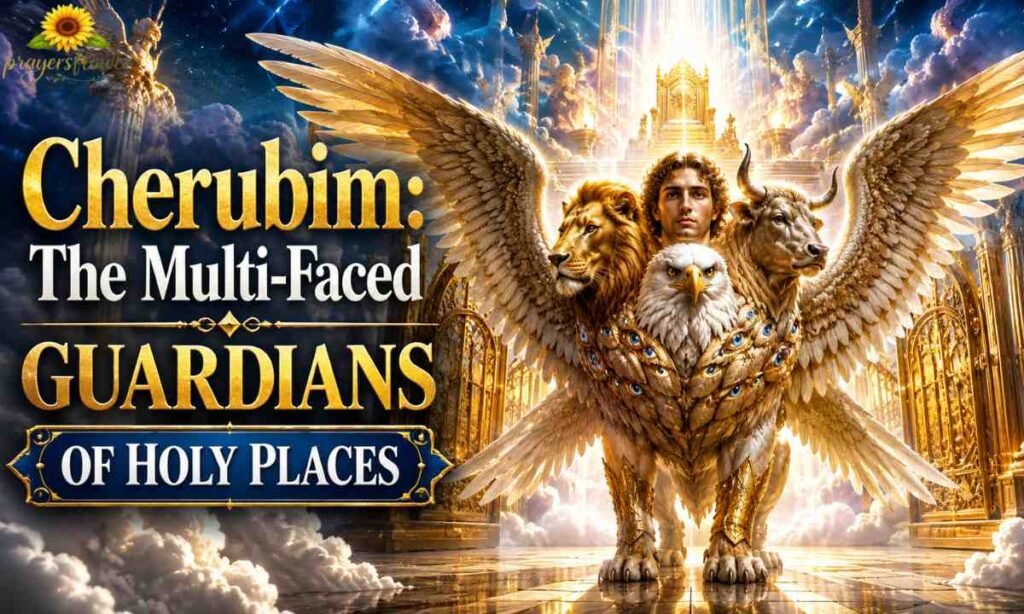
Cherubim in Scripture are a far cry from the chubby figures carved on furniture and painted on ceilings.
- They first appear in Genesis guarding the entrance to Eden with flaming swords — these are not decorative beings.
- Ezekiel’s vision in chapters 1 and 10 describes cherubim with four faces: the face of a man, a lion, an ox, and an eagle.
- Their wings span wide, their forms gleam like burnished bronze, and they move with the speed and direction of the Spirit of God.
- Biblically accurate angels of the cherubim class are guardians of the holy — present wherever the sacred boundary between God and creation is drawn.
Living Creatures and Ophanim: The Most Mysterious Angels
Some of the most striking descriptions of biblically accurate angels appear in forms that resist easy categorisation.
- The four living creatures in Revelation 4 are full of eyes, day and night giving glory to God — a vision of total awareness and unceasing worship.
- The ophanim, described in Ezekiel 1 as intersecting wheels with eyes along their rims, appear alongside the cherubim and seem to be a distinct class of heavenly being.
- These figures remind us that the heavenly realm was not designed to be fully comprehensible to human minds — they were described as they appeared, not as they could be explained.
- Their presence in Scripture is a call to reverence rather than explanation.
Archangels: The Named Messengers of Heaven
Only a few angels are named in the canonical Scriptures, and each name carries the weight of specific mission.
- Michael is described in Daniel as a great prince who stands over the people of Israel, and in Jude and Revelation as the archangel who contends against the enemy.
- Gabriel appears in Daniel, Luke 1, and is always the bearer of monumental news — the kind of announcement that changes history.
- The name Raphael appears in the deuterocanonical book of Tobit, where he is described as one of the seven angels who stand before God.
- Biblically accurate angels with names in Scripture are not celebrities of heaven — they are servants defined entirely by the God they serve.
General Angels: The Messengers Throughout Scripture
Beyond the named and classified, Scripture is filled with unnamed angelic messengers moving through the story of God’s people.
- An angel opened the prison doors for Peter in Acts 12. No name, no preamble — just the work of God accomplished through a heavenly servant.
- Angels ministered to Jesus in the wilderness after the temptation, quiet and present when the trial was over.
- Hebrews 1:14 asks whether angels are not all ministering spirits sent out to serve those who will inherit salvation — a verse that gives biblically accurate angels a role tied directly to the lives of believers.
- Their unnamed nature is not a diminishment. It is a reflection of what they are — servants oriented entirely toward God’s purposes, not their own recognition.
While angels are powerful heavenly beings with a clear biblical purpose, many Christians also wonder about the biblical meaning of a dragonfly and how this beautiful creature has come to symbolise spiritual transformation and renewed hope.
The Angel of the Lord: Messenger, Theophany, or Pre-Incarnate Christ?
Few figures in the Old Testament carry more theological weight than the Angel of the Lord.
- When the Angel of the Lord speaks, He often speaks in the first person as God — not relaying a message but speaking as the source.
- Hagar, Gideon, Manoah, and Moses all encountered the Angel of the Lord, and in each case the encounter had the character of meeting God Himself.
- Many theologians across church history have understood these appearances as theophanies — visible manifestations of God — and some specifically as pre-incarnate appearances of Christ.
- This figure stands apart from all other biblically accurate angels precisely because the worship He receives is never corrected. The invitation to study this thread in Scripture is one of the richest in all of biblical theology.
Angels Surrounding the Life, Death, and Resurrection of Jesus Christ
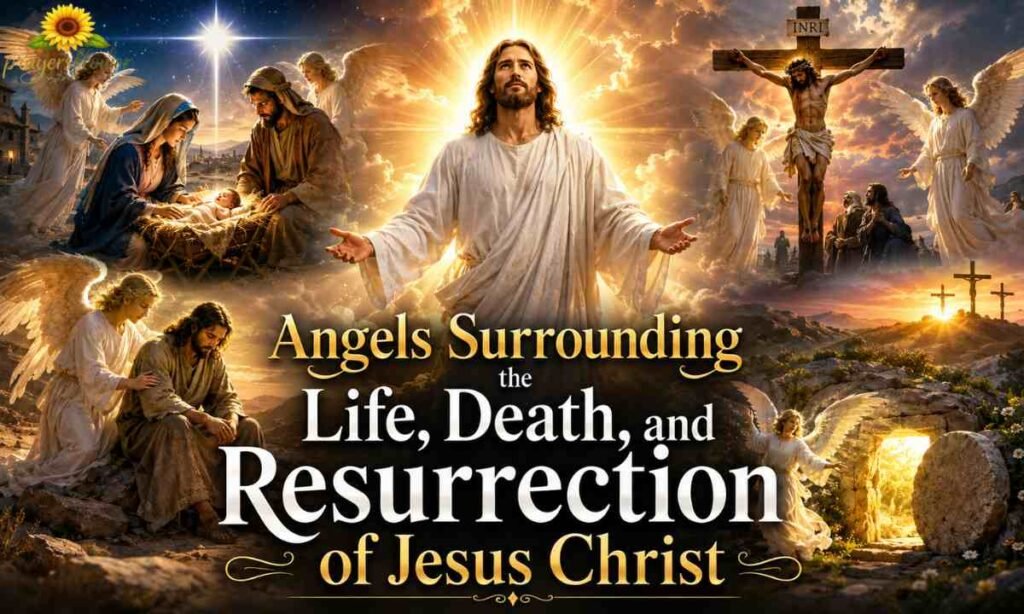
No life in human history is more attended by biblically accurate angels than the life of Jesus.
- An angel announced His conception to Mary, another to Joseph, and a multitude of the heavenly host appeared to the shepherds in Bethlehem.
- During the wilderness temptation, angels came and ministered to Him. In Gethsemane, an angel strengthened Him as the weight of what was coming pressed down on His body.
- At the resurrection, it was angels who announced to the women that He was not in the tomb — the first heralds of the gospel’s central event.
- The involvement of biblically accurate angels in Christ’s life is not incidental. It is a testimony to His glory, framing the whole arc of His mission in the reverence of heaven.
Although angels often appeared during moments of fear, one of their most frequent messages was, “Do not be afraid.” These comforting Bible verses about peace can help you meditate on God’s presence and reassurance throughout Scripture.
How Angels Guided and Protected the Early Church in Acts
The book of Acts reads in part like an angelic record of the Spirit’s movement through the first believers.
- An angel directed Philip toward the Ethiopian eunuch, one small redirection that carried the gospel into Africa.
- An angel released Peter from prison while the church prayed for him — an answer so direct that the community could barely believe it when he knocked on the door.
- Cornelius, the Roman centurion, received his first instruction to seek Peter from an angel in a vision — the opening of the gospel to the Gentile world.
- Biblically accurate angels in Acts are not background figures. They are active participants in the early expansion of the Kingdom of God.
Angels in Revelation: Judgment, Warfare, and the Final Victory
In the book of Revelation, biblically accurate angels take on a scale and gravity that exceeds every other biblical description.
- Seven angels hold the seven trumpets whose sounding ushers in waves of divine judgment on the earth.
- Michael and his angels wage war against the dragon and his angels — a cosmic conflict that mirrors and resolves the rebellion begun before creation.
- Angels pour out the bowls of God’s wrath, bind Satan for the millennium, and at the end of all things, stand at the gates of the New Jerusalem.
- Revelation does not sentimentalise its angels. They are instruments of the holy justice of a God who will make all things right.
Guardian Angels: What the Bible Actually Says About Divine Protection
The idea of guardian angels is deeply embedded in Christian culture, and Scripture does offer some grounding for it.
- Jesus Himself said in Matthew 18:10 that the little ones have angels in heaven who always see the face of the Father — the closest the Gospels come to confirming personal angelic guardians.
- Psalm 91:11 speaks of God commanding His angels to guard you in all your ways, a verse referenced even by the enemy in the wilderness temptation.
- Hebrews 1:14 describes angels as ministering spirits sent to serve those who will inherit salvation — a corporate rather than individual framing, but one that places believers within angelic care.
- Biblically accurate angels in this role are not personal companions but servants of God deployed in the interest of those He loves. The comfort is real. The mystery remains.
According to research published through Harvard’s T.H. Chan School of Public Health, regular spiritual practice including prayer is associated with greater wellbeing and resilience — a finding that resonates deeply with the biblical picture of believers sustained by both the Spirit and the ministering presence of angelic beings.
Contrasting Biblical Angels with Popular Culture
The distance between biblically accurate angels and their cultural counterparts is not just aesthetic — it is theological.
- Popular culture frames angels as human spirits who have earned their wings, a concept with no biblical support whatsoever.
- The soft, feminised, halo-crowned figures of Renaissance art have shaped Western imagination far more than the book of Ezekiel has.
- In films and greeting cards, angels offer comfort without conviction, presence without holiness, nearness without the weight of God’s glory that always accompanies their real biblical appearances.
- Recovering a biblical view of heavenly messengers is not merely academic. It restores the proper scale of the God they serve.
Common Misconceptions About Angels That the Bible Corrects
Scripture is direct about what angels are not.
- Humans do not become angels when they die. Angels are a distinct order of creation, not an upgraded form of the human soul.
- Angels are not omniscient. Peter writes that even the angels long to look into the things of the gospel, implying there are things they do not fully know.
- Angels are not to be worshipped. Twice in Revelation, John falls at an angel’s feet and is corrected immediately: “Worship God.”
- Biblically accurate angels do not carry harps and sit on clouds. They burn, they fly, they carry out holy work in the service of the living God.
Satan’s Fall and the Origin of Fallen Angels
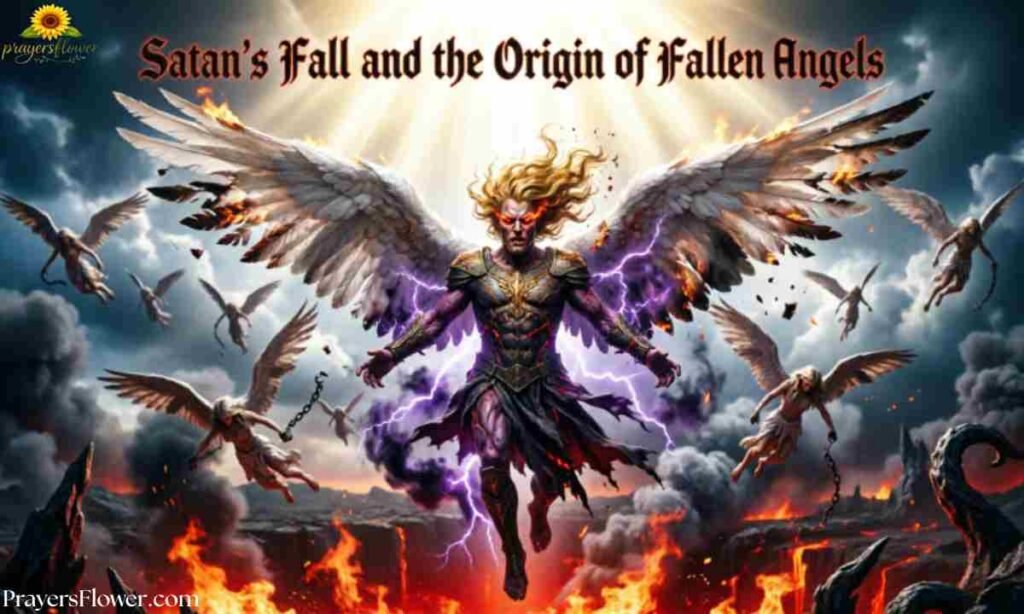
The story of fallen angels begins with the creature who once stood among the most exalted heavenly beings.
- Isaiah 14 and Ezekiel 28, read as references to the spiritual power behind earthly kings, describe a being of great beauty and wisdom who fell through pride.
- Jesus said in Luke 10:18 that He saw Satan fall like lightning from heaven — a brief and devastating summary of the primal rebellion.
- Jude 6 speaks of angels who did not keep their proper domain but abandoned their own dwelling, and who are now kept in eternal chains awaiting judgment.
- The fall of these beings is not a footnote in biblical theology. It is the beginning of the spiritual conflict that shapes every page of Scripture until Revelation’s final resolution.
Other Fallen Angels: Demons and Spiritual Rebellion
Below the figure of Satan, Scripture acknowledges a vast company of fallen spiritual beings.
- Paul writes in Ephesians 6:12 that believers wrestle not against flesh and blood but against rulers, authorities, cosmic powers of darkness, and spiritual forces of evil in the heavenly places.
- Demons in the Gospels recognise Jesus immediately and tremble before His authority, which tells us something important about the order of power in the spiritual realm.
- The language of territorial spirits in Daniel 10, where a prince of Persia resisted Gabriel for twenty-one days, suggests a spiritual geography that overlaps with human history and geopolitics.
- Understanding fallen angels is not an invitation to obsession but to vigilance, dressed in the full armour that God has provided.
Common Myths About Biblically Accurate Angels
| Myth | Biblical Reality |
|---|---|
| Every angel looks like a wheel covered in eyes. | Only certain heavenly beings are described this way. |
| Angels are babies with wings. | The Bible never describes angels as babies. |
| Angels should be worshipped. | Angels consistently direct worship to God. |
| Everyone becomes an angel after death. | The Bible distinguishes humans from angels. |
Do Angels Still Interact With Humans Today?
Hebrews 13:2 reminds believers to show hospitality to strangers, because some have entertained angels without knowing it.
- This single verse, written to a first-century audience, implies that angelic presence among humans was not considered a closed chapter even then.
- Testimonies of angelic protection and intervention have been documented across church history and across cultures where the gospel has taken root.
- The Bible does not promise a daily visible angelic encounter, but it does affirm that the spiritual realm is active, that God’s servants are deployed, and that the boundary between seen and unseen is thinner than it appears.
- Believers can hold this with both humility and confidence: the same God who sent angels to Daniel, to Mary, to the early Church, has not changed, and neither has His care for those who are His.
Among all heavenly beings, the archangel Michael stands out as one of the most powerful defenders of God’s people. To understand his identity and mission more deeply, explore the Biblical Meaning of the Name Michael, where his name’s Hebrew meaning and biblical role are explained in detail.
Angel Comparison Chart
| Question | Answer |
|---|---|
| Do all angels have wings? | No. Many biblical angels appear as ordinary men. |
| Are all angels covered with eyes? | No. This description is associated with specific heavenly beings such as the Ophanim. |
| Is Gabriel an archangel? | The Bible names Gabriel but does not explicitly call him an archangel. |
| Is Michael an archangel? | Yes. Jude 9 refers to Michael as the archangel. |
| Do angels receive worship? | No. Revelation 22:8–9 shows angels directing worship to God alone. |
Frequently Asked Questions About Biblically Accurate Angels
What do biblically accurate angels actually look like in Scripture?
Biblically accurate angels are described with multiple faces, wings, fire-like appearances, and radiant light — far removed from the gentle winged figures of popular art.
Are biblically accurate angels the same as the angels in movies and greeting cards?
No. The cultural image of angels has been shaped more by Renaissance painting and pop culture than by Scripture, which depicts heavenly messengers as overwhelming, holy, and purpose-driven beings.
What is the hierarchy of biblically accurate angels in the Bible?
Scripture describes at least seraphim, cherubim, archangels, living creatures, and general messenger angels, with Paul’s letters adding thrones, dominions, rulers, and authorities to the picture.
Do guardian angels exist according to biblical teaching?
Jesus references the angels of children in Matthew 18:10, and Psalm 91 speaks of angelic protection, but the Bible frames angelic care as under God’s direction rather than as permanent personal companions.
How do fallen angels differ from the heavenly angels described in Scripture?
Fallen angels, including Satan, chose rebellion against God and now operate in opposition to His purposes, while holy angels remain devoted servants who carry out His will across creation.
Major Angel Appearances in the Bible
| Event | Angel | Scripture |
|---|---|---|
| Garden of Eden | Cherubim | Genesis 3:24 |
| Jacob’s dream | Angels | Genesis 28:12 |
| Daniel’s visions | Gabriel & Michael | Daniel 8–10 |
| Announcement to Mary | Gabriel | Luke 1:26–38 |
| Resurrection of Jesus | Angels | Matthew 28:2–7 |
| End Times | Michael and angels | Revelation 12 |
Closing Thoughts
The study of biblically accurate angels is ultimately a study of God, because every true angel points away from itself and toward the One it serves. When Scripture pulls back the veil on these extraordinary beings, what we see is not a gallery of wonders but a throne room of holiness, and every creature in it exists to magnify the name above all names. To understand heavenly messengers correctly is to be drawn deeper into worship, not distracted from it.
If you have carried a soft or sentimental image of angels for years, let Scripture reshape it — not to frighten you, but to give you a more honest and more magnificent picture of the God who created them. The same God whose seraphim cry holy without ceasing is the God who sent His Son for you, and that is the truth that makes even the most awe-inspiring angel fall silent in reverence.
“Angels can fly because they take themselves lightly.” — G.K. Chesterton

John Carrol is a Christian writer and prayer minister with over a decade of experience in faith-based content, devotional writing, and spiritual encouragement. Rooted in Scripture and a lifelong love of intercessory prayer, John created PrayersFlower to help believers find the right words when their own run out. His writing draws from pastoral study, personal faith practice, and a deep conviction that prayer is the most powerful act available to the human heart. When he is not writing, John is found in quiet study of the Word, mentoring young believers, and serving his local church community.