

The biblical meaning of eagles is one of Scripture’s most powerful symbols, pointing directly to God’s strength, His protective love, and the spiritual renewal He promises to every believer who waits on Him.
There is a reason people search for this topic in quiet moments — after a hard season, a broken dream, or a sky-splitting encounter with something that felt almost holy. Eagles stop people. They demand attention. And for those walking a life of faith, they stir something deeper: a longing to understand what God might be saying. The biblical meaning of eagles has carried believers through centuries of struggle and surrender, and it continues to speak today.
This article unpacks every layer of that meaning — from the original Hebrew word nesher to prophetic visions in Revelation, from God carrying Israel on eagles’ wings to what it means when you see an eagle in a dream or in the wild. The biblical meaning of eagles is richer than most people realize, and by the end of this page, you will have the full picture.
Key Takeaways
- Isaiah 40:31 contains the Bible’s most direct promise about eagles, linking spiritual renewal to waiting on God — not human effort.
- The Hebrew word nesher, translated “eagle,” may refer to a griffon vulture in some passages, which changes how we understand several key texts.
- God uses eagle imagery in both tender ways (carrying His people) and terrifying ways (swift judgment against nations).
- The biblical meaning of eagles spans both testaments, appearing in poetry, prophecy, law, and apocalyptic vision — making it one of Scripture’s most versatile symbols.
What Does the Eagle Symbolize in the Bible? (Core Meaning Explained)
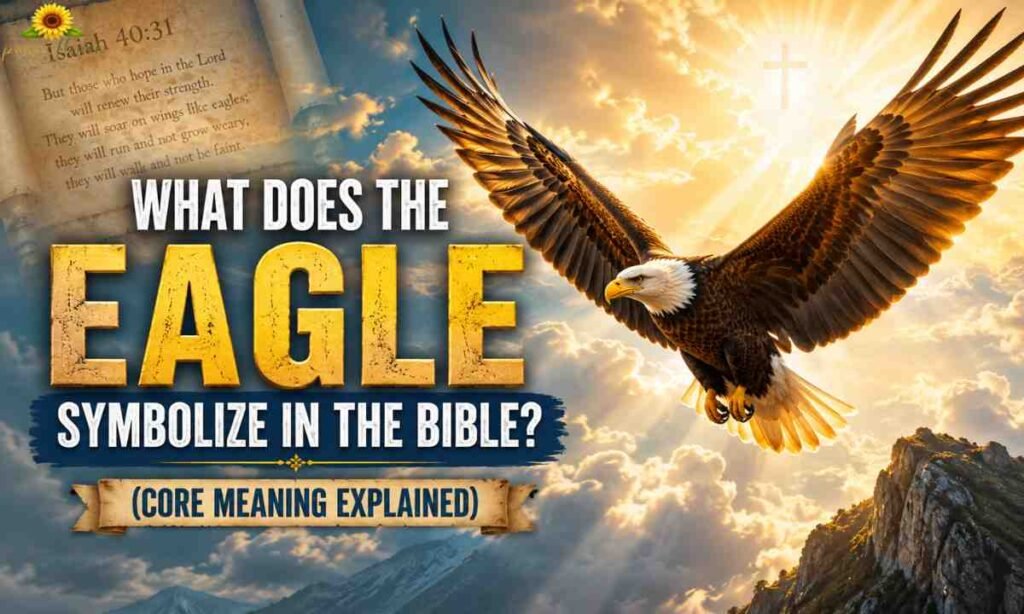
The eagle in the Bible is not a single symbol. It carries at least four distinct layers of meaning across Scripture, and understanding all four is what separates a shallow reading from a genuinely grounded one.
First, the eagle symbolizes divine strength and swiftness. The bird’s speed, its height, its piercing vision — all of these qualities made it the natural metaphor for a God who acts without hindrance and sees without limit. Job 9:26 speaks of days passing “like an eagle swooping on its prey,” and Habakkuk 1:8 describes an enemy army moving “swifter than leopards” and flying “like an eagle swooping to devour.” Speed and power belong to the eagle’s core symbolism throughout the Old Testament.
Second, and more tenderly, the eagle symbolizes God’s personal care and rescue. This is the meaning most clearly on display in Exodus 19:4 and Deuteronomy 32:11, where God compares Himself to an eagle hovering over its young, stirring the nest, and carrying its children on its wings. This is not distant authority — it is intimate, hands-on divine parenting.
Third, the eagle appears as a symbol of judgment and devastation. In the prophetic books, eagles signal the rapid approach of enemies sent by God to discipline a wayward people. Hosea 8:1, Jeremiah 4:13, and Lamentations 4:19 all reach for eagle imagery to describe the terrifying speed of coming wrath.
Fourth, and most transcendently, the eagle symbolizes spiritual renewal — the capacity to be remade, to rise, to soar beyond what the body or the circumstances should allow. This is the meaning that anchors Isaiah 40:31 and makes it one of the most beloved promises in all of Scripture.
The biblical meaning of eagles, then, is not one thing. It is layered, alive, and shaped by context. That is what makes it worth studying carefully.
Isaiah 40:31 — Soaring on Wings Like Eagles: The Promise of Renewed Strength
“But those who hope in the Lord will renew their strength. They will soar on wings like eagles; they will run and not grow weary, they will walk and not be faint.” — Isaiah 40:31 (NIV)
This is the verse most people reach for when they think of eagles in the Bible, and rightly so. But its full power only opens when you read it in context.
Isaiah 40 was written to a people who were exhausted. The nation of Israel was facing exile, and the opening of the chapter addresses a people who had received “double for all their sins” (v. 2). By verse 27, they are saying that God has hidden His face from their way — that justice has passed them by. They are not struggling with minor discouragement. They are undone.
Into that exhaustion, Isaiah speaks one of the most counter-intuitive promises in Scripture: the ones who wait will be the ones who soar. Not the ones who fight harder. Not the ones who work longer. The ones who wait — who hope, who place their expectation in the Lord rather than their own resources — those are the ones who receive renewed strength.
The Hebrew word translated “renew” (chalaph) carries a sense of exchange — as if your old strength is traded in and God’s strength is given in its place. That is a profound spiritual truth. You do not manufacture the strength to soar. You receive it, through the posture of waiting on God.
The eagle image here is perfectly chosen. Eagles are known for their ability to ride thermal air currents — columns of warm air rising from the earth — for hours at a time, covering vast distances without flapping their wings. They are not working harder. They are surrendering to a force greater than themselves and being lifted. That is the picture Isaiah is painting of the believer who waits on the Lord.
The progression in verse 31 is worth noting: soar, then run, then walk. Many readers assume this is ascending order of achievement. But many biblical scholars read it as descending — soaring is the dramatic moment, running is the sustained effort, walking is the faithful daily ordinary grind. And God promises strength for all three. The biblical meaning of eagles here is not just for mountaintop moments. It is for Tuesday mornings when you are just trying to get through.
What Does Seeing an Eagle Mean Spiritually? Biblical Interpretation of Eagle Encounters
People encounter eagles and immediately wonder if it means something. From a biblical worldview, the honest answer is: it might, and it might not — and discernment matters more than assumption.
The Bible does not teach that every eagle sighting is a direct message from God. What it does teach is that God speaks through creation (Psalm 19:1, Romans 1:20), that He can use any element of the natural world to communicate with those whose hearts are open, and that the Holy Spirit is capable of making a moment spiritually significant in ways that are specific and personal.
What does Scripture associate with eagles that might lend meaning to an encounter?
Seeing an eagle could prompt reflection on Isaiah 40:31 — particularly if you are in a season of weariness. The invitation is to ask: am I waiting on God, or am I straining in my own strength?
An eagle overhead can be a reminder of Deuteronomy 32:11 — the image of God hovering over His people with watchful, parental care. If you are feeling unseen or abandoned, this may be exactly the reminder your heart needs.
In prophetic literature, eagles also signal alertness and urgency. Proverbs 23:5 warns that riches “sprout wings and fly off to the sky like an eagle” — a reminder not to place ultimate trust in earthly things.
The spiritually mature response to seeing an eagle is not to assign it a fixed meaning but to bring it to prayer. Ask God what He is stirring in you. Let the encounter become an invitation to reflection, to Scripture, to listening. That is the biblical pattern: creation points, the Spirit illuminates, the Word confirms.
Biblical Meaning of an Eagle in a Dream — What Scripture and Faith Say
Dreams occupy significant space in biblical revelation. From Joseph in Genesis to Daniel to the visions of Joel that Peter quotes at Pentecost, God has spoken to His people through dreams. So when an eagle appears in a dream, it is worth taking seriously — while also holding it wisely.
Eagles in dreams, viewed through a biblical lens, most commonly carry one of the following associations:
A call to rise above. If you have been mired in low-level anxiety, petty conflicts, or earthbound thinking, an eagle in a dream may be an invitation to gain perspective — to see your situation from the altitude of God’s viewpoint rather than from the ground.
Divine protection or oversight. The mother eagle image of Deuteronomy 32:11 is deeply nurturing. An eagle in a dream may be communicating that you are being watched over, that God’s eye is on your situation even when you cannot see it.
Prophetic urgency. In the prophetic books, eagles signal something is coming swiftly. A dream featuring an eagle in flight might stir a sense of urgency in intercession or in a decision that has been delayed.
Strength for the journey. Isaiah 40:31 is always worth meditating on after an eagle dream. Is God promising renewed strength for a specific road ahead?
One caution: Scripture consistently warns against treating dreams as infallible revelation or making major life decisions based on them alone (Ecclesiastes 5:7, Jeremiah 23:25-28). Bring any dream to prayer, to trusted spiritual community, and above all to the Word. The biblical meaning of eagles in dreams is a prompt for seeking God, not a substitute for it.
All Bible Verses About Eagles — Complete Scripture Reference List (Old and New Testament)
The following is a full topical list of eagle references throughout Scripture. Understanding each passage in context gives the biblical meaning of eagles its full depth.
Exodus 19:4 — God describes carrying Israel “on eagles’ wings” out of Egypt. Leviticus 11:13 / Deuteronomy 14:12 — The eagle listed among unclean birds, not to be eaten. Deuteronomy 32:11 — God as eagle stirring the nest and carrying young on wings. 2 Samuel 1:23 — Saul and Jonathan described as “swifter than eagles” in David’s lament. Job 9:26 — Days pass like an eagle swooping to devour. Job 39:27-30 — God asks Job whether the eagle soars at His command; eagle’s nest on high crags. Psalm 103:5 — God satisfies your desires “so that your youth is renewed like the eagle’s.” Proverbs 23:5 — Riches fly away like an eagle toward heaven. Proverbs 30:17 — The eye that mocks a father will be pecked out by eagles. Proverbs 30:19 — The way of an eagle in the sky among the four things too wonderful to understand. Isaiah 40:31 — Those who hope in the Lord will soar on wings like eagles. Jeremiah 4:13 — Enemy chariots swift as an eagle, bringing woe. Jeremiah 48:40 / 49:22 — Babylon described sweeping like an eagle over Moab and Edom. Lamentations 4:19 — Pursuers swifter than eagles of the sky. Ezekiel 1:10 / 10:14 — The four living creatures include one with an eagle’s face. Ezekiel 17:3-7 — Extended allegory involving two great eagles and a vine (representing Babylon, Egypt, and Israel). Daniel 4:33 — Nebuchadnezzar’s hair grows like eagles’ feathers during his madness. Daniel 7:4 — The first beast like a lion with eagle’s wings. Hosea 8:1 — An eagle over the house of the Lord signals judgment coming. Obadiah 1:4 — Though you soar like an eagle and nest among the stars, God will bring you down. Micah 1:16 — A call to shave the head bald like an eagle, in mourning. Habakkuk 1:8 — Enemy cavalry fly like an eagle swooping to devour. Matthew 24:28 / Luke 17:37 — “Where there is a carcass, there the eagles will gather” — likely vultures, a sign of judgment. Revelation 4:7 — One of the four living creatures like a flying eagle. Revelation 8:13 — An eagle flying in midheaven announcing three woes. Revelation 12:14 — The woman given two wings of a great eagle to flee into the wilderness.
This represents one of the most comprehensive collections of eagle-related Scripture available. The sheer breadth confirms that the biblical meaning of eagles is not a minor theme — it is woven into the fabric of both Testaments.
The Hebrew Word for Eagle (“Nesher”) — What the Original Language Reveals
The primary Hebrew word translated “eagle” throughout the Old Testament is nesher. It appears approximately 26 times in the Hebrew Bible, and understanding it is essential to grasping the biblical meaning of eagles with precision.
The problem is that nesher is not entirely straightforward. Modern ornithologists and biblical scholars have raised serious questions about whether nesher always refers to an eagle (Aquila species) or whether it sometimes — or even primarily — refers to the griffon vulture (Gyps fulvus), which was far more common in ancient Israel.
The griffon vulture is large, powerful, and bald-headed. Several characteristics attributed to nesher in Scripture align better with the vulture than the eagle: its baldness (Micah 1:16), its soaring on thermal updrafts for great distances, its association with carrion (Matthew 24:28), and its nesting on high rocky crags (Job 39:27).
At the same time, many of the qualities attributed to nesher — speed, power, divine oversight, majestic soaring — apply equally well to the golden eagle, which was also present in the ancient Near East and was a prestigious symbol in surrounding cultures.
The honest scholarly position is that nesher likely served as a category word covering large soaring birds of prey, not a precise ornithological designation. In some texts it almost certainly refers to a vulture. In others, particularly those emphasizing speed and power in a positive divine context, a large eagle is the more likely image.
What this means practically: the spiritual and theological meanings Scripture draws from nesher do not change based on whether the bird is technically an eagle or a vulture. God inspired the images for their symbolic weight, not their taxonomic accuracy. The biblical meaning of eagles (nesher) retains its full spiritual force regardless.
Keep Feeding Your Faith: Biblical Meaning of Owls: Symbolism, Spiritual Significance, and What the Bible Really Says
Deuteronomy 32:11 — God as the Eagle Who Stirs the Nest and Carries His People
“Like an eagle that stirs up its nest and hovers over its young, that spreads its wings to catch them and carries them aloft…” — Deuteronomy 32:11 (NIV)
This verse sits inside the Song of Moses — a long poetic account of God’s faithfulness and Israel’s tendency toward rebellion. The specific image in verse 11 describes the behavior of a mother eagle teaching her young to fly.
Ancient descriptions of eagle parenting — some accurate, some embellished by folklore — depicted the mother eagle disturbing the nest deliberately, making the soft comfortable space inhospitable. She then pushes or encourages the eaglets toward the edge. When they tumble, she swoops beneath them, spreading her wings to catch and carry them before they can fall too far.
Whether this is precise ornithology or poetic approximation matters less than what God is saying about Himself: I am the one who disrupts your comfortable places when comfort is becoming a cage. I am the one who pushes you toward the terrifying edge of growth. And when you fall — which you will — I am already beneath you.
The wilderness wandering that Moses is describing was not random. God led Israel through a “howling waste” (v. 10) deliberately — found them there, cared for them there, guarded them “as the apple of His eye.” The disruption of Egypt, the vulnerability of the desert, the daily dependence on manna — all of it was the eagle stirring the nest.
The biblical meaning of eagles in Deuteronomy 32:11 is this: God’s most loving acts sometimes feel like disturbance. His faithfulness is active, not passive. He does not simply leave His children in safe places. He trains them to fly.
Exodus 19:4 — “I Bore You on Eagles’ Wings”: God’s Rescue of Israel Unpacked
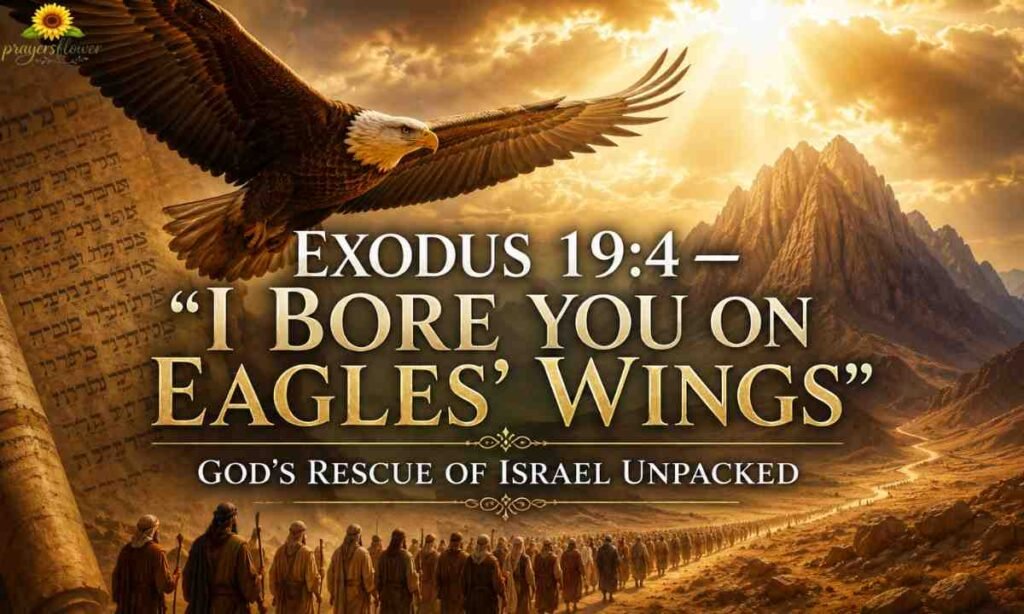
“You yourselves have seen what I did to Egypt, and how I carried you on eagles’ wings and brought you to myself.” — Exodus 19:4 (NIV)
Three months after the Exodus, God speaks these words to Moses on Mount Sinai. Israel is assembled at the foot of the mountain, and God is about to offer them a covenant. Before He gives the terms, He reminds them of what He has already done.
“I carried you on eagles’ wings.”
This is not metaphor for comfort. It is metaphor for rescue — for being lifted entirely out of a situation you could not escape by your own effort, transported through the impossible, and set down somewhere new. Egypt was not a bad job situation. It was generational slavery, cultural erasure, and infanticide. The Exodus was not gradual improvement. It was divine extraction.
The eagle image reinforces the nature of salvation itself. You did not climb out of Egypt. You were borne. You were carried. The power was entirely on the side of the one doing the carrying, not the one being carried.
This text also contains one of the most significant phrases in all of Scripture about God’s purpose in salvation: “and brought you to myself.” The destination was not just freedom. The destination was relationship. God’s rescue was always relational in its intent. The Exodus existed so that Israel could come near.
The biblical meaning of eagles in Exodus 19:4 is inseparable from the doctrine of grace: what God does for His people is not earned. It is gifted, borne, carried — and the landing place is always His presence.
Keep Feeding Your Faith: The Great Biblical Meaning of the Name CHARLES: Freedom, Strength, and Divine Purpose Revealed
Spiritual Lessons From the Eagle for Christian Living Today
The biblical meaning of eagles is not merely historical or theological. It carries practical instruction for Christian discipleship in the present tense.
Lesson 1: Waiting is not weakness. Isaiah 40:31 calls believers to wait on God — a posture our productivity-obsessed culture reads as passive and wasteful. But waiting on God in Scripture is active spiritual attention. It is the choice to resist anxious striving and instead align yourself with God’s timing and power. The eagle that rides the thermal does not flap furiously. It waits for the current and then commits to it completely.
Lesson 2: Disruption can be divine. Deuteronomy 32:11 teaches that God sometimes stirs the nest. If your comfortable season has become uncomfortable — if what you depended on has been shaken — it is worth asking whether God is training you to use wings you did not know you had.
Lesson 3: You are carried, not just coached. Exodus 19:4 is a reminder that the Christian life is not primarily about self-improvement. It is about being borne by a God who has already acted decisively on your behalf. Your transformation is His project, not yours alone. Let yourself be carried.
Lesson 4: Gain perspective before descending into the conflict. Eagles are known for their high-altitude vision. They can see prey from extraordinary distances because of the altitude they maintain. Spiritually, before you engage the next battle, conflict, or decision, return to altitude. Spend time in prayer and Scripture that lifts your perspective before bringing it down to ground level.
Lesson 5: Renewal is available after depletion. Psalm 103:5 promises that God renews your youth like the eagle’s. Whatever has worn you down — grief, betrayal, chronic disappointment, physical exhaustion — the promise is restoration, not just survival. The biblical meaning of eagles includes the promise of genuine renewal, not just management of decline.
Eagle as a Symbol of God’s Strength, Protection, and Divine Power in Scripture
Throughout the canon, the eagle functions as a primary image for divine attributes that language alone struggles to convey.
God’s strength is described in eagle terms because the eagle represented the apex of natural power in the ancient world. When God compares His action to an eagle’s flight or grip, He is reaching for the most potent natural image available to His audience.
God’s protection is drawn in the eagle image most vividly in Psalm 91:4: “He will cover you with his feathers, and under his wings you will find refuge.” While Psalm 91 uses the broader bird imagery (the Hebrew there is more general), it draws from the same reservoir of meaning. The wings of God are shelter. They are not decorative — they are protective.
God’s power to sustain is in view whenever Scripture links the eagle to endurance. The bird that can soar for hours on thermal currents, covering enormous ground without exhausting itself, is the perfect image of a God whose strength does not deplete. Isaiah 40:28 establishes the theological ground: “He will not grow tired or weary, and his understanding no one can fathom.” The eagle imagery in verse 31 flows directly from this divine inexhaustibility.
Revelation 4:7 and 12:14 — The Eagle in Prophetic and Apocalyptic Vision
Eagles appear twice in the book of Revelation in memorable and theologically weighty ways.
In Revelation 4:7, the four living creatures surrounding the throne of God include one with the face of a flying eagle. These creatures — which echo the four-faced beings of Ezekiel 1 — have been interpreted throughout Christian history in multiple ways. The most enduring interpretation links them to the four Gospels: the lion to Mark (power), the ox to Luke (service), the man to Matthew (humanity of Christ), and the eagle to John (divine perspective, soaring theological vision). The eagle in this context represents divine transcendence — the capacity to see from above, to comprehend spiritual realities that are invisible from ground level.
In Revelation 12:14, the woman — widely understood as representing the people of God, or Israel, or the church — is given “two wings of a great eagle” to fly into the wilderness, where she is nourished and protected for “a time, times and half a time.” This deliberate echo of Exodus 19:4 is almost certainly intentional. The same image of God bearing His people on eagles’ wings now appears in eschatological context. In the end times, as in the original Exodus, God’s people will be supernaturally sustained and protected in a wilderness season of trial. The biblical meaning of eagles in Revelation 12:14 is a direct promise of divine covering in the midst of the final tribulation.
Psalm 103:5 and the Eagle’s Renewal — Does the Eagle Really Molt and Become Young Again?
“Who satisfies your desires with good things so that your youth is renewed like the eagle’s.” — Psalm 103:5 (NIV)
This verse has generated significant folklore over the centuries, and it is worth separating the true from the embellished.
A widespread popular story, circulated widely in Christian motivational content, claims that eagles at a certain age retreat to a mountain, knock out their beak, pluck out their talons and feathers, and after 150 days of pain, emerge completely renewed — with new beak, talons, and plumage — for another 30 years of life. This story is biologically false. Eagles do not behave this way. Removing their beak and talons would be fatal. The story appears to have originated in medieval European bestiaries — collections of animal lore that blended natural observation with spiritual allegory — and was not intended as biological fact even by its authors.
What eagles do genuinely experience is molting — a gradual annual replacement of feathers that keeps their plumage functional. Young eagles also appear markedly different from mature adults, leading some ancient observers to believe the bird was transformed or renewed as it aged.
The Hebrew of Psalm 103:5 uses nesher, and the point is renewal — the idea that God’s goodness reverses the natural trajectory of decline. The psalmist is not making a claim about eagle biology. He is making a claim about God’s character: He does not let you simply age down into feebleness. He restores, replenishes, and revives.
The biblical meaning of eagles in Psalm 103:5 is about the God who is in the renewal business — and that truth stands completely independent of whether eagles molt dramatically or quietly. For a helpful resource on the historical background of this passage, the Biblical Archaeology Society’s work on ancient animal symbolism offers valuable context: https://www.biblicalarchaeology.org
Eagle as a Symbol of Judgment and Destruction in the Prophetic Books
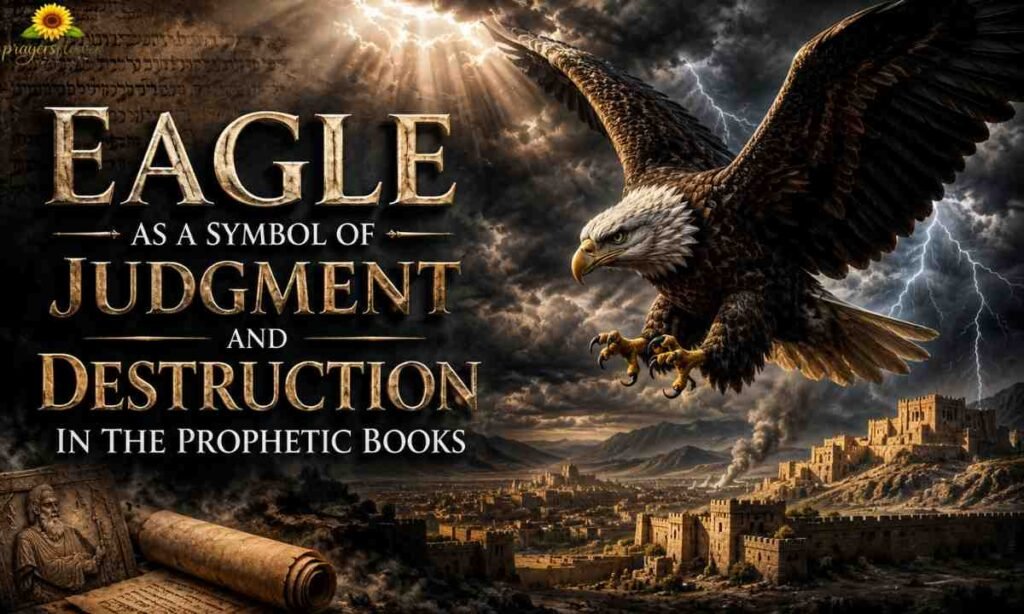
The eagle is not always a symbol of grace and protection in Scripture. In the prophetic literature, it appears repeatedly as a sign of swift and terrifying judgment — and understanding this dimension is essential to the biblical meaning of eagles in its full form.
Hosea 8:1 opens with an urgent cry: “Put the trumpet to your lips! An eagle is over the house of the Lord because the people have broken my covenant and rebelled against my law.” The eagle here is not a protector. It is the Assyrian army, fast and deadly, about to descend on Israel.
Jeremiah 4:13 uses the same image: “His chariots come like a whirlwind, his horses swifter than eagles.” The approaching Babylonian force is compared to eagles in flight — unstoppable, fast, already upon you before you see them coming.
Lamentations 4:19 mourns in the aftermath of Jerusalem’s fall: “Our pursuers were swifter than eagles in the sky.” The city has fallen, the people are scattered, and the eagle image captures the horrifying speed with which everything unraveled.
Obadiah 1:4 uses the image to warn the proud: “Though you soar like an eagle and make your nest among the stars, from there I will bring you down.” Here the eagle is the symbol of Edom’s arrogance — and the promise is that God’s judgment will reach even those who believe they have elevated themselves beyond reach.
The dual symbolism of the eagle — protective in one context, terrifying in another — reflects the nature of God Himself: Father and Judge, Savior and Sovereign. The same God who bore Israel on eagles’ wings also sent eagle-swift armies against them when they broke covenant. Understanding the biblical meaning of eagles in its fullness requires holding both of these truths together.
Why Were Eagles Considered Unclean in Leviticus 11? The Dietary Law Explained
Leviticus 11:13 lists the eagle (nesher) first among the birds that Israel was forbidden to eat. This surprises many readers who associate eagles with the positive divine imagery elsewhere in Scripture. Why would the symbol of God’s own protection be declared unclean?
Several explanations have been offered across biblical scholarship.
The most widely accepted is the category of diet. The birds listed as unclean in Leviticus 11 are almost entirely birds of prey and scavengers — birds that eat blood, carrion, or other animals. The dietary laws were partly about association: foods that consume death were avoided. This aligns with the broader Levitical concern for blood, purity, and the boundary between life and death.
A second explanation focuses on the principle of holiness as distinctiveness. Israel was called to be set apart — to live differently from surrounding nations. Eagles and large raptors were prized, even worshipped, in Egyptian, Babylonian, and Assyrian culture. Prohibiting their consumption reinforced Israel’s separation from these cultural systems.
A third reading notes that the purpose of the dietary laws was not hygienic but covenantal. They were identity markers — daily, embodied reminders that Israel belonged to a specific God with specific claims on their bodies and behavior.
Crucially, the uncleanness of the eagle for food purposes does not diminish its spiritual symbolic value. These are two different registers of meaning operating in the same text. An eagle could simultaneously be a forbidden food and a powerful image of God’s character — and Scripture holds both without contradiction.
Eagles in Ancient Near Eastern Culture — How the Bible Reframed a Pagan Symbol
To fully appreciate the biblical meaning of eagles, it helps to understand what eagles meant in the cultures surrounding Israel.
Eagles were among the most prestigious symbols in the ancient world. In Mesopotamia, the thunderbird Anzu — depicted as an eagle or eagle-lion hybrid — was associated with storms, divine power, and cosmic battle. In Egypt, the falcon-headed god Horus was the patron of the pharaoh, and the eagle was associated with royal authority and solar power. In Assyria and Babylon, eagle imagery adorned royal standards and temple gates, communicating military supremacy and divine favor toward the king.
Israel was surrounded by civilizations that had already assigned enormous symbolic weight to eagles — and that weight was inseparably tied to their gods and their kings.
When Scripture applies eagle imagery to the God of Israel — not to a pagan deity, not to a human king, but to YHWH — it is making a deliberate theological claim. The power and majesty that your neighbors attribute to their gods, and to the kings who claim those gods’ favor, actually belongs to the God of Israel. He is the one who is swift, powerful, high above, and capable of bearing His people.
This is not borrowing from surrounding culture. It is an act of theological reclamation. God speaks in images His people can recognize — and then redirects those images to Himself. The biblical meaning of eagles is therefore not just spiritual. It is a declaration of exclusive sovereignty: there is one God above the gods, and He is the eagle above all eagles.
Eagle vs Vulture in the Bible — Was the “Nesher” an Eagle or a Griffon Vulture?
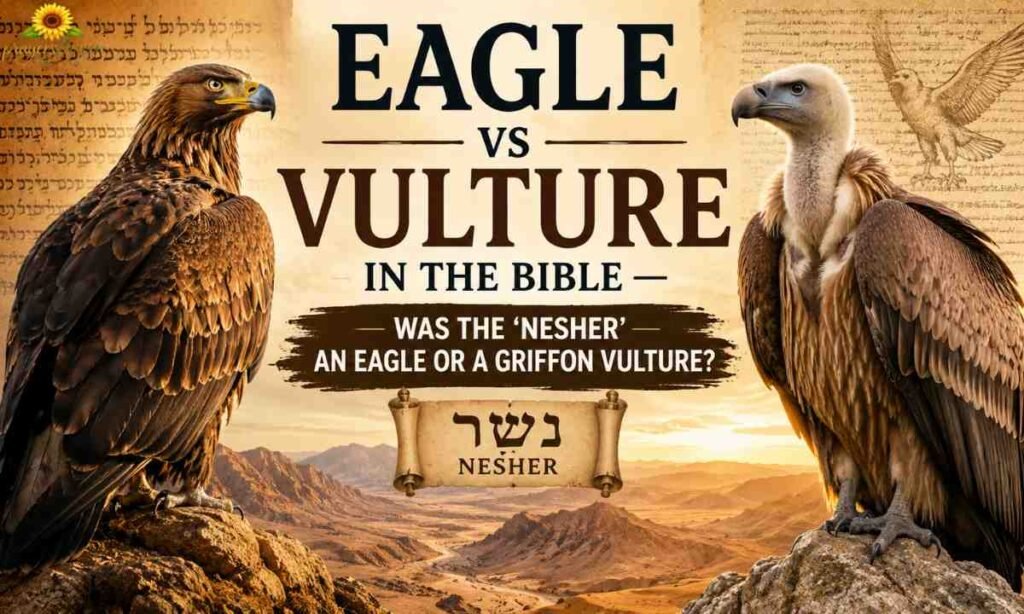
This is one of the most fascinating textual debates in biblical ornithology, and it deserves a careful treatment.
As noted in the earlier section on the Hebrew word nesher, modern scholars are divided on whether the primary referent is the golden eagle (Aquila chrysaetos) or the griffon vulture (Gyps fulvus). Several clues within the text point toward the vulture.
Baldness. Micah 1:16 calls for mourning “as bald as the nesher.” The griffon vulture has a distinctively bare head and neck. Eagles in the region are not bald. This clue points strongly toward the vulture in at least this passage.
Carrion association. Matthew 24:28 and Luke 17:37 — “wherever there is a carcass, there the eagles will gather” — almost certainly describes vultures, which gather at carcasses. Eagles occasionally eat carrion but are primarily hunters.
Thermal soaring. The griffon vulture is specifically adapted for long-distance soaring on thermal air currents, covering hundreds of miles in a single day without flapping. This behavior maps perfectly onto Isaiah 40:31’s promise of soaring without growing weary.
Nest placement. Job 39:27 asks whether the nesher makes its nest on high and “lodges on the rocky crag.” Both eagles and vultures nest on cliff faces, so this is not conclusive.
The honest answer is that nesher most likely covered both large raptors — eagle and vulture — as a general category. Different passages probably intend different birds. The theological and spiritual meanings Scripture attaches to the nesher are not undermined by this ambiguity. Whether the image is a golden eagle’s fierce nobility or a vulture’s improbable grace in flight, the spiritual truth being communicated remains intact.
What matters is that God chose these images on purpose. He knew His audience, He knew these birds, and He used them to reveal Himself. The biblical meaning of eagles — whether strictly eagle or partially vulture — is always ultimately about God and about what He is and does for His people.
FAQs
What is the biblical meaning of eagles in Scripture?
The biblical meaning of eagles encompasses God’s strength, protective care, swift judgment, and the promise of spiritual renewal for all who wait on Him.
What does Isaiah 40:31 mean when it says we will soar on wings like eagles?
Isaiah 40:31 promises that those who wait on God will exchange their depleted strength for His, rising above weariness the way an eagle effortlessly rides thermal winds.
Is seeing an eagle a sign from God according to the Bible?
While Scripture does not teach that every eagle sighting is a direct message, God can use creation to speak, and an eagle encounter is a worthy prompt for prayerful reflection on His Word.
What does the eagle symbolize in the book of Revelation?
In Revelation 4:7, the eagle-faced living creature represents divine transcendence and heavenly vision, while in Revelation 12:14 the eagle’s wings symbolize God’s supernatural protection of His people in times of tribulation.
Why did God describe Himself as an eagle in Deuteronomy 32:11?
God used the eagle image in Deuteronomy 32:11 to reveal His active, parental love — One who deliberately stirs the nest to encourage growth, then swoops beneath His children to carry them when they fall.
Conclusion
The biblical meaning of eagles is one of Scripture’s great gifts — a symbol large enough to hold both the tenderness of a hovering mother bird and the terrifying swiftness of divine judgment. From Exodus to Revelation, the eagle traces the arc of God’s character: rescuing, training, renewing, and ultimately bringing His people to Himself.
If you are in a season of weariness today, Isaiah 40:31 is your promise. If you are being disrupted and do not understand why, Deuteronomy 32:11 is your anchor. The God who bore Israel on eagles’ wings has not changed, and He is bearing you still.
God, let this name be a whisper of Your love to every soul who needed to hear it today.

John Carrol is a Christian writer and prayer minister with over a decade of experience in faith-based content, devotional writing, and spiritual encouragement. Rooted in Scripture and a lifelong love of intercessory prayer, John created PrayersFlower to help believers find the right words when their own run out. His writing draws from pastoral study, personal faith practice, and a deep conviction that prayer is the most powerful act available to the human heart. When he is not writing, John is found in quiet study of the Word, mentoring young believers, and serving his local church community.