

The biblical meaning of the name Esther begins with a hidden identity and ends with the salvation of an entire nation, which is exactly why this name still stops people in their tracks today. Behind the crown and the courage lies a Hebrew word for “hidden” and a Persian word for “star,” two roots woven into one destiny.
Understanding the biblical meaning of Esther’s name is one of those quiet truths that transforms how American Christian families interpret courage, the kind of insight a pastor, a priest, or even a hospital chaplain returns to again and again in daily conversation. This article will unpack her story, her name, and the scripture that made her famous — Esther 4:14, “for such a time as this.”
The Hebrew and Persian Roots of Esther — Dual Etymology
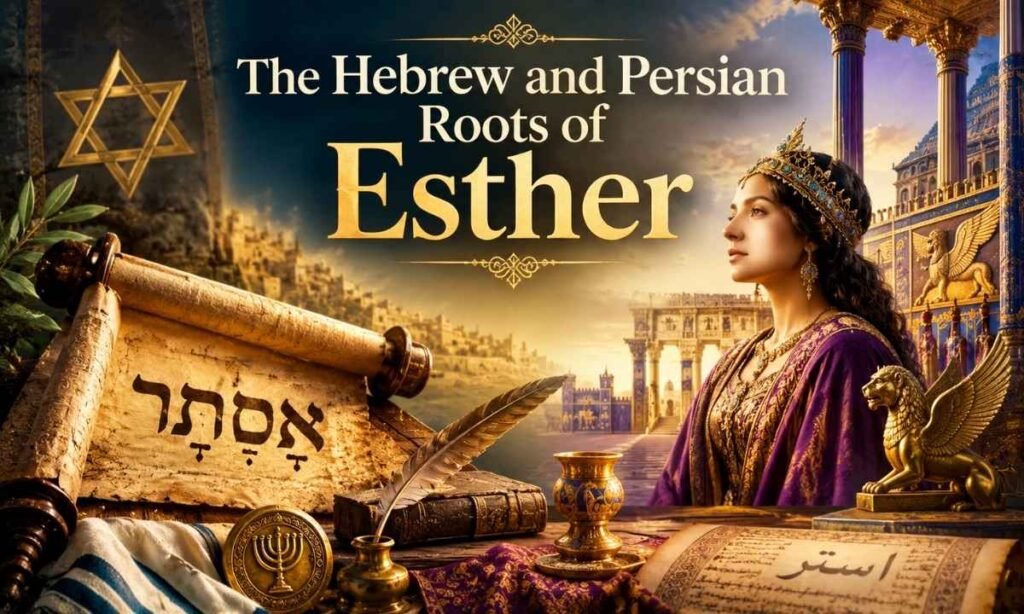
If you’ve ever wondered why one name can carry two completely different meanings, Esther is the perfect place to start unpacking that mystery. The biblical meaning of the name Esther isn’t a coincidence — it’s a snapshot of a girl living two lives at once, one Jewish and hidden, one Persian and public.
Esther Means Star — Persian Root Explained
In Persian, Esther is widely connected to “Stara” or “Sitara,” meaning star, a fitting picture of a young woman who rose to shine in the most unlikely of places — a foreign king’s palace. This Persian meaning reflects the identity she wore publicly in Susa, the name given to her so she could blend into a culture that wasn’t her own. When people ask what does Esther mean on the surface level, this radiant, star-like brightness is usually the first answer they find.
Esther Means Hidden — Hebrew Root Explained
Beneath that Persian star name sits a deeper Hebrew meaning tied to “Hadassah,” her birth name, and to the Hebrew root “sathar,” meaning to hide or conceal. This Hebrew meaning is the one that carries the real spiritual weight of her story, because Esther spent years concealing her Jewish identity inside a palace that would have destroyed her had the truth come out too soon. Esther biblical meaning, in this sense, is really a study in what God can accomplish through someone who is unseen before they are ever called to be seen.
Esther Name Variations
Across cultures and generations, Esther has traveled well, appearing as Ester in Spanish and Italian, Esteri in Finnish, and Esta or Hester in older English usage. Each variation keeps the core Esther name meaning intact while adapting it to different tongues and traditions. This is part of why Esther name significance has endured for thousands of years without losing its original identity.
Essie Nickname Meaning
The nickname Essie has grown into its own gentle, familiar shorthand for Esther, often used in close family settings or by grandparents passing the name down a generation. It softens the formality of the full name while still pointing back to the same Esther Christian name heritage. Many parents today choose Essie as an everyday nickname while keeping “Esther” for the birth certificate and baptism record.
If you’re exploring faith-filled names, our guide to Biblical Meaning of Baby Names explains how Scripture gives many names profound spiritual significance.
Esther Before the Palace — Her Hidden Jewish Identity
Long before she wore a crown, Esther was an orphaned Jewish girl in exile, raised by a cousin in a country that did not belong to her people. That backstory matters more than most readers realize when studying the biblical meaning of the name Esther, because it’s the reason her later courage means anything at all.
Mordecai and Esther — Their Relationship
Mordecai raised Esther as his own daughter after the death of her parents, and Scripture tells us plainly in Esther 2:7 that he “brought up Hadassah, that is, Esther, his uncle’s daughter.” Their bond was not just guardianship; it was the anchor that kept her Jewish identity intact even while she lived inside a pagan court. Mordecai and Esther’s relationship becomes the quiet engine behind every major decision she later makes, including the fast and the risk she takes before the king.
Esther’s Beauty and the Palace Selection
When King Ahasuerus removed Queen Vashti, officials searched the kingdom for beautiful young women, and Esther was brought into that selection process without any guarantee of what would happen to her. Scripture notes she “obtained favor in the sight of all them that looked upon her” (Esther 2:15), yet her true value was never about appearance alone. Her Jewish identity remained hidden throughout this entire process at Mordecai’s instruction, a detail that later becomes the hinge point of the whole book.
Esther 4:14 For Such a Time as This — Deep Scripture Analysis
This single verse is the reason most people search for the biblical meaning of the name Esther in the first place, because it captures a moment where an ordinary person is asked to risk everything for a purpose bigger than themselves. It’s worth slowing down here, because this verse still speaks directly into modern seasons of hesitation and fear.
Mordecai’s words to Esther in chapter 4 are blunt and urgent: deliverance would come for the Jewish people whether or not she acted, but her silence would cost her own life and her father’s house. He then asks the question that has echoed through sermons ever since — “who knoweth whether thou art come to the kingdom for such a time as this?” This is where Esther 4:14 meaning shifts from personal risk to divine assignment; her position as queen was never random, it was providential. For a deeper full analysis, Blue Letter Bible offers a helpful verse-by-verse breakdown of the Hebrew text and its historical context, which is worth reading alongside your own Bible study.
Whether you sit under a Baptist pulpit, a Catholic mass, or a Pentecostal service, this verse tends to get preached the same way — as a call to stop waiting for a more convenient moment. The biblical meaning of the name Esther finds its clearest expression right here, in a woman who chose obedience over safety.
The Fast of Esther — 3 Days That Changed History
Before Esther ever approached the king, she called for something far less dramatic but every bit as powerful — a fast. This section is about what happens in the waiting room before the miracle, the part most retellings skip past too quickly.
The 3-Day Fast — Who Fasted and What Happened
Esther instructed Mordecai to gather all the Jews in Susa and fast on her behalf for three days and nights, neither eating nor drinking, and she and her maidens fasted the same way. Esther fast 3 days wasn’t a symbolic gesture; it was a desperate, communal plea for God’s favor before she broke Persian law by entering the king’s presence uninvited. Only after this fast did she put on her royal robes and walk toward the throne room, which tells us the courage came after the surrender, not before it.
Esther’s Courage Before the King — What Christians Learn
There is a specific kind of fear that comes from knowing the outcome of your obedience is completely out of your hands, and that’s exactly where Esther stood before this moment. Her courage wasn’t loud or rehearsed; it was quiet, prayed-over, and final.
Esther Approaching the King — The Courage Required
Persian law stated that anyone who approached the king’s inner court without being summoned could be put to death unless the king extended his golden scepter. Esther courage king moments like this one remind us that biblical bravery is rarely about confidence — it’s about moving forward despite the very real possibility of loss. When the king extended his scepter toward her, it wasn’t luck; it was the answer to three days of fasting and a lifetime of quiet faithfulness.
Esther Name Personality — What This Name Speaks Over You
Names carry weight beyond sound, and for families choosing Esther as a baby girl name, there’s often a hope tucked inside that choice. This section speaks to the Esther spiritual meaning behind her personality and what it can declare over a child or over your own life.
Esther Name Blessing
To carry the name Esther is to carry a blessing of hidden strength that surfaces exactly when it’s needed most, not a moment before. Esther name personality often points toward someone who appears gentle on the surface but holds a quiet resolve underneath, much like the woman the name honors.
Esther Name Declaration
Speaking a declaration over the name Esther might sound like this: “You are called for such a time as this, and what feels hidden in you now will one day be used for someone else’s rescue.” That kind of declaration turns a name into a daily reminder rather than just a label on a birth certificate.
Esther Name Prayer
A simple prayer for someone carrying this name might be: “Lord, give her the wisdom of Esther, the patience to wait on Your timing, and the courage to act when You call her forward.” Praying this over a daughter, a goddaughter, or even yourself connects the Esther name meaning to a living, ongoing relationship with God rather than history alone.
Esther Name Destiny
Esther’s story shows that destiny doesn’t always arrive with fanfare; sometimes it arrives disguised as an uncomfortable assignment nobody else wants. For a name tied so closely to being “hidden,” it’s worth noting how often Esther name destiny actually plays out in the open, front and center, once God’s timing catches up to it.
Like Esther’s, every biblical name carries a story, as explained in our guide to the Biblical Meaning of Your Name.
Famous Christian Women Named Esther Through History
The name has never faded from use, and part of that staying power comes from the real women throughout history who carried it well. This section highlights a handful of examples that show the name is still very much alive today.
Long before any modern namesake, the Queen Esther Bible account itself set the standard, and Esther Ahn Kim, a Korean Christian missionary and pastor, endured imprisonment under Japanese occupation for refusing to bow to a Shinto shrine, echoing the same refusal-to-compromise spirit found in her biblical namesake. In more recent generations, countless missionaries, worship leaders, and everyday church members named Esther have carried the name into Bible studies, mission fields, and home churches across denominations. Famous Christians named Esther are rarely household names in the way celebrities are, but within their own communities, they often become the same kind of quiet, steady presence the original Esther was in Persia.
Key Bible Verses From the Book of Esther
Reading the actual text matters more than any summary of it, so here are several verses that carry the heart of the biblical meaning of the name Esther in the Bible’s own words.
Esther 2:7 — “And he brought up Hadassah, that is, Esther, his uncle’s daughter: for she had neither father nor mother, and the maid was fair and beautiful; whom Mordecai, when her father and mother were dead, took for his own daughter.”
Esther 4:14 — “For if thou altogether holdest thy peace at this time, then shall there enlargement and deliverance arise to the Jews from another place; but thou and thy father’s house shall be destroyed: and who knoweth whether thou art come to the kingdom for such a time as this?”
Esther 4:16 — “Go, gather together all the Jews that are present in Shushan, and fast ye for me, and neither eat nor drink three days, night or day: I also and my maidens will fast likewise; and so will I go in unto the king, which is not according to the law: and if I perish, I perish.”
Esther 8:16 — “The Jews had light, and gladness, and joy, and honour.”
Esther 9:22 — “As the days wherein the Jews rested from their enemies, and the month which was turned unto them from sorrow to joy, and from mourning into a good day.”
Esther in Christian Theology — Typology and Prophecy
Beyond the history and the courage, many Christian theologians see something bigger woven into Esther’s story — a pattern that points forward to a much larger rescue. This final section looks at how her story fits into the wider biblical narrative of deliverance.
Esther as Type of the Church — Theological Reading
Some Bible teachers read Esther as a picture of the Church itself, hidden among the nations, chosen for a specific purpose, and positioned to intercede on behalf of a people set for destruction. Esther typology church readings often draw a parallel between her risking her life before the king and the Church’s calling to stand between judgment and mercy through intercession. This isn’t the only lens through which to read Esther, but it’s a common one taught from pulpits across many denominations.
Esther Prophecy Meaning
While the Book of Esther never mentions God by name, its entire structure — hidden providence, reversed fortunes, deliverance arriving at exactly the right moment — reflects a prophetic pattern seen throughout Scripture. Esther prophecy meaning, in this theological sense, points to God’s hidden hand working behind ordinary human decisions to accomplish extraordinary outcomes. It’s a reminder that silence in a biblical text doesn’t mean absence.
Both Esther and Mary accepted God’s calling with humility, leaving a lasting legacy of faith for believers.
Frequently Asked Questions
What does the name Esther mean in the Bible?
The biblical meaning of the name Esther combines a Hebrew root meaning “hidden” with a Persian root meaning “star,” reflecting both her secret identity and her rise to prominence.
Is Esther a Hebrew or Persian name?
Esther is both — her birth name was the Hebrew name Hadassah, while “Esther” itself is generally understood as her Persian court name.
What was Esther’s Hebrew name before she became queen?
Before entering the palace, Esther was known by her Hebrew name, Hadassah, meaning myrtle tree.
What does Esther 4:14 mean?
Esther 4:14 means that God can position ordinary people in specific places and seasons “for such a time as this,” so their obedience can bring deliverance to others.
Why did Esther fast for three days?
Esther called for a three-day fast to seek God’s favor and protection before she broke Persian law by approaching the king uninvited.
Is Esther a good Christian name to give a baby girl?
Yes, the biblical meaning of the name Esther makes it a widely loved Christian baby girl name tied to courage, faith, and quiet strength.
What personality does the name Esther represent?
The Esther name personality is often associated with hidden strength, humility, wisdom, and courage that surfaces at the right moment.
Final Thoughts
The biblical meaning of the name Esther is really a story about timing — a girl hidden for years suddenly positioned to save an entire nation the moment she stopped waiting for permission. Her name still carries that same quiet invitation today, whether you gather in a home church, a Sunday morning service, or a small group Bible study to talk about it.
If this name belongs to you, your daughter, or someone you love, let it be a reminder that hidden seasons are never wasted seasons. May it bring the kind of guidance that brings comfort and spiritual growth to any Christian home still waiting on its own “such a time as this.”

John Carrol is a Christian writer and prayer minister with over a decade of experience in faith-based content, devotional writing, and spiritual encouragement. Rooted in Scripture and a lifelong love of intercessory prayer, John created PrayersFlower to help believers find the right words when their own run out. His writing draws from pastoral study, personal faith practice, and a deep conviction that prayer is the most powerful act available to the human heart. When he is not writing, John is found in quiet study of the Word, mentoring young believers, and serving his local church community.